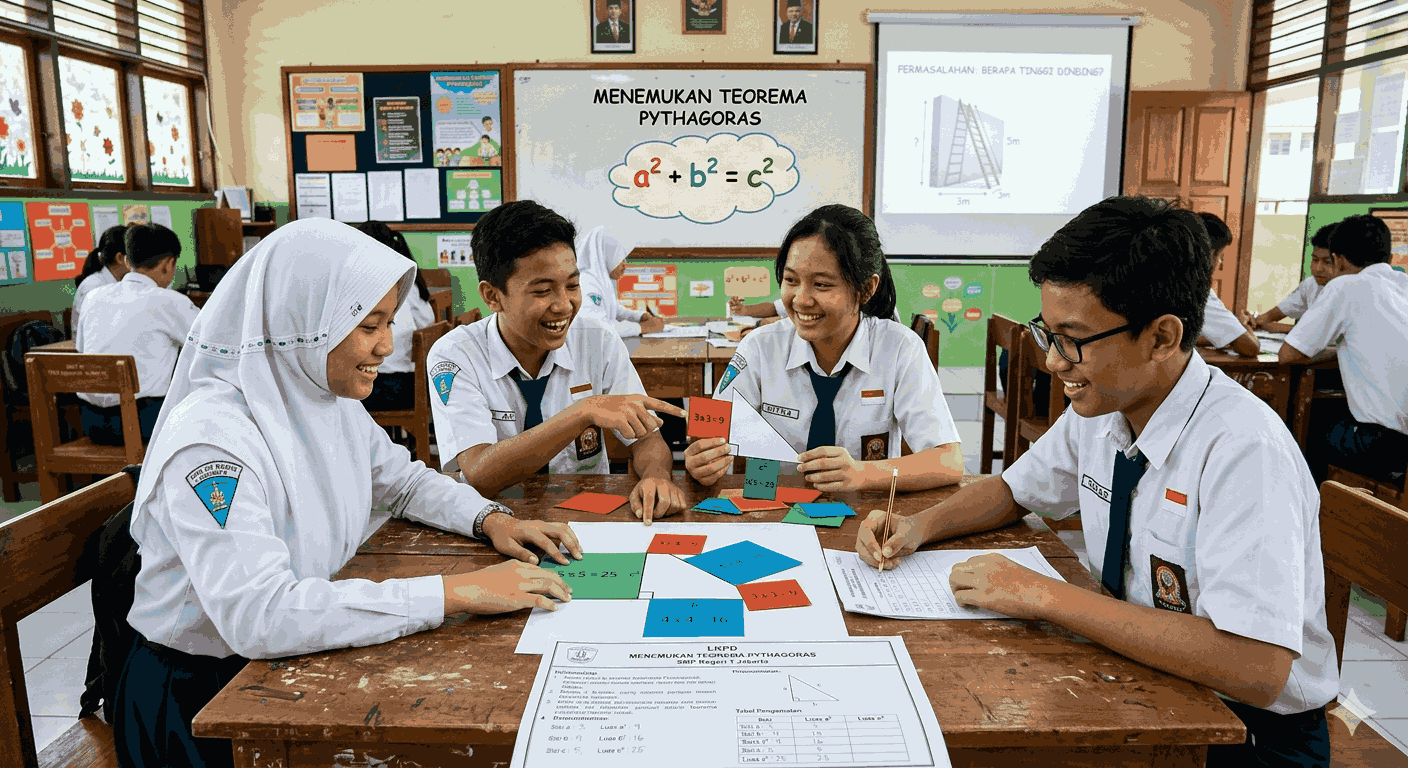
Peningkatan pemahaman konsep dan aktivitas belajar peserta didik melalui model pembelajaran discovery learning berbantuan LKPD pada materi teorema pythagoras
Authors
-
 Safira Damayanti
none
Safira Damayanti
none
DOI:
https://doi.org/10.55757/cejou.v4i2.336Keywords:
understanding concepts, learning activities, discovery learning modelsAbstract
This research aims to determine the effect of the discovery learning model assisted by LKPD on students' understanding of concepts and learning activities on the Pythagorean theorem material. This classroom action research was designed in two cycles. Actions taken by observing during learning activities with indicators include: attendance level, activeness in answering educators' questions, and activeness in asking questions appropriate to the discussion material. The material covered in cycle I and cycle II is the Pythagorean Theorem. The subjects of this research were 28 Class VIII C MTsN 6 Pasuruan students for the 2023/2024 academic year. The results of Classroom Action Research were obtained in two cycles, there has been an increase in understanding of mathematical concepts as seen from the increase in learning outcomes reaching 89.3% in the second cycle from 71.4% in the first cycle. Students' learning activity also increased starting from 87.13 % in cycle I became 92.66% in cycle II. The increase in student activity in collecting assignments increased from 68.57% in cycle I to 85.71% in cycle II.
Downloads
References
Damayanti, Safira (2023). Peningkatan pemahaman konsep dan aktivitas belajar peserta didik melalui model pembelajaran discovery learning berbantuan LKPD pada materi teorema pythagoras. Center of education Journal (CEJou), 1(1), 1-10.
Downloads
Published
How to Cite
Issue
Section
License
Copyright (c) 2024 Safira Damayanti

This work is licensed under a Creative Commons Attribution-ShareAlike 4.0 International License.