Simbol Budaya dan Nilai-Nilai Edukasi dalam Ritual Molanggu: Sebuah Studi Etnografi Kuantatif
Authors
-
 Hanisah Hanafi
Universitas Negeri Gorontalo
Hanisah Hanafi
Universitas Negeri Gorontalo
-
Merry Balango
Universitas Negeri Gorontalo, Indonesia
-
Rusni Podungge
Universitas Negeri Gorontalo, Indonesia
DOI:
https://doi.org/10.55757/cejou.v6i1.897Keywords:
Molanggu, pengobatan tradisional, etnopedagogi, kearifan lokal, pendidikan karakter, budaya GorontaloAbstract
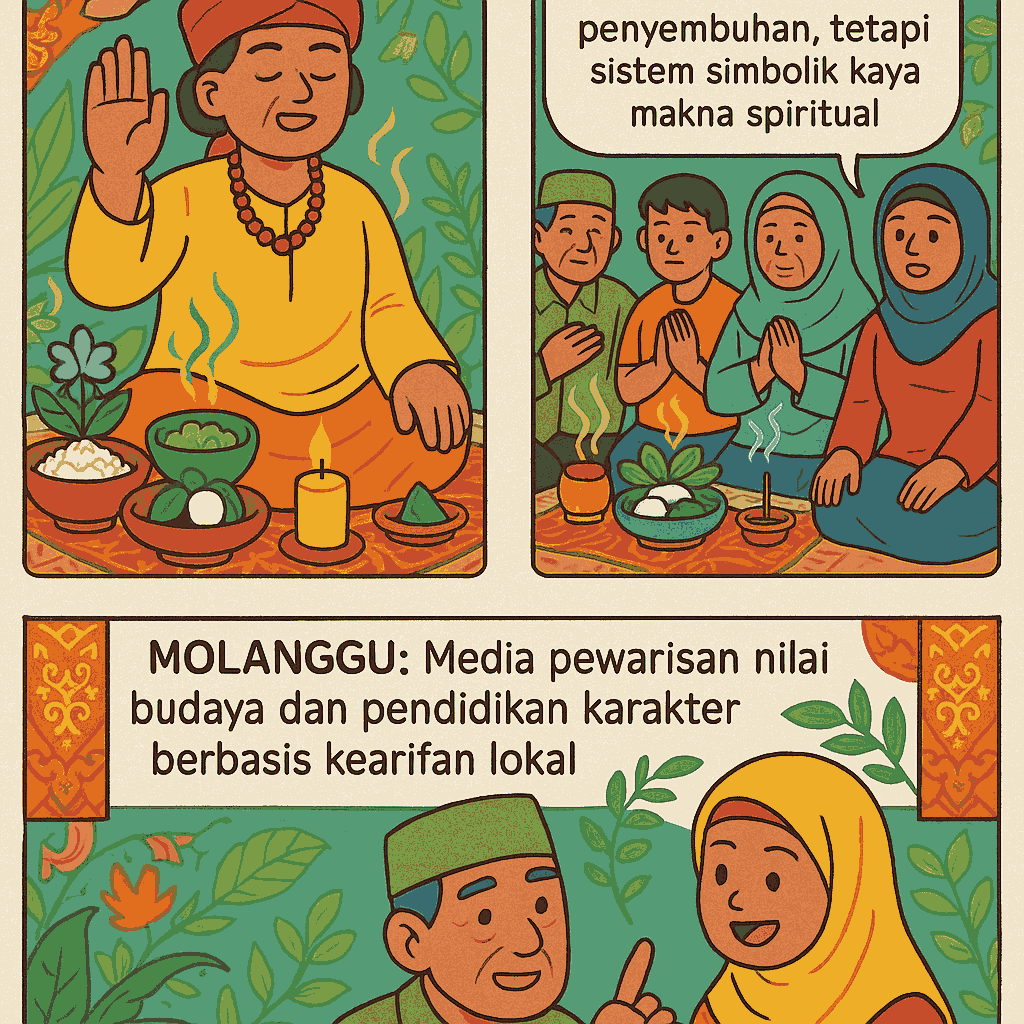
Studi ini mengeksplorasi praktik penyembuhan tradisional Molanggu di Gorontalo sebagai warisan budaya yang mengandung nilai-nilai edukasi yang relevan dengan pendidikan karakter dan pembelajaran kontekstual. Dengan menggunakan desain deskriptif kualitatif dengan unsur etnografi, penelitian ini dilakukan di Kabupaten Bone Bolango, Provinsi Gorontalo, melalui observasi, wawancara mendalam, dan dokumentasi. Informan kunci meliputi dukun Molanggu, tokoh budaya, dan anggota masyarakat setempat. Temuan penelitian mengungkapkan bahwa Molanggu bukan hanya ritual terapeutik, tetapi juga sistem simbolik yang kaya akan kearifan lokal, makna spiritual, dan identitas budaya. Prosedur penyembuhan ini mengintegrasikan unsur-unsur tradisi lisan, sistem kepercayaan, dan nilai-nilai komunal yang mencerminkan keharmonisan dengan alam, rasa hormat kepada orang tua, dan disiplin moral. Analisis menunjukkan bahwa Molanggu mewujudkan inti prinsip-prinsip etnopedagogis dan dapat berfungsi sebagai alat pedagogis untuk mengintegrasikan kearifan lokal ke dalam pendidikan formal. Lebih lanjut, persepsi masyarakat menegaskan relevansi Molanggu dalam melestarikan pengetahuan antargenerasi dan menumbuhkan kebanggaan budaya di kalangan generasi muda. Studi ini berkontribusi pada wacana pendidikan yang responsif budaya dengan memposisikan tradisi penyembuhan lokal sebagai sumber pendidikan karakter kontekstual. Studi ini juga menawarkan perspektif strategis bagi para pembuat kebijakan dan pendidik untuk merevitalisasi praktik budaya lokal melalui pengembangan kurikulum, lokakarya budaya, dan inisiatif pendidikan berbasis masyarakat. Kebaruan penelitian ini terletak pada pembingkaian Molanggu bukan hanya sebagai praktik budaya, tetapi juga sebagai media pendidikan yang berlandaskan epistemologi adat.
Downloads
References
Ahmed, M., Usmiyatun, U., Darmayanti, R., Purnamasari, P., Choirudin, C., & ... (2021). CODE ATI: Sewing activities with various patterns affect the cognitive aspects of kindergarten children? AMCA Journal of Education and Behavioral Change, 1(1), 22–25.
Alduais, A. M., Yassin, A. A., & Allegretta, S. (2025). Computational linguistics: a scientometric review. Quality and Quantity. https://doi.org/10.1007/s11135-025-02138-2
Anjarwati, S., Darmayanti, R., & Khoirudin, M. (2023). Development of “Material Gaya” Teaching Materials Based on Creative Science Videos (CSV) for Class VIII Junior High School Students. Jurnal Edukasi Matematika Dan Sains, 11(1), 163–172.
Axelsson, M., & Jakobson, B. (2020). Negotiating science - building thematic patterns of the scientific concept sound in a Swedish multilingual lower secondary classroom. Language and Education, 34(4), 291–310. https://doi.org/10.1080/09500782.2020.1740730
Bashir, M. H., Azmi, A. M., Nawaz, H., Zaghouani, W., Diab, M. T., Al-Fuqaha, A. I., & Qadir, J. (2023). Arabic natural language processing for Qur’anic research: a systematic review. Artificial Intelligence Review, 56(7), 6801–6854. https://doi.org/10.1007/s10462-022-10313-2
Cao, Q., Zhang, K., He, X., & Shen, J. (2023). Be an Excellent Student: Review, Preview, and Correction. IEEE Signal Processing Letters, 30, 1722–1726. https://doi.org/10.1109/LSP.2023.3333240
Carrete-Marín, N., & Domingo-Peñafiel, L. (2022). Textbooks and Teaching Materials in Rural Schools: A Systematic Review; Učbeniki in učna gradiva podeželskih šol: sistematični pregled. Center for Educational Policy Studies Journal, 12(2), 67–94. https://doi.org/10.26529/cepsj.1288
Chutia, T., & Baruah, N. (2024). A review on emotion detection by using deep learning techniques. Artificial Intelligence Review, 57(8). https://doi.org/10.1007/s10462-024-10831-1
Darmayanti, R., Baiduri, B., & Inganah, S. (2022). Moodle-based learning media development of flex model in improving mathematical hard skills of high school students. AKSIOMA: Jurnal Program Studi Pendidikan Matematika, 11(4), 2649–2665.
Dhelim, S., Chen, L. L., Ning, H., & Nugent, C. D. (2023). Artificial intelligence for suicide assessment using Audiovisual Cues: a review. Artificial Intelligence Review, 56(6), 5591–5618. https://doi.org/10.1007/s10462-022-10290-6
Eram, F., Quamri, M. A., Zaidi, A., & Sonam, null. (2024). A Comprehensive Review of Anaemia Associated with Hypothyroidism. New Emirates Medical Journal, 5. https://doi.org/10.2174/0102506882282237240206075352
Firetto, C. M., Starrett, E., & Jordan, M. E. (2023). Embracing a culture of talk: STEM teachers’ engagement in small-group discussions about photovoltaics. International Journal of STEM Education, 10(1). https://doi.org/10.1186/s40594-023-00442-7
Gebre, E. H., & Polman, J. L. (2020). From “context” to “active contextualization”: Fostering learner agency in contextualizing learning through science news reporting. Learning, Culture and Social Interaction, 24. https://doi.org/10.1016/j.lcsi.2019.100374
Granjou, C., Cavin, J. S., Boisvert, V., Chalmandrier, M., Flaminio, S., Kull, C. A., & Moretti, M. D. (2023). Researching Cities, Transforming Ecology An Investigation into Urban Ecology Agendas. Nature and Culture, 18(2), 148–174. https://doi.org/10.3167/nc.2023.180202
Hermida, P. C. D. Q., & Dos Santos, E. M. (2023). Detecting hate speech in memes: a review. Artificial Intelligence Review, 56(11), 12833–12851. https://doi.org/10.1007/s10462-023-10459-7
Hoptová, L. (2020). The issue of the holocaust teaching at primary and secondary schools in Slovakia. Journal of Education Culture and Society, 11(2), 429–443. https://doi.org/10.15503/jecs2020.2.429.443
Khan, A., Malik, K. M., Ryan, J., & Saravanan, M. (2023). Battling voice spoofing: a review, comparative analysis, and generalizability evaluation of state-of-the-art voice spoofing counter measures. Artificial Intelligence Review, 56, 513–566. https://doi.org/10.1007/s10462-023-10539-8
Khoiriyah, B., Darmayanti, R., & Astuti, D. (2022). Design for Development of Canva Application-Based Audio-Visual Teaching Materials on the Thematic Subject" Myself (Me and My New Friends)" Elementary School Students. Jurnal Pendidikan Dan Konseling (JPDK), 4(6), 6287–6295.
Lasekan, O. A., Opazo, F., & Mendez-Alarcon, C. M. (2024). Enhancing Sustainable Development Goal Integration in Chilean Citizenship Education: A Thematic Analysis of Textbook Content and Instructional Strategies. Sustainability (Switzerland), 16(12). https://doi.org/10.3390/su16125092
Marles, H., Chisholm, F., & Varsou, O. (2021). A contextual thematic analysis of the accessory nerve in Scottish historical medical collections of the Royal Colleges of Edinburgh and Glasgow. Clinical Anatomy, 34(2), 170–177. https://doi.org/10.1002/ca.23593
Matviichuk, M., Popeliushko, V., Herasymchuk, O., Gongalo, S., & Borzhetska, N. (2022). Ioannikii Malynovskyi as an Enlightener of the History of Law. Journal of Education Culture and Society, 13(2), 65–84. https://doi.org/10.15503/jecs2022.2.65.84
Mustafa, H. H., Darwish, N. R., & Hefny, H. A. (2024). Automatic Speech Emotion Recognition: a Systematic Literature Review. International Journal of Speech Technology, 27(1), 267–285. https://doi.org/10.1007/s10772-024-10096-7
Paternina-Borja, O. I., & Juárez-Ruiz, E. (2023). Lesson planning to teach symmetries: Scenario to characterize the Pedagogical Knowledge of a mathematics teacher. Revista Lasallista de Investigacion, 20(1). https://doi.org/10.22507/rli.v20n1a5
Rizki, N., Laila, A. R. N., Inganah, S., & Darmayanti, R. (2022). Analysis of Mathematic Connection Ability in Mathematics Problem Solving Reviewed from Student’s Self-Confedence. Seminar Nasional Teknologi Pembelajaran, 2(1), 111–126.
Sah, R. W. A., Laila, A. R. N., Setyawati, A., Darmayanti, R., & Nurmalitasari, D. (2023). Misconception analysis of minimum competency assessment (AKM) numeration of high school students from field dependent cognitive style. Jurnal Edukasi Matematika Dan Sains, 11(1), 58–69.
Salvatori, M. L., & Cherubini, D. (2024). Gender stereotypes in physical education: state of the art and future perspectives in primary school. Pedagogy of Physical Culture and Sports, 28(3), 231–238. https://doi.org/10.15561/26649837.2024.0308
Sugianto, R., Darmayanti, R., & Vidyastuti, A. N. (2022). Stage of cognitive mathematics students development based on piaget’s theory reviewing from personality type. Plusminus: Jurnal Pendidikan Matematika, 2(1), 17–26.
Sugiarni, R., Herman, T., Suryadi, D., Prabawanto, S., & Abdullah, K. H. (2024). A Bibliometric Review of Mathematics Textbooks Research. Journal of Scientometric Research, 13(2), 396–405. https://doi.org/10.5530/jscires.13.2.31
Sutoyo, R., Warnars, H. L. H. S., Isa, S. M., & Budiharto, W. (2023). EMOTIONALLY AWARE CHATBOT FOR RESPONDING TO INDONESIAN PRODUCT REVIEWS. International Journal of Innovative Computing, Information and Control, 19(3), 861–876. https://doi.org/10.24507/ijicic.19.03.861
Syaifuddin, M., Darmayanti, R., & Rizki, N. (2022). Development of a two-tier multiple-choice (TTMC) diagnostic test for geometry materials to identify misconceptions of middle school students. Jurnal Silogisme: Kajian Ilmu Matematika Dan Pembelajarannya, 7(2).
Wang, J., Xun, S., & Wang, H. (2025). Sentiment Tendency Analysis of a Traditional Chinese Culture Corpus Based on Computational Methods and Its Communication Effects. International Journal for Housing Science and Its Applications, 46(3), 1779–1791. https://doi.org/10.70517/ijhsa463140
Wang, Z., Hanley, N., Kwak, J., Vari-Lavoisier, I., Al Hussein, M., Tyson, L. S., Akkad, A., & Chankseliani, M. (2024). How do international student returnees contribute to the development of their home countries? A systematic mapping and thematic synthesis. International Journal of Educational Research, 125. https://doi.org/10.1016/j.ijer.2024.102330
Wijanarko, A. W. (2021). The Value of Pancasila as a Filter on Foreign Culture in the Era of the Information Technology (IT) Development Social Media. Social, Humanities, and Educational Studies (SHEs): Conference Series, 4(4). https://doi.org/10.20961/shes.v4i4.50620
Wulandari, T., Nurmalitasari, D., Susanto, K., & Darmayanti, R. (2022). Etnomatematika Pada Batik Daun Sirih dan Burung Kepodang Khas Pasuruan. Seminar Nasional Teknologi Pembelajaran, 2(1), 95–103.
Xuanyuan, M., Wang, Y., Guo, H., Qu, H., Zhang, K., Li, Z., Yan, D., Yu, T., Tao, J., & Dai, Q. (2025). Creating Multimodal Interactive Digital Twin Characters from Videos: A Dataset and Baseline. IEEE Transactions on Pattern Analysis and Machine Intelligence. https://doi.org/10.1109/TPAMI.2025.3603653
Yan, S., Wang, J., Zhu, S., Cui, Y., & Tao, Z. (2023). Research on Internet Sensitive Speeches Recognition Combining Features of Characters and Words; 融合字词特征的互联网敏感言论识别研究. Computer Engineering and Applications, 59(13), 129–138. https://doi.org/10.3778/j.issn.1002-8331.2203-0301
Yuniwati, E. D., Darmayanti, R., & Karim, S. (2023). Is it feasible to establish a connection between cassava and rice in terms of their image? Revenue Journal: Management and Entrepreneurship, 1(2), 99–103.
Yusuf, R., Sanusi, Razali, Maimun, & Putra, I. (2020). The efforts to improve culture literation and student citizenship through ICT based (LBK) media in pancasila and citizenship education. Universal Journal of Educational Research, 8(4). https://doi.org/10.13189/ujer.2020.080444
Published
How to Cite
Issue
Section
License
Copyright (c) 2025 Hanisah Hanafi, Merry Balango, Rusni Podungge

This work is licensed under a Creative Commons Attribution-ShareAlike 4.0 International License.