Reconstructing Sustainable Teacher Professional Development in Responding to Algorithmic Dominance in Digital Education
Authors
-
 Hasmi Nur Bayhaqi
Universitas Islam Negeri Sunan Ampel Surabaya, Indonesia
-
Abdulloh Hamid
-
Moh Faizin
DOI:
https://doi.org/10.55757/ashlach.v4i01.1362Keywords:
Sustainable teacher professional development, algorithmic dominance, teacher agency, digital education, educational transformationAbstract
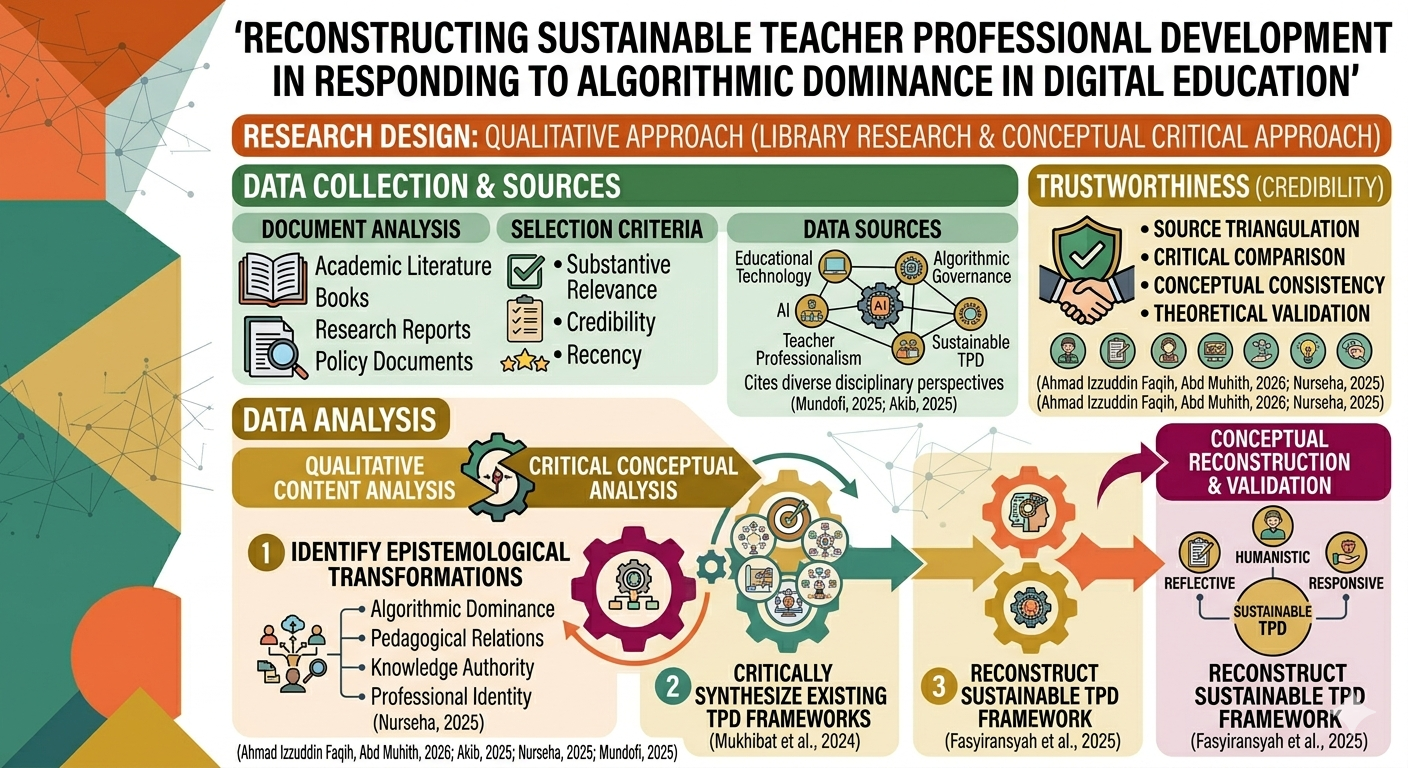
Objective: This study aims to analyze the implications of algorithmic dominance for teachers’ professional identity and pedagogical agency while reconstructing Sustainable Teacher Professional Development (TPD) to better respond to the complexities of digital education. Methodology: This study employed a qualitative approach using library research and a conceptual-critical design. Data were collected through documentation of academic literature, including international journal articles, scholarly books, research reports, and educational policy documents, and analyzed using qualitative-interpretive content analysis combined with critical-conceptual synthesis. Findings: The findings indicate that algorithmic dominance has transformed the epistemological foundations of education through datafication, automation, and platformization, resulting in shifts in knowledge production, distribution, and validation. These transformations affect teachers’ epistemic authority, pedagogical agency, and professional identity, increasing the risk of pedagogical atrophy and reducing teacher autonomy within data-driven educational environments. Implications: This research implies that teacher professional development programs should move beyond technical digital skills and focus on strengthening algorithmic literacy, critical awareness, pedagogical reflection, and teachers’ capacity to maintain humanistic values in digital learning contexts. Originality: This study contributes to the literature by reconstructing Sustainable Teacher Professional Development from a critical-humanistic perspective and positioning algorithmic dominance as the primary analytical lens, an approach that remains underexplored in previous studies that predominantly emphasize digital competencies and technology integration
References
Aagaard, T., Amdam, S. H., Nagel, I., Vika, K. S., Andreasen, J. K., Pedersen, C., & Røkenes, F. M. (2025). Teacher preparation for the digital age: Is it still an instrumental endeavor? Scandinavian Journal of Educational Research, 69(3), 651–665.
Abedi, M., Alshybani, I., Shahadat, M. R. Bin, & Murillo, M. (2023). Beyond traditional teaching: The potential of large language models and chatbots in graduate engineering education. ArXiv Preprint ArXiv:2309.13059.
Ahadi, A., Bower, M., Lai, J., Singh, A., & Garrett, M. (2024). Evaluation of teacher professional learning workshops on the use of technology-a systematic review. Professional Development in Education, 50(1), 221–237.
Alzahrani, A. (2024). Unveiling the shadows: Beyond the hype of AI in education. Heliyon, 10. https://doi.org/10.1016/j.heliyon.2024.e30696
Ambady, A., & K. V, T. (2025). Persona pedagogica in crisis: are educators becoming data custodians in the age of AI? Frontiers in Artificial Intelligence, 8, 1743016.
Amemasor, S. K., Oppong, S. O., Ghansah, B., Benuwa, B.-B., & Essel, D. D. (2025). A systematic review on the impact of teacher professional development on digital instructional integration and teaching practices. Frontiers in Education, 10, 1541031.
Amin, M. S. (2025). Pengaruh algoritma media sosial terhadap narasi keislaman di ruang digital. El-Wasathy: Journal of Islamic Studies, 3(1), 148–158.
Andrade, F. V., & Barbosa, C. S. (2025). DA INOVAÇÃO À CAPTURA: A PLATAFORMIZAÇÃO DA EDUCAÇÃO, O AVANÇO DAS EDTECHS E OS NOVOS GRILHÕES AO TRABALHO DOCENTE. Colloquium Humanarum. ISSN: 1809-8207, 22(1), 1--e255210.
Antony Jose, S., Cowan, N., Davidson, M., Godina, G., Smith, I., Xin, J., & Menezes, P. L. (2025). A comprehensive review on cellulose nanofibers, nanomaterials, and composites: manufacturing, properties, and applications. Nanomaterials, 15(5), 356.
Baker, R. S., & Hawn, A. (2022). Algorithmic bias in education. International Journal of Artificial Intelligence in Education, 32(4), 1052–1092.
Bayhaqi, H. N., & Darmawan, D. (2025). DO TEACHER COMPETENCE, LEARNING ENVIRONMENT, AND ACADEMIC STRESS SIGNIFICANTLY INFLUENCE STUDENT LEARNING OUTCOMES IN ISLAMIC JUNIOR HIGH SCHOOLS? Prima Magistra: Jurnal Ilmiah Kependidikan, 6(3), 396–412.
Brandão, A., Pedro, L., & Zagalo, N. (2024). Teacher professional development for a future with generative artificial intelligence--an integrative literature review. Digital Education Review, 45, 151–157.
Code, J., Moylan, R., Forde, K., & Ralph, R. (2023). Teachers’ Sense of Efficacy During a Time of Crisis. Canadian Journal of Science, Mathematics and Technology Education, 23(3), 538–558.
Daher, R. (2025). Integrating AI literacy into teacher education: a critical perspective paper. Discover Artificial Intelligence, 5(1), 217.
Daliri-Ngametua, R., & Hardy, I. (2022). The devalued, demoralized and disappearing teacher: The nature and effects of datafication and performativity in schools. Education Policy Analysis Archives, 30, 102.
Eradze, M., De Martino, D., Tinterri, A., Albó, L., Bardone, E., Sunar, A. S., & Dipace, A. (2023). After the pandemic: Teacher professional development for the digital educational innovation. Education Sciences, 13(5), 432.
Fernández-Batanero, J. M., Montenegro-Rueda, M., Fernández-Cerero, J., & Tadeu, P. (2020). Formación del profesorado y TIC para el alumnado com discapacidad: Una revisión sistemática. Revista Brasileira de Educação Especial, 26, 711–732.
Gu, J., Lai, Y., Shou, H., & Wang, L. (2025). Time since last birth and the risk of endometrial cancer: A meta-analysis of observational studies. Plos One, 20(7), e0325907.
HolonIQ. (2023). Global education technology market outlook 2027. Https://Www.Holoniq.Com.
Jandrić, P., & Knox, J. (2022). The postdigital turn: Philosophy, education, research. Policy Futures in Education, 20(7), 780–795.
Jarke, J., & Breiter, A. (2019). The datafication of education. Learning, Media and Technology, 44(1), 1–6.
Kemendikbudristek. (2022). Peraturan Menteri Pendidikan, Kebudayaan, Riset dan Teknologi Republik Indonesia Nomor 22 Tahun 2022. Kemdikbudristek, 9(22), 1–87.
Kerssens, N., & Van Dijck, J. (2022). Governed by edtech? Valuing pedagogical autonomy in a platform society. Harvard Educational Review, 92(2), 284–303.
Kim, J. (2025). Exploring students’ perspectives on Generative AI-assisted academic writing. Education and Information Technologies, 30(1), 1265–1300. https://doi.org/10.1007/s10639-024-12878-7
Kong, S.-C., & Yang, Y. (2024). A human-centered learning and teaching framework using generative artificial intelligence for self-regulated learning development through domain knowledge learning in K--12 settings. IEEE Transactions on Learning Technologies, 17, 1562–1573.
Lagos-Castillo, A., Chiappe, A., Ramirez-Montoya, M.-S., & Rodr’iguez, D. F. B. (2025). Mapping the intelligent classroom: Examining the emergence of personalized learning solutions in the digital age. Contemporary Educational Technology, 17(1), ep543.
Maulidi, A., Alanshori, M. Z., Hidayati, Z., Maknin, N. A. K., Rahmah, W., Zuhri, A. M., & Zaini, A. (2025). Techno-Humanistic Learning: A New Paradigm for Human-Centered Digital Pedagogy on Islamic Education. EDUKASIA Jurnal Pendidikan Dan Pembelajaran, 6(2), 831–852.
Montero-Mesa, L., Fraga-Varela, F., Vila-Couñago, E., & Rodr’iguez-Groba, A. (2023). Digital technology and teacher professional development: Challenges and contradictions in compulsory education. Education Sciences, 13(10), 1029.
Mouta, A., Torrecilla-Sánchez, E. M., & Pinto-Llorente, A. M. (2025). Comprehensive professional learning for teacher agency in addressing ethical challenges of AIED: Insights from educational design research. Education and Information Technologies, 30(3), 3343–3387.
Muhić, S., Goran, N., & Begović, A. (2023). Proposal of a model for smart waste management system using IoT camera and AI for real-time QR code objects recognition. 2023 31st Telecommunications Forum (TELFOR), 1–4.
Osorio Vanegas, H. D., Segovia Cifuentes, Y. de M., & Sobrino Morrás, A. (2025). Educational technology in teacher training: A systematic review of competencies, skills, models, and methods. Education Sciences, 15(8), 1036.
Perrotta, F., Corbi, G., Mazzeo, G., Boccia, M., Aronne, L., D’Agnano, V., Komici, K., Mazzarella, G., Parrella, R., & Bianco, A. (2020). COVID-19 and the elderly: insights into pathogenesis and clinical decision-making. Aging Clinical and Experimental Research, 32(8), 1599–1608.
Popow, M. (2026). Decolonizing knowledge in the postdigital era: Pedagogical strategies for navigating AI-driven epistemic transformations. Educational Philosophy and Theory, 58(1–2), 44–56.
Raj, N. S., & Renumol, V. G. (2024). An improved adaptive learning path recommendation model driven by real-time learning analytics. Journal of Computers in Education, 11(1), 121–148.
Ramiel, H., & Fisher, E. (2024). The epistemic machinery of educational platforms. Learning, Media and Technology, 49(4), 623–638.
Renz, A., & Hilbig, R. (2020). Prerequisites for artificial intelligence in further education: Identification of drivers, barriers, and business models of educational technology companies. International Journal of Educational Technology in Higher Education, 17(1), 14.
SEJDIU, N. P., Ramadani, R., & Sejdiu, S. (2026). Countering the code: Emancipatory teaching and critical digital literacy in platformized schools. Open Research Europe, 6(28), 28.
Shulga, V. I. (2024). Simulation of ion beam sputtering with OKSANA and SRIM: A comparative study. Vacuum, 230, 113644.
Sperling, K., Stenberg, C.-J., McGrath, C., Åkerfeldt, A., Heintz, F., & Stenliden, L. (2024). In search of artificial intelligence (AI) literacy in teacher education: A scoping review. Computers and Education Open, 6, 100169.
Stenberg, C.-J., Åkerfeldt, A., Stenliden, L., & McGrath, C. (2025). Teaching with the algorithm: anticipations of AI in teacher education. European Journal of Teacher Education, 48(5), 1056–1076.
Sutrisno, R. D. (2025). Ketika Algoritma Mengajar: Pendekatan Psikologi Pendidikan Agama Kristen Dalam Membentuk Karakter Anak Di Era Media Digital.”. EDUCATIONAL: Jurnal Inovasi Pendidikan & Pengajaran, 5.
Trevisan, L. V., Eustachio, J. H. P. P., Dias, B. G., Filho, W. L., & Pedrozo, E. Á. (2024). Digital transformation towards sustainability in higher education: state-of-the-art and future research insights: LV Trevisan et al. Environment, Development and Sustainability, 26(2), 2789–2810.
Turvey, K., & Pachler, N. (2026). A topological exploration of convergence/divergence of human-mediated and algorithmically mediated pedagogy. British Journal of Educational Technology, 57(3), 619–638.
Vetter, M. A., & McDowell, Z. J. (2023). A spectrum of surveillance: Charting functions of epistemic inequality across EdTech platforms in the post-COVID-19 era. Journal of University Teaching and Learning Practice, 20(2), 1–17.
Vorobyeva, K. I., Belous, S., Savchenko, N. V, Smirnova, L. M., Nikitina, S. A., & Zhdanov, S. P. (2025). Personalized Learning through AI: Pedagogical Approaches and Critical Insights. Contemporary Educational Technology, 17(2).
Williamson, B., Macgilchrist, F., & Potter, J. (2023). Re-examining AI, automation and datafication in education. In Learning, media and technology (Vol. 48, Issue 1, pp. 1–5). Taylor & Francis.
Zhai, X. (2025). Transforming teachers’ roles and agencies in the era of generative AI: Perceptions, acceptance, knowledge, and practices. Journal of Science Education and Technology, 34(6), 1323–1333.
Zhao, Q., & Zhai, Y. (2024). Two Simple Methods of Drawing Perspective Drawing by Measuring Point Method. International Conference on Geometry and Graphics, 46–52.
Published
How to Cite
Issue
Section
License
Copyright (c) 2026 Hasmi Nur Bayhaqi, Abdulloh Hamid, Moh Faizin

This work is licensed under a Creative Commons Attribution-ShareAlike 4.0 International License.