Fiqh-Based Zero Plastic Waste Initiative in Islamic Boarding Schools
Authors
-
 Ahmad Mujtaba
Universitas Islam Tribakti Lirboyo Kediri
-
Mochamad solahudin
Universitas Islam Tribakti Lirboyo Kediri
DOI:
https://doi.org/10.55757/ashlach.v4i02.1365Keywords:
Mabadi Fikih, Pesantren, Zero Plastic Waste, Al-Qur’an dan HadisAbstract
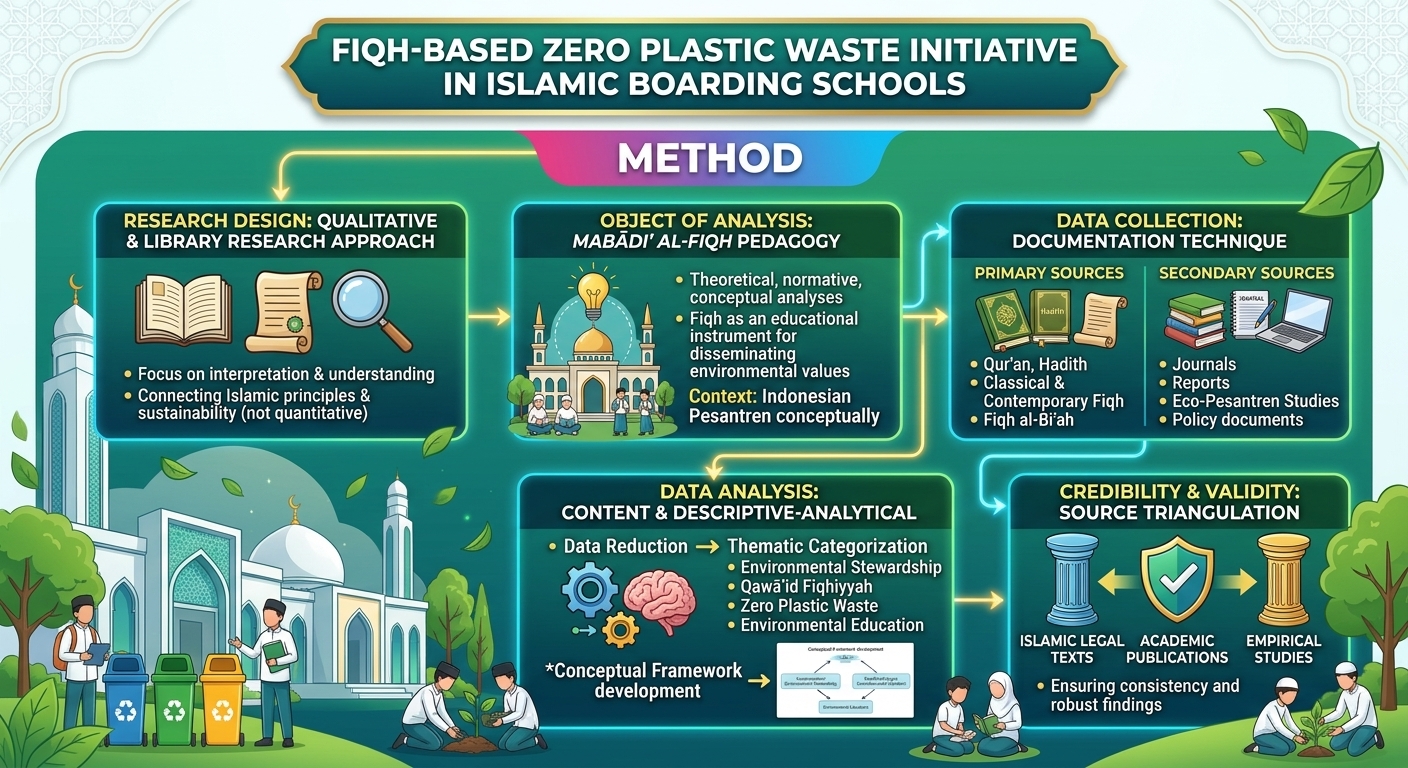
Islamic boarding schools (pesantren) have strategic potential to address environmental crises, particularly plastic waste problems, through an educational approach rooted in Islamic values. However, waste management efforts in pesantren often remain focused on technical aspects and have not yet produced profound changes in students’ mindsets. This study aims to examine the role of Mabādi’ Fiqh instruction as an instrument for disseminating Zero Plastic Waste values in Islamic boarding schools from the perspectives of the Qur’an and Hadith. The study employs a qualitative approach using library research by analyzing fiqh literature, normative Islamic sources, and empirical reports on waste management practices in pesantren. The findings indicate that fiqh principles such as lā ḍarar wa lā ḍirār and dar’u al-mafāsid muqaddam ‘alā jalb al-maṣāliḥ provide a strong moral foundation for fostering ecological awareness among students. Integrating Mabādi’ Fiqh instruction with technical waste management practices, including ecobrick production, waste bank management, and Zero Waste Index measurement, can promote more sustainable ecological behavioral change. These findings emphasize that fiqh education functions not only as the transmission of legal knowledge but also as a pedagogy for transforming environmental behavior and developing an Eco-Pesantren model that integrates theological values with sustainability practices. The originality of this study lies in positioning Mabādi’ Fiqh as a pedagogical framework for disseminating Zero Plastic Waste values in Islamic boarding schools, thereby extending the role of fiqh education from a normative orientation toward the formation of sustainable ecological behavior.
Downloads
References
Abidin, A. Z., & Noorhidayati, S. (2025). Promoting Eco-Pesantren Based on Qur’an and Hadith at PPTA Al-Kamal Integrated Islamic Boarding School, Blitar, East Java, Indonesia. Qof, 9(1), 135–154. https://doi.org/10.30762/qof.v9i1.2794
Absori, Budiono, A., Bangsawan, M. I., Rizka, & Mustaffa, A. (2026). The Integration of Positive and Islamic Law in Contemporary Forest Conservation Policies Based on Sustainable Development: A Comparative Study of Indonesia and Malaysia. MILRev: Metro Islamic Law Review, 5(1), 458–491. https://doi.org/10.32332/milrev.v5i1.13038
Al Hadid, H., & Syibly, M. R. (2026). The Role of Environmental Fiqh in Tackling the Problem of Non-Organic Waste in Yogyakarta’s Tourist Areas. Al Qalam: Jurnal Ilmiah Keagamaan Dan Kemasyarakatan, 20(1), 90. https://doi.org/10.35931/aq.v20i1.4060
Anas, M., Nur, M., Hikmah, L., & Arif, M. (2027). Ecological Jurisprudence and Character Education : A Study of Implementation in the Adiwiyata Program at Madrasahs. Tafkir, 7(2), 648–659.
Arifah Millati Agustina. (2023). The Development of Maqasid Al Shari’a on The Role of Women in Environmental Conservation. Musãwa Jurnal Studi Gender Dan Islam, 22(1), 14–23. https://doi.org/10.14421/musawa.2023.221.14-23
Bahri, W. S., Maswani, Kafid, N., Amili, R. M., & Masruri, A. (2026). Green Pesantren: Best Practice of Integrating Green Technology and Sustainable Agriculture for Eco-friendly Education. Kharisma, 5(1), 203–217. https://doi.org/10.59373/kharisma.v5i1.251
Bintang Kejora, M. T., Komariah, A., Herawan, E., & Sudarsyah, A. (2025). Ekopesantren: An Ecology-Based Education Model with Local Wisdom Supports the Sustainable Development Goal’s. AL-ISHLAH: Jurnal Pendidikan, 17(1), 291–306. https://doi.org/10.35445/alishlah.v17i1.6246
Diana, R. C. (2017). Ar Qurani (Al Ibrah Qurani): Upaya Internalisasi Nilainilai Qurani Pada Anak Muslim Indonesia Berbasis Modul Kisah Teladan Al Quran. Seminar Nasional Pendidikan – Fakultas Ilmu Pendidikan Universitas Negeri Malang, 361–373.
Faris El Amin, Abdul Jalil, Achmad Fauzi, Abd Wahed, & Aminullah Furqoni. (2025). The Environmental Practices of Coastal Muslim Families from the Perspective of Fiqh al-Bi’ah. Journal of Indonesian Islamic Family Law, 7(1), 116–135. http://ejournal.iainmadura.ac.id/index.php/almanhaj/index
Fitria, T. N. (2025). Management and Utilization of Students’ Leftover Food to Reduce Food Waste in the Free Nutritious Meal (MBG) Program: An Islamic Economics Perspective and …. Jurnal Ilmiah Ekonomi Islam, 11(6), 24–47. https://jurnal.stie-aas.ac.id/index.php/jei/article/view/19090%0Ahttps://jurnal.stie-aas.ac.id/index.php/jei/article/download/19090/8036
Kaltsum, L. U., Bidayaturrohmah, A., Najib Tsauri, M., & Amin, A. S. (2025). The role of the Qur’an in urban women’s waste management practices: A case study of the bank Sampah Lestari 2 community in Tangerang city. Towards Resilient Societies: The Synergy of Religion, Education, Health, Science, and Technology, 385–390. https://doi.org/10.1201/9781003654940-60
Kharismawati, D. E. (2019). Peran kepala sekolah dalam meningkatkan mutu pendidikan: studi kasus di SMA Unggulan Harapan Ummat International Islamic Boarding School Darul Hikam Mojokerto. Jurnal Kajian Teori Dan Praktik Kependidikan, 4(1), 19–28. https://www.semanticscholar.org/paper/32287eabd11d08726a018a4d4948c0e597e4b648
Kusuma Pertiwi, A., Septia Anggra Cahyani, S., Chulashotud Diana, R., & Gunawan, I. (2018). The Leadership of Kyai: A Descriptive Study. International Conference on Education Management and Administration (CoEMA), 269(CoEMA), 121–126. https://doi.org/10.2991/coema-18.2018.32
Kuswandi, D., Setyosari, P., Suryati, N., & Chusniyah, T. (2020). Development Of Life-Based Curriculum Model Designs In The Global Era. Proceeding on International Conference of Science Management Art Research Technology (IC-SMART), 1(1), 26–32. https://doi.org/10.31098/ic-smart.v1i1.23
Mubarok, Z., & Koidin, M. (2020). Ibadah Mengolah Sampah Di Desa Grobog Wetan Kecamatan Pangkah Kabupaten Tegal. Dimas: Jurnal Pemikiran Agama Untuk Pemberdayaan, 20(1), 1. https://doi.org/10.21580/dms.2020.201.4806
Muin, A., Rosyid, M. Z., Rahman, H., & Rofiqi, R. (2025). Ecological Tauhid-Based Green School Management : A Case Study of Eco-Pesantren Implementation at Mambaul Ulum Islamic Junior High School Pamekasan. EDUKASIA: Jurnal Pendidikan Dan Pembelajaran, 6(1), 551–562. https://doi.org/10.62775/edukasia.v6i1.1457
Munir, M., & Ukhrawiyah, F. (2025). Fiqh Studies and Critical Thinking in Pesantren-Based Islamic Education : Revisiting UNESCO ’ s Four Pillars. 3(2), 115–125.
Nailis Sa’adah, Minati Asrofi Hidayah, Dewi Suhaimatun Nausy, M. H. M. (2025). Implementation of Maqashid Sharia in Sustainable Business : Analysis of Ecobricks and Eco Enzyme Models as Waste Management Innovations for a Circular Economy. International Conference On IISLAMIC ECONOMICS AND BUSNESS, 40–51.
Prihatin, N. A., & Novianto, V. (2025). Implementing Deep Learning Through the Development of Eco-Pesantren As a School Culture At Ppm Baitussalam. Jurnal Sosialita, 20(1), 1–11. https://doi.org/10.31316/js.v20i1.7740
Rahem, Z. (2025). Kerja Artikulatif Perempuan Pesantren Di Sumenep Madura Dalam Menjaga Bumi. Ta’dibiya, 5(1), 70–81. https://doi.org/10.61624/japi.v5i1.171
Rukmana, I. H. (2020). The Ecological Crisis and Indonesian Muslim Organizations’ Responses. International Journal of Interreligious and Intercultural Studies, 3(2), 101–109. https://doi.org/10.32795/ijiis.vol3.iss2.2020.1094
Ruppel, O. C., & Murray, R. (2024). The Future of the SDGs: A Comparative Constitutional Rescue Plan? One does not discover new lands without consenting to lose sight of the shore. André Gide. Environmental Policy and Law, 54(2–3), 155–187. https://doi.org/10.3233/EPL-239022
Suryati, N., Kuswandi, D., Setyosari, P., Hutkemri, Chusniyah, T., Diana, R. C., & Nurdiansa, E. S. (2020). Curriculum Development of Postgraduate Study Program Based on Life-Based Learning Philosophy and Disruption Technology. International Conference On Information Technology And Education (ICITE 2020) Curriculum, 508(Icite), 434–436. https://doi.org/10.2991/assehr.k.201214.273
Syifa, M., Widigdo, A., & Azhar, M. (2025). Fiqh al- Bi ’ ah : The Application of Islamic Environmental Ethics in the Community-Based Waste Management in Yogyakarta. PROCEEDING INTERNATIONAL CONFERENCE OF COMMUNITY SERVICES, 3(2), 5152–5159.
Published
How to Cite
Issue
Section
License
Copyright (c) 2026 Ahmad Mujtaba, Mochamad solahudin

This work is licensed under a Creative Commons Attribution-ShareAlike 4.0 International License.