Problem-Based Learning for Strengthening Religious Moderation: Evidence from Tolerance Education in Islamic Higher Education
Authors
-
 Laila Badriyah
Universitas Sunan Giri Surabaya, Indonesia
Laila Badriyah
Universitas Sunan Giri Surabaya, Indonesia
-
Siti Kholidatur Rodiyah
Universitas Sunan Giri Surabaya, Indonesia
DOI:
https://doi.org/10.55757/ashlach.v4i01.1366Keywords:
Problem-Based Learning, religious moderation, tolerance education, Islamic higher education, learning strategyAbstract
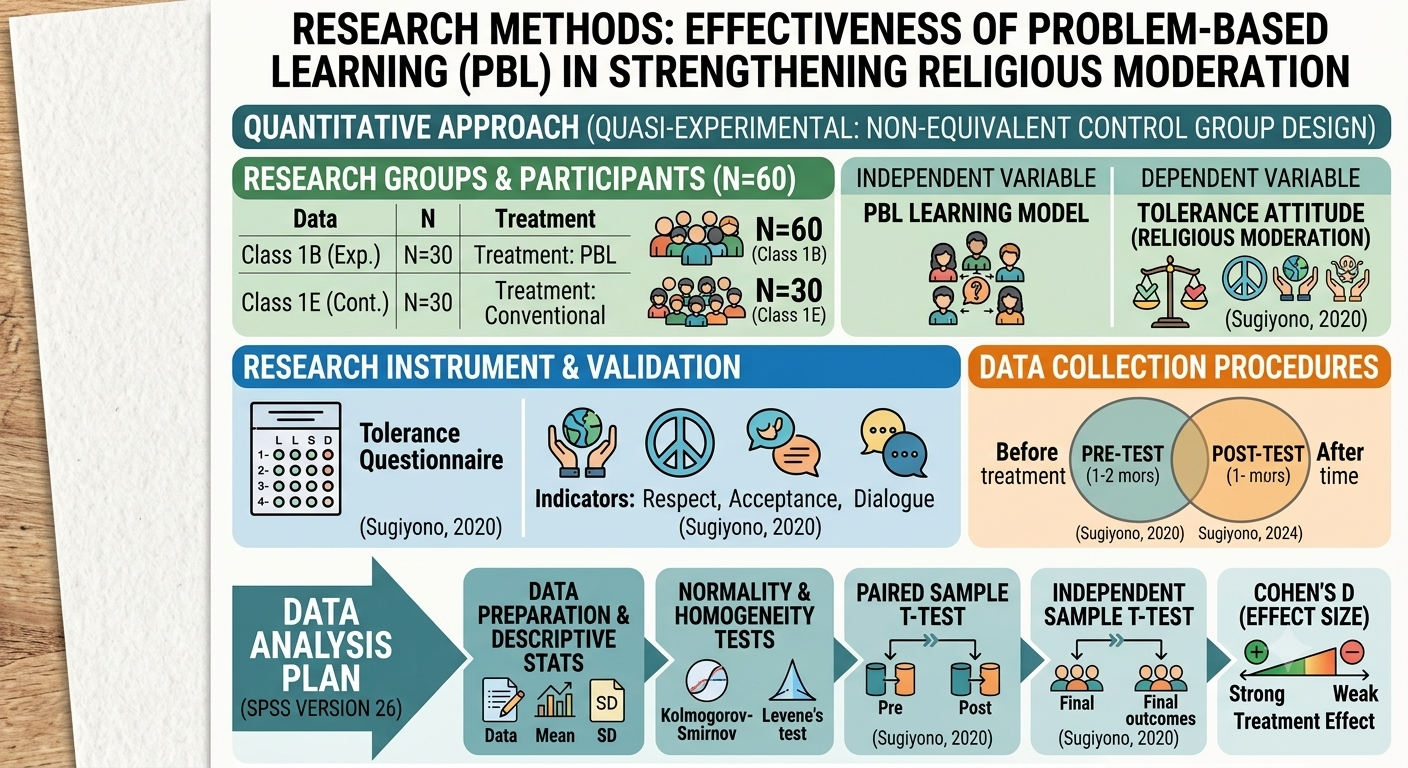
The rapid development of information and communication technology has increased the intensity of social interaction in diverse societies, while presenting various challenges related to intolerance, exclusivism, and social polarization. This condition shows the importance of strengthening religious moderation in the university environment through a learning process that is able to instill the values of tolerance in a more contextual manner. This study aims to analyze the effectiveness of the application of Problem-Based Learning (PBL) in increasing student tolerance as one of the indicators of religious moderation in Islamic Religious Education courses. The study uses a quantitative approach with a quasi-experimental design of the Non-Equivalent Control Group Design. The research subjects consisted of 60 first-semester students who were divided into experimental groups and control groups. Data collection was carried out using a tolerance attitude questionnaire that had been declared valid and reliable. Data were analyzed through descriptive and inferential statistics including normality, homogeneity, Paired Sample t-Test, Independent Sample t-Test, and effect size calculation using Cohen's d. The results showed that students who participated in PBL-based learning experienced a higher increase in tolerance attitudes than students who participated in conventional learning. This difference is proven to be statistically significant with an effect size value of 1.82 which is in the large category. These findings indicate that PBL is effectively used as a learning strategy to develop tolerance, strengthen reflective skills, and support the internalization of religious moderation values in students
References
Allen, A. (2022). An introduction to constructivism: Its theoretical roots and impact on contemporary education. Journal of Learning Design and Leadership, 1(1), 1–11.
Amanda, D. A. S., & Ndzijia, A. N. (2026). Implementation of Problem-Based Learning in Enhancing Student Engagement and Learning Achievement in Islamic Religious Education for Children. Research Journal on Teacher Professional Development, 4(01), 19–38.
Asrohah, H., Ritonga, I., & others. (2025). Socio-Physical and Spiritual Environment (SPaSE) Model For Religious Moderation in Madrasa. Nazhruna: Jurnal Pendidikan Islam, 8(1), 75–91.
Azra, A. (2021). Moderasi Beragama dalam Konteks Indonesia.
Badriyah, L. (2021). Multikultural dalam Pendidikan Islam. TABYIN: JURNAL PENDIDIKAN ISLAM, 3(01), 116–128.
Badriyah, L. (2025). Harmony in Diversity: Islamic Perspectives on Student Perceptions and Engagement in Interfaith Dialogue on Campus. FALASIFA: Jurnal Studi Keislaman, 16(02), 165–177.
Bafadhol, I. (2017). PENDIDIKAN AKHLAK DALAM PERSPEKTIF ISLAM Pendidikan Akhlak … Pendidikan Akhlak …. 0(12).
Bendeliani, N., & Torstensdotter, G. L. (2026). The role of the “problem” in problem-based learning: PBL tutors’ conceptions. Scandinavian Journal of Educational Research, 1–14.
Destriani. (2021). Pembelajaran Pendidikan Agama Islam Berbasis Moderasi Beragama Menuju Society Era 5.0. International Journal Of Educational Resources, 2(6), 648.
Fitri, S. R. A., Hasanah, A., Nursobah, A., & Sadiah, D. (2025). Problem-Based Islamic Religious Education (PBL) Learning to Strengthen Students’ Moderate Attitudes and National Insight. International Journal of Islamic Educational Research, 2(3), 107–116.
Foundation, W. (2022). Program—Intoleransi Masih Tinggi, Wahid Foundation Gandeng Media dan Kesbangpol Jateng Gerakkan Sekolah Damai. https://wahidfoundation.org/news/detail/Intoleransi-Masih-Tinggi-Wahid-Foundation-Gandeng-Media-dan-Kesbangpol-Jateng-Gerakkan-Sekolah-Damai.
Hermanto, I. M., Nurhayati, N., & Samatowa, L. (2022). Identifikasi profil retensi pengetahuan siswa melalui penerapan model pembelajaran guided context-problem based learning (GC-PBL). Normalita (Jurnal Pendidikan), 10(2).
Jakarta, U. (2019). Radikalisme dan Pendidikan Multikultural | Universitas Islam Negeri Syarif Hidayatullah Jakarta Website Resmi. https://www.uinjkt.ac.id/id/radikalisme-dan-pendidikan-multikultural/.
Keliat, N. R., Anggraini, P. P., & Tapilouw, M. C. (2025). The Role of Problem-Based Learning Models with The Lesson Study Approach in Improving Student’s Collaborative Skills. 6th Sriwijaya University Learning and Education International Conference 2024 (SULE-IC 2024), 18–40.
Kementerian Agama, R. I. (2019). Moderasi beragama. Jakarta: Badan Litbang Dan Diklat Kementerian Agama RI, 15.
Larkins, G., & Owen, S. (2025). Why there is a place for dialogue in religious education today. Religions, 16(4), 487.
Maulidi, A., Alanshori, M. Z., Hidayati, Z., Maknin, N. A. K., Rahmah, W., Zuhri, A. M., & Zaini, A. (2025). Techno-Humanistic Learning: A New Paradigm for Human-Centered Digital Pedagogy on Islamic Education. EDUKASIA Jurnal Pendidikan Dan Pembelajaran, 6(2), 831–852.
Muhibbi, M. S., Yaakob, M. F. M., Utama, S., Fahmi, M., & others. (2025). Religious Moderation Practices in Indonesian Higher Education Institutions: A Systematic Literature Review on Typology, Strategy, and Evaluation. Jurnal Pendidikan Agama Islam, 22(2), 423–445.
Muliatul, M., Sidqi, N., & Mazrur, M. (2024). The Role of High Schools in Central Kalimantan in Developing Islamic Religious Education for Adolescents: A Field Review in the Technological Era. Islamika, 6(3), 1350–1361.
Nisa, I., Hatip, A., & others. (2025). Students’ Critical Thinking and Collaborative Skills Through the Problem-Based Collaborative Learning Model. Jurnal Pendidikan Matematika, 16(2), 129–142.
Nurwidodo, N., Zaenab, S., Hindun, I., & Wahyuni, S. (2025). Development of Problem Orientation Model and Work Organization in Problem-Based Learning at Muhammadiyah Senior High School of Batu City. Journal of Biological Education Indonesia (Jurnal Pendidikan Biologi Indonesia), 11(1), 424–437.
Qadri, S. S., Hussin, N. S., & Dar, M. M. (2024). Countering extremism through islamic education: Curriculum and pedagogical approaches. Journal on Islamic Studies, 1(1), 74–89.
Qutub, S. (2024). Strategi Pembelajaran Problem Based Learning di Perguruan Tinggi Islam pada Mata Kuliah Fiqh. SAP (Susunan Artikel Pendidikan), 9(1), 45–51.
Rafi, A. Al, Orni, K. N., Subah, T. A., Akther, S., Acharjee, A., Zuhayr, I. Al, & Mallick, D. (2025). Trends and Burden of Breast and Cervical Cancer in Bangladesh: A Data-Driven Analysis and Future Outlook. MedRxiv, 2012–2025.
RI, T. B. K. (2019). Moderasi Beragama (Jakarta: Badan Litbang dan Diklat Kementerian Agama RI.
Ridlo, M. A., & Hanan, A. (2026). Revitalization of Islamic Education Thru Interactive Learning: Fostering Creativity and Critical Thinking Among Students. Indonesian Journal of Islamic Education and Learning, 1(2), 64–74.
Shin, M. (2023). The impact of problem-based learning on collaborative problem-solving and communication skill development. The Korean Society of Culture and Convergence, 45, 133–140.
Siregar, H. L., Nurmayani, N., & Junaidi, J. (2025). Development of a Problem-Based Learning Model in Islamic Religious Education to Enhance Students’ Critical Thinking Skills. Jurnal Iqra’: Kajian Ilmu Pendidikan, 10(2), 169–185.
Sugiyono. (2020). Metodologi Penelitian Kuantitatif, Kualitatif dan R & D.
Triyanto. (2026). Teachers’ perspective concerning multicultural education to support Sustainable Development Goals (SDGs). Journal for Multicultural Education, 1–14.
UNESCO. (2021). Education for Sustainable Development A roadmap. Unesco.
Widiastuti, I. A. M. S., Mantra, I. B. N., Utami, I. G. A. L. P., Sukanadi, N. L., Susrawan, I. N. A., & others. (2023). Implementing problem-based learning to develop students’ critical and creative thinking skills. JPI (Jurnal Pendidikan Indonesia), 12(4), 658–667.
Wulandari, W. (2022). Implementation of Islamic Education and Wasathiyah Da’wah for Millennial Generation with Al-Qur’an Perspective in Facing Society 5.0. Jurnal Pendidikan Agama Islam, 19(1), 129–140. https://doi.org/10.14421/jpai.2022.191-10
Published
How to Cite
Issue
Section
License
Copyright (c) 2026 Laila Badriyah, Siti Kholidatur Rodiyah

This work is licensed under a Creative Commons Attribution-ShareAlike 4.0 International License.