Pedagogical Transformation Through Student-Centered Learning in Islamic Religious Education under the Kurikulum Merdeka Framework: A Qualitative Case Study
Authors
-
 Almas Dzakiyyah
Institut Islam Mamba'ul 'Ulum Surakarta, Indonesia
Almas Dzakiyyah
Institut Islam Mamba'ul 'Ulum Surakarta, Indonesia
-
Muhammad Ja'far Nashir
Institut Islam Mamba'ul 'Ulum Surakarta, Indonesia
DOI:
https://doi.org/10.55757/ashlach.v4i02.1521Keywords:
Student-Centered Learning, Pedagogical Transformation, Islamic Religious Education, Kurikulum Merdeka, Meaningful LearningAbstract
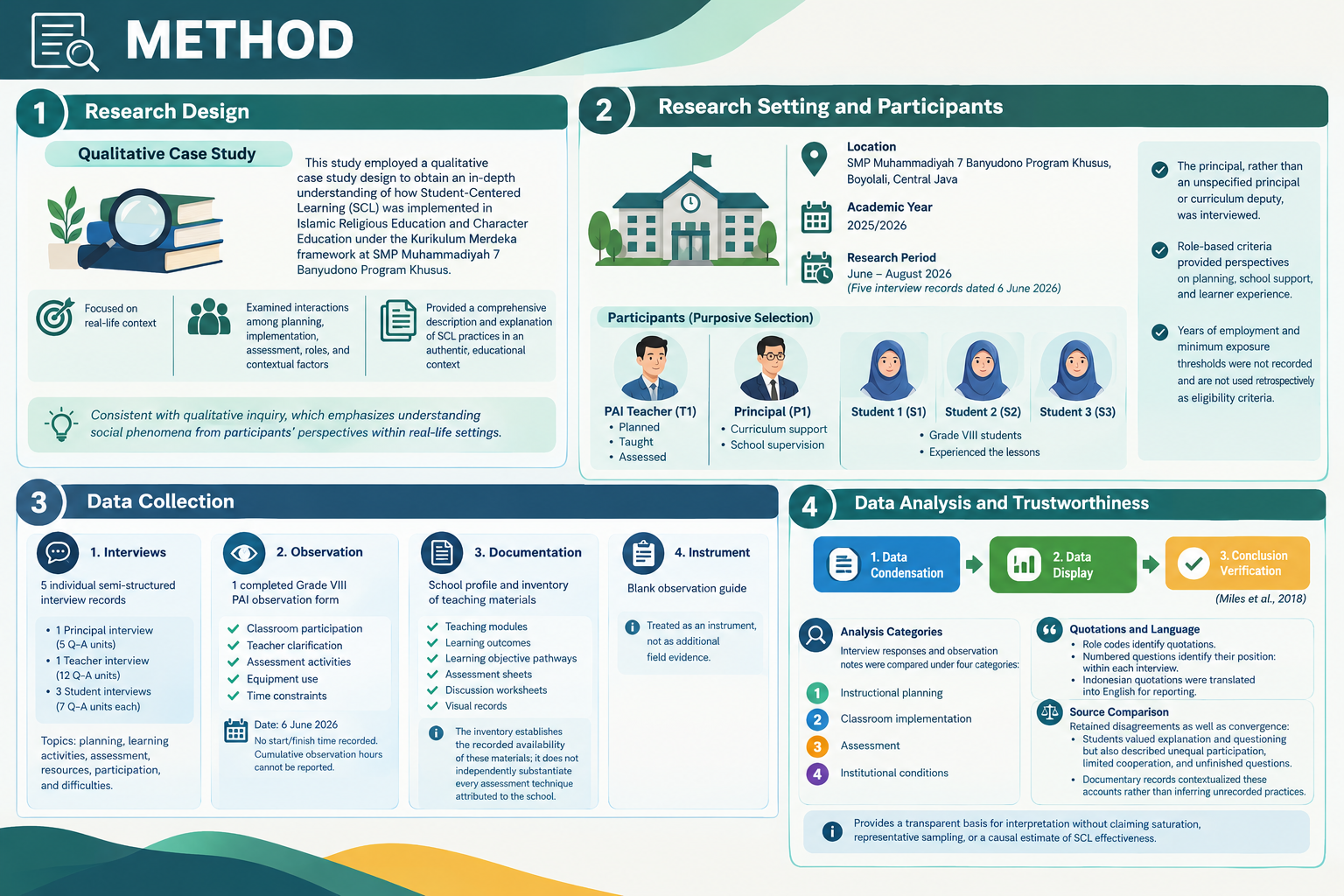
This study examines how instructional planning, classroom facilitation, assessment, and institutional support interact in Student-Centered Learning (SCL) within Islamic Religious Education under Kurikulum Merdeka. A qualitative case study at SMP Muhammadiyah 7 Banyudono Program Khusus drew on five interviews dated 6 June 2026 with the principal, a PAI teacher, and three Grade VIII students, together with a completed classroom observation form and documentation records. Analysis followed data condensation, display, and conclusion verification. The findings identify topic-sensitive methods, teacher explanation combined with questioning and practice, process-oriented assessment, and support through supervision and monthly teacher discussion. Participation was uneven, and group cooperation, lesson time, and access to shared equipment posed constraints. Practical Fiqh activities connected religious understanding to performance, while approachable teacher–student relationships created opportunities for moral conversation. These findings suggest pathways toward value internalization, but do not establish sustained behavioural change. The article proposes a contextual model connecting four pedagogical dimensions and discusses its relevance to Indonesia’s diverse Islamic educational institutions while retaining the Muhammadiyah identity of the case.
References
Abdul Rahman, N. F., Davies, N., Suhaimi, J., Idris, F., Syed Mohamad, S. N., & Park, S. (2023). Transformative learning in clinical reasoning: a meta-synthesis in undergraduate primary care medical education. Education for Primary Care, 34(4), 211–219. https://doi.org/10.1080/14739879.2023.2248070
Amalia, E. R., Khoiriyati, S., Ummah, N., Oviani, M., Kusumawardhani, J., & Umayyah, U. (2024). Bridging Educational Reform and Faith: Evaluating Kurikulum Merdeka’s Compatibility with Islamic Values in Madrasahs. Munaddhomah: Jurnal Manajemen Pendidikan Islam, 5(4), 483–500. https://doi.org/10.31538/munaddhomah.v5i4.1413
Aspandi, A., & Muttaqin, M. A. (2025). Transforming Teacher Roles in Indonesia’s Digital Era: Enhancing Learning Effectiveness and Student Engagement. Journal of General Education and Humanities, 4(4), 1495–1510. https://doi.org/10.58421/gehu.v4i4.616
Berg, E., & Lepp, M. (2023). The meaning and application of student-centered learning in nursing education: An integrative review of the literature. Nurse Education in Practice, 69, 103622. https://doi.org/https://doi.org/10.1016/j.nepr.2023.103622
Bremner, N., Sakata, N., & Cameron, L. (2022). The outcomes of learner-centred pedagogy: A systematic review. International Journal of Educational Development, 94, 102649. https://doi.org/https://doi.org/10.1016/j.ijedudev.2022.102649
Doolittle, P., Wojdak, K., & Walters, A. (2023). Defining active learning: A restricted systematic review. Teaching and Learning Inquiry, 11. https://doi.org/10.20343/teachlearninqu.11.25
González-Pérez, L. I., & Ramírez-Montoya, M. S. (2022). Components of Education 4.0 in 21st century skills frameworks: systematic review. Sustainability, 14(3), 1493. https://doi.org/10.3390/su14031493
Gustina, E., Hanani, S., & Sesmiarni, Z. (2025). Active learning based on deep learning: A critical review of the role and readiness of islamic religious education teachers. International Journal of Islamic Educational Research, 2(3), 54–60. https://doi.org/10.61132/ijier.v2i3.331
Ismail, M., Yanti, P., Gradini, E., Yunus, M., & Ubit, F. (2025). Transformation of Learning in Madrasah: Best Practices in the Implementation of Kurikulum Merdeka at MTsN 2 Bener Meriah. Jumper: Journal of Educational Multidisciplinary Research, 4(2), 174–194. https://doi.org/10.56921/jumper.v4i2.318
Kaloko, N. S. (2025). Pelaksanaan Kurikulum Merdeka pada Pembelajaran Pendidikan Agama Islam di SMP Negeri 1 Karanganyar. YASIN, 5(4), 3777–3799. https://doi.org/10.58578/yasin.v5i4.6339
Kerimbayev, N., Umirzakova, Z., Shadiev, R., & Jotsov, V. (2023). A student-centered approach using modern technologies in distance learning: a systematic review of the literature. Smart Learning Environments, 10(1), 61. https://doi.org/10.1186/s40561-023-00280-8
Khair, U., Harmi, H., & Sari, D. P. (2026). Curriculum Reform in Practice: Implementation of Kurikulum Merdeka in Islamic Religious Education at Sekolah Penggerak. Al-Ishlah: Jurnal Pendidikan, 18(1), 271–281. https://doi.org/10.35445/alishlah.v18i1.7681
Ly, C. K. (2024). Teachers’ roles on English language teaching for promoting learner-centered language learning: A theoretical review. International Journal of TESOL & Education, 4(2), 78–98. https://doi.org/10.54855/ijte.24425
Marlina, Y., Muliawati, T., & Erihadiana, M. (2023). Implementation of Kurikulum Merdeka in integrated Islamic school. Tatar Pasundan: Jurnal Diklat Keagamaan, 17(1), 69–85. https://doi.org/10.38075/tp.v17i1.312
Mat, N. C., & Jamaludin, K. A. (2024). Effectiveness of practices and applications of student-centered teaching and learning in primary schools: A systematic literature review. International Journal of Academic Research in Progressive Education and Development, 13(3), 1025–1044. https://doi.org/10.6007/ijarped/v13-i3/21733
Miles, M. B., Huberman, A. M., & Saldana, J. (2018). Qualitative Data Analysis: A Methods Sourcebook. SAGE Publications. https://books.google.co.id/books?id=fjh2DwAAQBAJ
Musanna, S., & Duskri, M. (2025). Test and Non-Test Evaluation Methods in Islamic Religious Education Learning in Senior High School: A Critical Analysis Based on Literature Review to Strengthen Student-Centered Learning. DARUSSALAM: Scientific Journal of Islamic Education, 2(1), 8–13. https://doi.org/10.62945/darussalam.v2i1.752
Mustofa, A., Oktavia, V., & Himami, A. S. (2023). Problematika Penerapan Kurikulum Merdeka Dalam Mata Pelajaran Pendidikan Agama Islam. Irsyaduna: Jurnal Studi Kemahasiswaaan, 3(3), 350–360. https://doi.org/10.54437/irsyaduna.v3i3.1350
Prahastina, L., Indriayu, M., & Matsuri, M. (2024). Exploring the effectiveness of the Merdeka curriculum in promoting effective learning practices. JPPI (Jurnal Penelitian Pendidikan Indonesia), 10(3), 111–121. https://doi.org/10.29210/020244113
Putri, D. B., Asiana, A., Safutra, N. E., Mansur, A., & Anggara, B. (2026). Design of Islamic Religious Education Curriculum and Learning Outcomes in the Implementation of the Merdeka Curriculum in Indonesia. Journal of Indonesian Islamic Studies, 5(2), 287–297. https://doi.org/10.24256/jiis.v5i1.10532
Qodir, D. A., Albar, A. I., & Jalaludin, J. (2026). Pendekatan Pembelajaran Mendalam (Deep Learning) dalam Kebijakan Pendidikan Agama Islam untuk Pembentukan Karakter Siswa: Sebuah Studi Literatur. AKADEMIK: Jurnal Mahasiswa Humanis, 6(1), 408–416. https://doi.org/10.37481/jmh.v6i1.1781
Saleem, A., Kausar, H., & Deeba, F. (2021). Social constructivism: A new paradigm in teaching and learning environment. Perennial Journal of History, 2(2), 403–421. https://doi.org/10.52700/pjh.v2i2.86
Sukackė, V., Guerra, A. O. P. de C., Ellinger, D., Carlos, V., Petronienė, S., Gaižiūnienė, L., Blanch, S., Marbà-Tallada, A., & Brose, A. (2022). Towards active evidence-based learning in engineering education: A systematic literature review of PBL, PjBL, and CBL. Sustainability, 14(21), 13955. https://doi.org/10.3390/su142113955
Tibr, T. U., Fauzan, F., & Nurmaliyah, Y. (2025). Penerapan Kurikulum Merdeka pada Pembelajaran Pendidikan Agama Islam dan Budi Pekerti di SMK Sahid Jakarta. LEARNING : Jurnal Inovasi Penelitian Pendidikan Dan Pembelajaran, 5(3), 1442–1454. https://doi.org/10.51878/learning.v5i3.6652
Trullàs, J. C., Blay, C., Sarri, E., & Pujol, R. (2022). Effectiveness of problem-based learning methodology in undergraduate medical education: a scoping review. BMC Medical Education, 22(1), 104. https://doi.org/10.1186/s12909-022-03154-8
Winata, A., Parhun, M., & Sofiyandi, M. A. (2024). Implementasi Kurikulum Merdeka Terhadap Efektifitas Mata Pelajaran Pendidikan Agama Islam Kelas X di MA Al-Muthmainnah Leseng. Kasta: Jurnal Ilmu Sosial, Agama, Budaya Dan Terapan, 4(1), 11–18. https://doi.org/10.58218/kasta.v4i1.1325
Zhai, X. (2025). Transforming Teachers’ Roles and Agencies in the Era of Generative AI: Perceptions, Acceptance, Knowledge, and Practices. Journal of Science Education and Technology, 34(6), 1323–1333. https://doi.org/10.1007/s10956-024-10174-0
Published
How to Cite
Issue
Section
License
Copyright (c) 2026 Almas Dzakiyyah, Muhammad Ja'far Nashir

This work is licensed under a Creative Commons Attribution-ShareAlike 4.0 International License.