Enhancing Learning Motivation through Interactive Video Technology in Islamic Religious Education
Authors
-
 Zahwatus Syahidah
Institut Islam Mamba’ul ‘Ulum Surakarta, Indonesia
Zahwatus Syahidah
Institut Islam Mamba’ul ‘Ulum Surakarta, Indonesia
-
Ngatmin Abbas
Institut Islam Mamba’ul ‘Ulum Surakarta, Indonesia
-
Arif Effendi
Institut Islam Mamba’ul ‘Ulum Surakarta, Indonesia
DOI:
https://doi.org/10.55757/ashlach.v4i01.728Keywords:
Interactive video technology, learning motivation, Islamic Religious Education, educational technology, multimedia learningAbstract
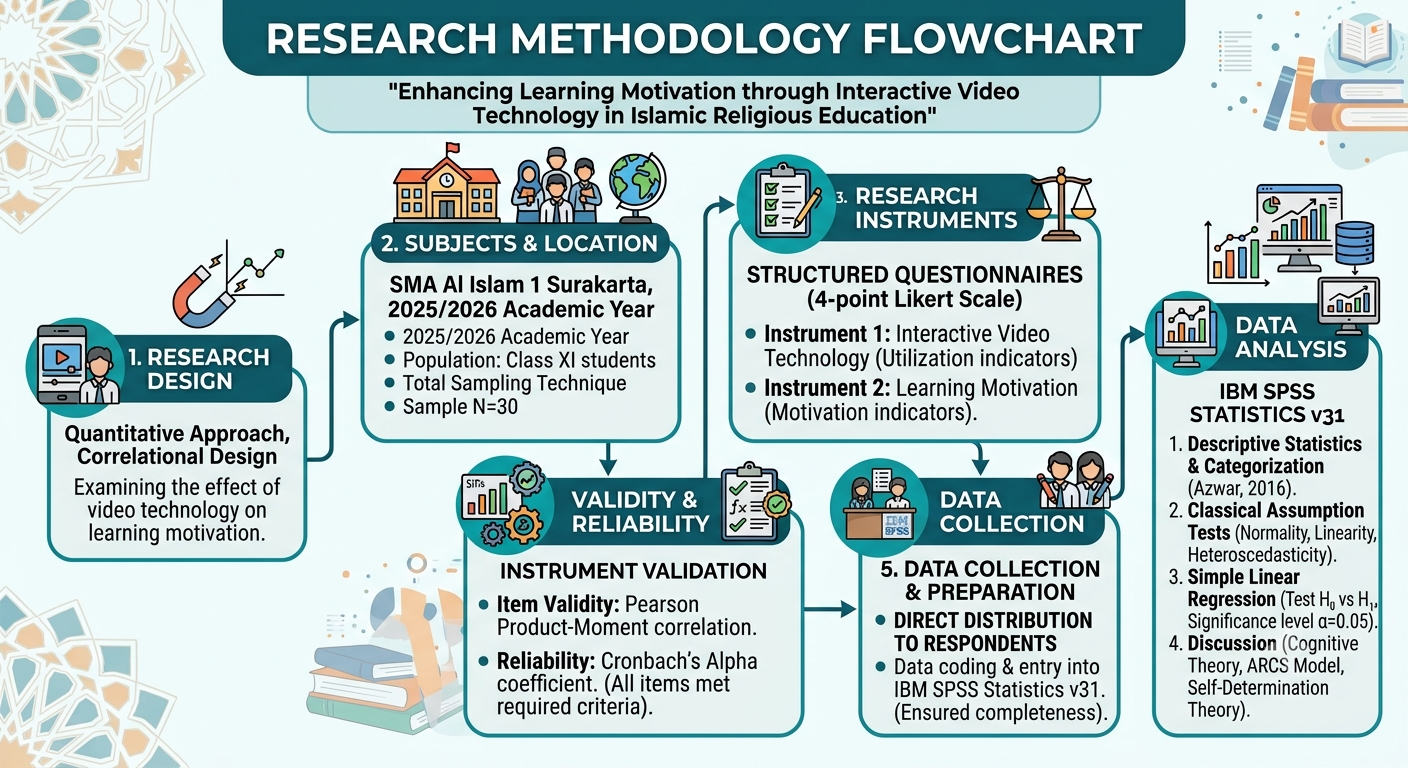
This study is motivated by the limited empirical research on the use of interactive video-based learning technology in Islamic Religious Education (IRE), despite its potential contribution to enhancing students’ learning motivation in the digital era. The study aims to analyze the effect of interactive video-based learning technology on students’ learning motivation in Islamic Religious Education. The research adopts a quantitative correlational design, involving 30 eleventh-grade students of SMA Al Islam 1 Surakarta selected through a total sampling technique. Data were collected using structured questionnaires measuring the utilization of interactive video-based learning technology and students’ learning motivation. Prior to data collection, the instruments were tested for validity and reliability. The data were analyzed using descriptive statistics and simple linear regression with the assistance of IBM SPSS Statistics version 31. The findings reveal that both the utilization of interactive video-based learning technology and students’ learning motivation were categorized at a moderate level. Furthermore, the regression analysis indicates that interactive video-based learning technology has a positive and statistically significant effect on students’ learning motivation (p = 0.012 < 0.05), with a coefficient of determination (R²) of 0.206, indicating that interactive video technology contributes 20.6% to the variance in learning motivation. These findings support the Cognitive Theory of Multimedia Learning, which emphasizes the effectiveness of multimedia-based instruction in facilitating meaningful learning experiences. The study concludes that interactive video-based learning technology plays an important role in enhancing students’ learning motivation in Islamic Religious Education. The implications of this study include theoretical contributions to the literature on educational technology and Islamic education, as well as practical recommendations for teachers and schools to integrate interactive video learning into instructional practices. Additionally, future research is encouraged to investigate other factors influencing learning motivation and to involve larger and more diverse samples across educational settings
References
Abdillah, M. I., Hunaida, W. L., & Muqit, A. (2025). Digitalization of Islamic Education Learning through Interactive Educational Games. Edudeena: Journal of Islamic Religious Education, 9(1), 67–76.
AlShaikh, R., Al-Malki, N., & Almasre, M. (2024). The implementation of the cognitive theory of multimedia learning in the design and evaluation of an AI educational video assistant utilizing large language models. Heliyon, 10(3). https://doi.org/10.1016/j.heliyon.2024.e25361
Aulia, M. G., Ratnasari, D., & Aribah, L. (2025). Development of Islamic Religious Education Learning Videos in Elementary Schools Using Powtoon Software. Al-Mudarris (Jurnal Ilmiah Pendidikan Islam), 8(3), 581–598.
Awaliyah, I. N. (2024). Mathematics Learning Innovation: Interactive Learning Videos to Increase Student Learning Activity and Motivation. JPMI (Jurnal Pendidikan Matematika Indonesia), 10(1), 1–18.
Azwar, S. (2016). Reliabilitas dan validitas aitem. Buletin Psikologi, 3(1), 19–26.
Bali, C., Tasdelen, B., Bandi, S., & Zsidó, A. (2026). Understanding the cognitive cost of multimedia learning: effects of visual load and language proficiency. Cognitive Research: Principles and Implications, 11(1), 2. https://doi.org/10.1186/s41235-025-00699-2
Godsk, M., & Møller, K. L. (2025). Engaging students in higher education with educational technology. Education and Information Technologies, 30(3), 2941–2976. https://doi.org/10.1007/s10639-024-12901-x
Herawati, E. T. H., Rukajat, A., Mansyur, M. H., & Kejora, M. T. B. (2025). Learning Islamic Religious Education Based On Local Wisdom Assisted By Animated Videos In Increasing The Learning Motivation Of Elementary School Students. Journal of Innovation and Research in Primary Education, 4(3), 1871–1881.
Howard, J. L., Bradshaw, E. L., & Ryan, R. M. (2026). Future directions for self-determination theory: Introduction to the special issue. Motivation and Emotion, 50(1), 1–12. https://doi.org/10.1007/s11031-025-10160-y
Keller, J. M. (2009). Motivational Design for Learning and Performance: The ARCS Model Approach. Springer US.
Krastiana. (2025). Increasing Students’ Interest and Motivation to Learn in Islamic Religious Education Learning through the Use of Interactive Videos at MA Al-Hidayah Makassar. ETNOPEDAGOGI: Jurnal Pendidikan Dan Kebudayaan, 2(1), 330–338.
Mayer, R. E. (2020). Multimedia Learning (3rd ed.). Cambridge University Press. https://doi.org/DOI: 10.1017/9781316941355
Mayer, R. E. (2024). The Past, Present, and Future of the Cognitive Theory of Multimedia Learning. Educational Psychology Review, 36(1), 8. https://doi.org/10.1007/s10648-023-09842-1
Muhammad, D. H., Turrohmah, B. M., Pramudita, A., Wardhani, M. K., Aisyah, S., Alatise, T., & Alsokari, T. (2025). The Effect of Implementing Interactive Video-Based E-Learning on Motivation to Learn the Arba’in Nabawi Hadith. JERIT: Journal of Educational Research and Innovation Technology, 2(2), 83–93.
Mukaromah, N., & Cholil, N. K. (2025). Level Up Pembelajaran Melalui Pendampingan Guru Dalam Pengembangan Game Edukatif Berbasis Gimkit Dan Quizwhizzer. Asskruie: Jurnal Pengabdian Kepada Masyarakat, 2(2), 39–46.
Mukaromah, N., Zidan, M. F., & Sabil, A. N. (2025). Transformasi Pembelajaran Haji di MTs Melalui Multimedia Interaktif Berbasis Canva dan Quizziz. Janitra: Journal of Educational Sciences, 1(1), 53–67.
Nurdin, N., Anhusadar, L., Lubis, M., Hadisi, L., & Rijal, M. (2024). Beyond the chalkboard: Digital innovations in islamic learning through interactive powerpoint. Jurnal Ilmiah Peuradeun, 12(3), 1099–1128.
Pasaribu, M. M., Sormin, D., & Lubis, J. N. (2025). Efforts To Increase Students’ Learning Motivation Through Audio-Visual Media. Tafkir: Interdisciplinary Journal of Islamic Education, 6(3), 601–618.
Pérez-Juárez, M. Á., González-Ortega, D., & Aguiar-Pérez, J. M. (2023). Digital distractions from the point of view of higher education students. Sustainability, 15(7), 6044.
Prihantoro, M. T., Pratama, Z. A., & Suparmi, S. (2025). The Effect of Animated Video Media Therapy on Enhancing University Students’ Learning Motivation. International Journal of Counseling and Psychotherapy, 2(3), 116–123.
Rohmiati, E. (2025). The use of digital media in learning Islamic religious education: Opportunities and challenges. Urwatul Wutsqo: Jurnal Studi Kependidikan Dan Keislaman, 14(1), 33–45.
Ryan, R. M., & Deci, E. L. (2000). Self-determination theory and the facilitation of intrinsic motivation, social development, and well-being. American Psychologist, 55(1), 68.
Ryan, R. M., & Deci, E. L. (2020). Intrinsic and extrinsic motivation from a self-determination theory perspective: Definitions, theory, practices, and future directions. Contemporary Educational Psychology, 61, 101860. https://doi.org/10.1016/j.cedpsych.2020.101860
Sandjaya, A. (2025). Utilization of YouTube Media in Islamic Religious Education Learning. Civic Engagement and Social Education Journal, 2(2), 250–255.
Sardiman, A. M. (2018). Interaksi dan Motivasi Belajar Mengajar. Rajawali Pers.
Shen, H., Ye, X., Zhang, J., & Huang, D. (2024). Investigating the role of perceived emotional support in predicting learners’ well-being and engagement mediated by motivation from a self-determination theory framework. Learning and Motivation, 86, 101968. https://doi.org/https://doi.org/10.1016/j.lmot.2024.101968
Trajaya, T., Wijaya, T., Nugroho, A. M. A., Pratama, W. D. J., & Febriani, E. (2025). The Role of Interactive Learning Media in Improving Students’ Learning Motivation of Islamic Education. International Journal Corner of Educational Research, 3(3), 163–167.
Truss, A., McBride, K., Porter, H., Anderson, V., Stilwell, G., Philippou, C., & Taggart, A. (2024). Learner engagement with instructor-generated video. British Journal of Educational Technology, 55(5), 2192–2211. https://doi.org/https://doi.org/10.1111/bjet.13450
Uno, H. B. (2023). Teori motivasi dan pengukurannya: Analisis di bidang pendidikan. Bumi Aksara.
Wang, Y., Wang, H., Wang, S., Wind, S. A., & Gill, C. (2024). A systematic review and meta-analysis of self-determination-theory-based interventions in the education context. Learning and Motivation, 87, 102015. https://doi.org/https://doi.org/10.1016/j.lmot.2024.102015
Waxman, J. B., & Goldie, S. J. (2023). Cognitive Theory of Multimedia Learning; Applying cognitive load theory to the design of educational multimedia.
Widodo, A. A., Husni, M., Al, U., & Malang, Q. (2025). Strategi Digitalisasi Pendidikan Pesantren Dalam Internalisasi Nilai Aswaja Bagi Generasi Z di Era Teknologi. Ihsan: Jurnal Pendidikan Islam, 3(1), 375–386.
Yang, Y., Chen, J., & Zhuang, X. (2025). Self-determination theory and the influence of social support, self-regulated learning, and flow experience on student learning engagement in self-directed e-learning. Frontiers in Psychology, Volume 16-2025.
Published
How to Cite
Issue
Section
License
Copyright (c) 2026 Zahwatus Syahidah, Ngatmin Abbas, Arif Effendi

This work is licensed under a Creative Commons Attribution-ShareAlike 4.0 International License.