Reassessing the Assumed Relationship Between Religious Practice and Student Leadership Character in Islamic Boarding Schools
Authors
-
 Mar’atus Sholihah
Institut Islam Mamba’ul ‘Ulum Surakarta, Indonesia
Mar’atus Sholihah
Institut Islam Mamba’ul ‘Ulum Surakarta, Indonesia
-
Isfihani Isfihani
Institut Islam Mamba’ul ‘Ulum Surakarta, Indonesia
-
Iffah Mukhlisah
Institut Islam Mamba’ul ‘Ulum Surakarta, Indonesia
DOI:
https://doi.org/10.55757/ashlach.v4i01.744Keywords:
Islamic religious education, leadership character, islamic boarding school, character education; religious practiceAbstract
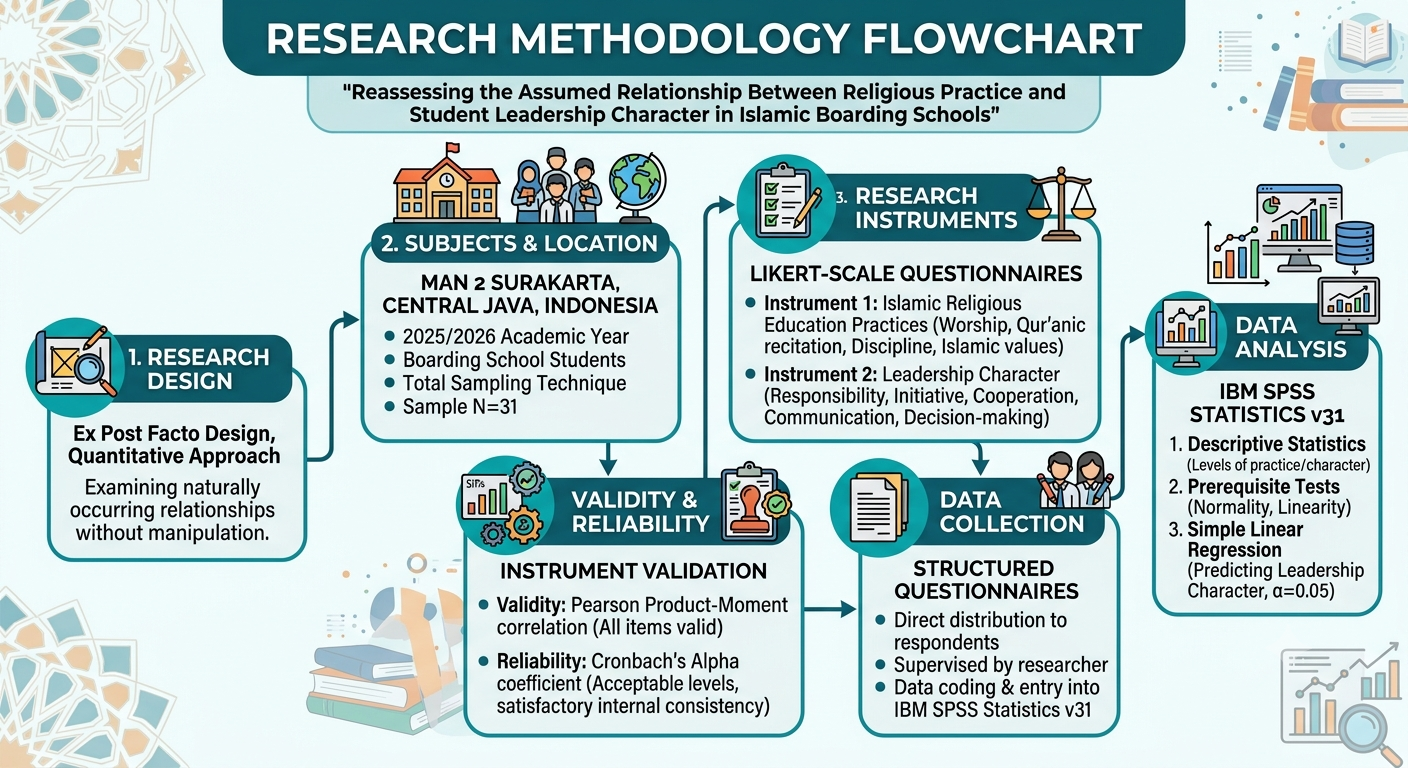
This study is motivated by the limited research on the relationship between Islamic Religious Education practices and leadership character, despite the widespread assumption that religious commitment contributes positively to students’ character development within Islamic educational institutions. The study aims to analyze the relationship between Islamic Religious Education practices and leadership character among students in a boarding school context. The research adopts a quantitative ex post facto design, with a sample of 31 students enrolled in the boarding school program at MAN 2 Surakarta selected through a total sampling technique. Data were collected using structured questionnaires measuring religious practice and leadership character and analyzed through descriptive statistics and simple linear regression using IBM SPSS Statistics 31. The findings reveal that students demonstrated relatively high levels of religious practice (M = 33.23) and positive leadership character (M = 18.29). However, the regression analysis indicated that Islamic Religious Education practices did not significantly predict leadership character (β = 0.060, *p* = 0.749; R² = 0.004). These findings challenge the commonly accepted assumption that stronger religious practice necessarily leads to stronger leadership character and instead support leadership development theories emphasizing the importance of experiential learning, social participation, and organizational involvement. The study concludes that religious practice functions primarily as a moral foundation rather than a direct determinant of leadership character. The implications encompass theoretical contributions by extending the literature on Islamic education, character education, and youth leadership development, as well as practical recommendations for Islamic boarding schools to integrate religious formation with structured leadership experiences through student organizations, mentoring programs, and leadership-based activities. Additionally, this study identifies future research opportunities involving broader samples, additional explanatory variables, and mixed-method approaches to better understand leadership character development in Islamic educational settings.
References
Arthur, J., Kristjánsson, K., & Walker, D. (2021). The Routledge international handbook of character education. Routledge.
Astuti, L., & Winarti, A. (2026). Moral Education in Islamic Boarding Schools for Shaping the Social Character of Adolescents. Al-Hayat: Journal of Islamic Education, 10(1), 20–36.
Azahar, R., Syahri, A., Indah, N., & Irawati, F. (2025). STUDENT LEADERSHIP DEVELOPMENT: INTEGRATING POTENTIAL, KNOWLEDGE, AND LOYALTY. As-Sulthan Journal of Education, 2(1), 89–102.
Berkowitz, M. W., & Bier, M. C. (2007). What Works In Character Education. Journal of Research in Character Education, 5(1), 29–48. https://doi.org/10.1108/CE-02-2007-0002
Chadijah, Kasim, A., Achruh, A., & Syamsudidin. (2026). INTEGRATING RELIGIOUS VALUES INTO CHARACTER EDUCATION: EVIDENCE FROM AN ISLAMIC MADRASAH IN INDONESIA. Multidisciplinary Indonesian Center Journal (MICJO), 3(1), 1319–1339.
Damon, W. (2008). The Path to Purpose: Helping Our Children Find Their Calling in Life. Free Press.
Day, D. V, Riggio, R. E., Tan, S. J., & Conger, J. A. (2021). Advancing the science of 21st-century leadership development: Theory, research, and practice. The Leadership Quarterly, 32(5), 101557. https://doi.org/https://doi.org/10.1016/j.leaqua.2021.101557
Dian, D., Hidayatulloh, R., Riyanti, T., & Aripin, J. (2024). The role of Kiai leadership in developing students’ character at Islamic boarding school. Al-Ishlah: Jurnal Pendidikan, 16(1), 234–246.
Geldhof, G. J., Bowers, E. P., Mueller, M. K., Napolitano, C. M., Callina, K. S., & Lerner, R. M. (2014). Longitudinal analysis of a very short measure of positive youth development. Journal of Youth and Adolescence, 43(6), 933–949. https://doi.org/10.1007/s10964-014-0093-z
Hadi, M. Y., & Prayogi, D. S. T. (2025). Managing Islamic school culture to develop students’ religious character. Journal of Educational Research and Practice, 3(2), 255–275.
Hamdan, M. H. A., & Helmi, A. M. (2026). KH. Nasihun Amin’s Leadership in Shaping Student Character. Journal of Islamic Education and Pesantren, 5(1), 1–11.
Hamid, E. A., & Bahari, M. F. Y. (2025). Management of Islamic-Based Character Education Implementation in Vocational Schools. Al-Hayat: Journal of Islamic Education, 9(3), 689–707.
Harahap, M. Y. (2025). Character Education for Islamic Boarding School Students through the Living Qur’an Approach Based on Technology Integration. Fitrah: Journal of Islamic Education, 6(2), 401–416.
Hardy, S. A., Nelson, J. M., Frandsen, S. B., Cazzell, A. R., & Goodman, M. A. (2022). Adolescent Religious Motivation: A Self-Determination Theory Approach. The International Journal for the Psychology of Religion, 32(1), 16–30. https://doi.org/10.1080/10508619.2020.1844968
Hidayat, Y., Manan, M., & Muslihun, M. (2025). Shaping The Religious Character Of Students From Fishermen Families Through Islamic Religious Education And Character Building. MUMTAZ: Jurnal Pendidikan Agama Islam, 5(2), 335–354.
Huda, N., Widodo, B. S., & Aseri, M. (2024). Strategies for Strengthening Character Education in Islamic Boarding Schools Through Extracurricular Activities. Munaddhomah: Jurnal Manajemen Pendidikan Islam, 5(3), 354–366.
Humaisi, M. S., & Thoyib, M. (2025). Charismatic Leadership in Improving the Quality of Islamic Boarding School Education. Al-Hayat: Journal of Islamic Education, 9(3), 662–677.
Kartiko, A., Rofiq, M. H., Fahmi, Q., & Samson, N.-A. T. (2026). Character education from the perspective of Islamic boarding school (pesantren): An implementative study. Fikroh: Jurnal Pemikiran Dan Pendidikan Islam, 19(1), 70–84.
Kholis, A. N., Taufiqurrahman, H., & Karimah, U. (2024). Leadership Development Program for Student Organizations at Islamic Boarding Schools. Proceeding of International Conference of Religion, Health, Education, Science and Technology, 1(1), 581–588.
King, P. E., & Boyatzis, C. J. (2015). Religious and spiritual development. Handbook of Child Psychology and Developmental Science, 3, 975–1021.
Kouzes, J. M., & Posner, B. (2012). The leadership challenge: How to make extraordinary things happen. Atlanta, GA: Better World Books.
Lerner, Richard M, Lerner, Jacqueline V, Almerigi, Jason B, Theokas, Christina, Phelps, Erin, Gestsdottir, Steinunn, Naudeau, Sophie, Jelicic, Helena, Alberts, Amy, Ma, Lang, Smith, Lisa M, Bobek, Deborah L, Richman-Raphael, David, Simpson, Isla, Christiansen, Elise DiDenti, & von Eye, Alexander. (2005). Positive Youth Development, Participation in Community Youth Development Programs, and Community Contributions of Fifth-Grade Adolescents: Findings From the First Wave Of the 4-H Study of Positive Youth Development. The Journal of Early Adolescence, 25(1), 17–71. https://doi.org/10.1177/0272431604272461
Muslim, M., Jannah, S., & Imroatun, I. (2025). Exploring Self-Leadership as a Predictor of Student Engagement in Religious Internship Programs. Tarbawi: Jurnal Keilmuan Manajemen Pendidikan, 11(03), 391–402.
Northouse, P. G. (2025). Leadership: Theory and practice. Sage publications.
Nucci, L. (2024). Domain-based moral education: Promoting moral wellness and the capacity for social justice. In Handbook of moral and character education (pp. 131–147). Routledge.
Nurhaliza, S., Ismail, I., Khairuddin, K., & Zakaria, N. B. (2024). Islamic Boarding School Leadership Strategy in Strengthening the Religious Character of Students in Darul Ihsan Islamic Boarding Schools of Aceh Besar. Jurnal Tarbiyatuna, 15(1), 1–14.
Pahrurroji, P. (2025). THE CHARACTER EDUCATION CURRICULUM IN ISLAMIC BOARDING SCHOOLS: A CASE STUDY OF MAN INSAN CENDEKIA SERPONG. Edukasi Islami: Jurnal Pendidikan Islam, 14(03), 865–882.
Sahin, A. (2018). Critical issues in islamic education studies: Rethinking islamic and western liberal secular values of education. Religions, 9(11). https://doi.org/10.3390/rel9110335
Susanto, F. A., Padil, M., Yasin, A. F., Syarifaturrahmatullah, S., Rifai, A. S., Hamzah, I., Bunayar, B., & Asy’arie, B. F. (2025). Educational Management in Islamic Boarding Schools: Enhancing Students’ Religious Character in Indonesian Senior High Schools. Al-Ishlah: Jurnal Pendidikan, 17(3), 5382–5397.
Tan, C. (2014). Educative tradition and Islamic schools in Indonesia. Journal of Arabic and Islamic Studies, 14, 47–62.
Published
How to Cite
Issue
Section
License
Copyright (c) 2026 Mar’atus Sholihah, Isfihani Isfihani, Iffah Mukhlisah

This work is licensed under a Creative Commons Attribution-ShareAlike 4.0 International License.