The Effect of YouTube-Based Learning Media on Students’ Achievement in Akidah Akhlak at the Madrasah Tsanawiyah Level
Authors
-
 Tien Azhari Ni’madina
Institut Islam Mamba’ul ‘Ulum Surakarta, Indonesia
Tien Azhari Ni’madina
Institut Islam Mamba’ul ‘Ulum Surakarta, Indonesia
-
Alfian Eko Rochmawan
Institut Islam Mamba’ul ‘Ulum Surakarta, Indonesia
-
Muhammad Fatchurrohman
Institut Islam Mamba’ul ‘Ulum Surakarta, Indonesia
DOI:
https://doi.org/10.55757/ashlach.v4i01.896Keywords:
YouTube media, Akidah Akhlak, learning outcomesAbstract
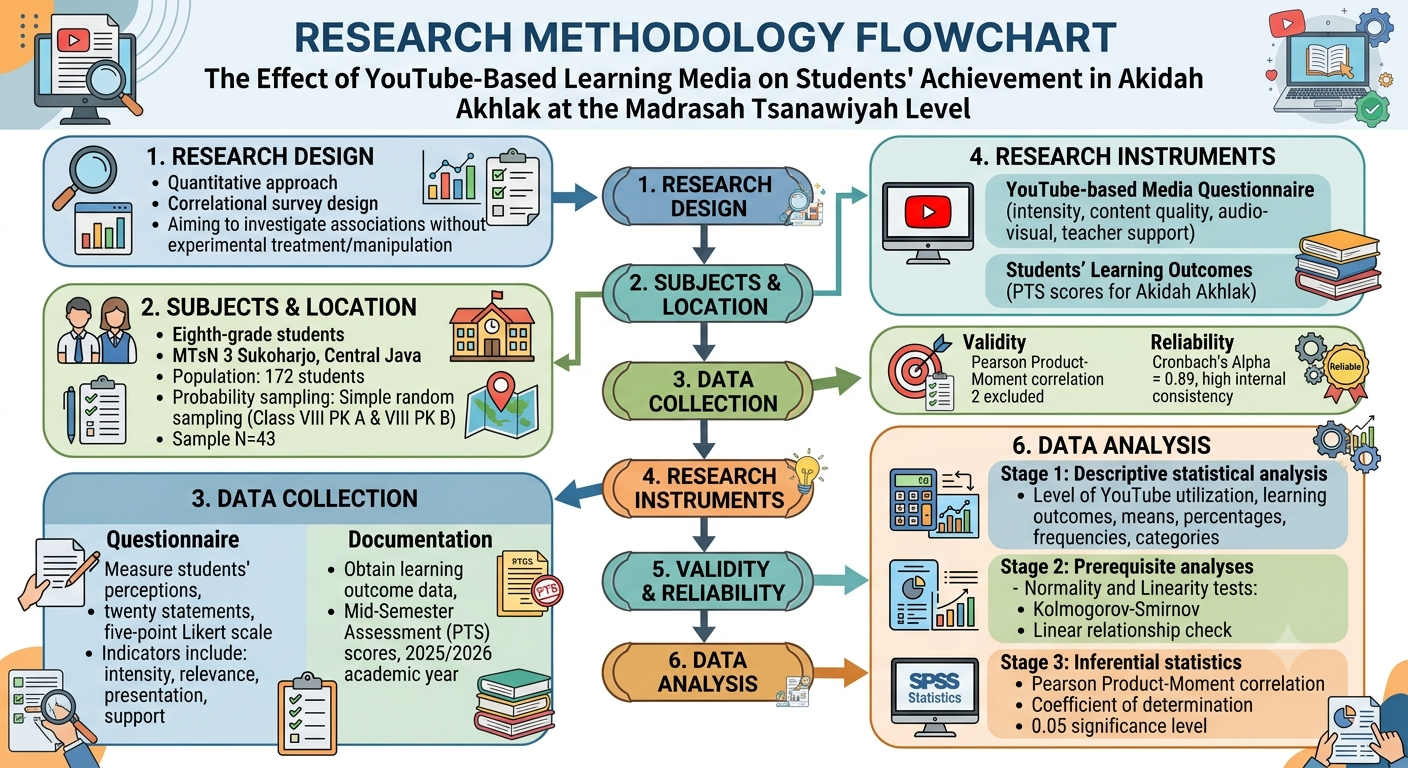
This study aims to analyze the effect of using YouTube media in Akidah Akhlak learning on the learning outcomes of eighth-grade students at MTsN 3 Sukoharjo, Indonesia, as a response to the growing need for digital learning media in religious education. The study employed a quantitative approach with a correlational survey design involving 43 students drawn from a total population of 172 students. Data were collected through a 20-item Likert-scale questionnaire to measure the use of YouTube media and through documentation of students’ midterm assessment scores. The data were then analyzed using descriptive statistics, a normality test, a linearity test, and Pearson Product-Moment correlation with the assistance of SPSS version 25. The results showed that the use of YouTube media was in the moderate category (70%), while students’ learning outcomes were also in the moderate category (60%). Statistical analysis indicated that there was no significant effect between the use of YouTube media and students’ learning outcomes, with a correlation value of r = -0.088 and a coefficient of determination of R² = 0.008, meaning that the use of YouTube media contributed only 0.78% to students’ learning outcomes. These findings suggest that, in the context of Akidah Akhlak learning, YouTube media functions more as a supporting learning medium than as a primary determinant of learning outcomes. Its effectiveness depends greatly on pedagogical integration, content relevance, and students’ readiness to engage in the learning process.
References
Abu-Taieh, E., AlHadid, I., Masa’deh, R., Alkhawaldeh, R. S., Khwaldeh, S., & Alrowwad, A. (2022). Factors Influencing YouTube as a Learning Tool and Its Influence on Academic Achievement in a Bilingual Environment Using Extended Information Adoption Model (IAM) with ML Prediction—Jordan Case Study. In Applied Sciences (Vol. 12, Issue 12, p. 5856). https://doi.org/10.3390/app12125856
Azizan, N., Lubis, M. A., & Muvid, M. B. (2020). Pemanfaatan media youtube untuk meningkatkan minat belajar siswa pada mata pelajaran akidah akhlak. Darul Ilmi: Jurnal Ilmu Kependidikan Dan Keislaman, 8(2), 195–212.
Beautemps, J., & Bresges, A. (2021). What Comprises a Successful Educational Science YouTube Video? A Five-Thousand User Survey on Viewing Behaviors and Self-Perceived Importance of Various Variables Controlled by Content Creators. Frontiers in Communication, Volume 5-2020. https://doi.org/10.3389/fcomm.2020.600595
Colás-Bravo, P., & Quintero-Rodríguez, I. (2023). YouTube as a Digital Resource for Sustainable Education. In Sustainability (Vol. 15, Issue 7, p. 5687). https://doi.org/10.3390/su15075687
Egenza, M. M., Hetilaniar, H., & Amirudin, A. (2024). Pengaruh Penggunaan Media Youtube Terhadap Hasil Belajar Siswa Pada Pembelajaran IPA Kelas V di SD Negeri 13 Palembang. EduTech: Jurnal Ilmu Pendidikan Dan Ilmu Sosial, 10(2), 393–398.
Greeves, S., & Oz, M. (2024). YouTube in higher education: comparing student and instructor perceptions and practices. Frontiers in Education, Volume 8-2023. https://doi.org/10.3389/feduc.2023.1330405
Halilintar, R., & Nadlif, A. (2025). EFEKTIVITAS PEMBELAJARAN AKIDAH AKHLAK DENGAN MEDIA YOUTUBE DALAM PEMBENTUKAN KARAKTER SISWA DI MI DARUSSALAM. Pendas: Jurnal Ilmiah Pendidikan Dasar, 10(03), 1–18.
Haryanto, A. T. (2024). APJII Jumlah Pengguna Internet Indonesia Tembus 221 Juta Orang. Detikinet.
Kohler, S., & Dietrich, T. C. (2021). Potentials and Limitations of Educational Videos on YouTube for Science Communication. Frontiers in Communication, Volume 6-2021. https://doi.org/10.3389/fcomm.2021.581302
Mawarni, E. W., Sulistyarini, S., Karolina, V., Ulfah, M., & Barella, Y. (2024). The Impact of YouTube as an Interactive Social Studies Learning Platform for 7th Grade Students at Junior High School. Edunesia: Jurnal Ilmiah Pendidikan, 5(3), 1371–1382.
Nashiruddin. (2024). The Use of Youtube Video Media to Improve Student Learning Outcomes in Islamic Education Learning at SMA Negeri 5 Padang. KOGNITIF: Jurnal Ilmiah Pendidikan Dan Keguruan, 1(2), 65–71.
Oktiana, H. (2021). Pengaruh Media Video Youtube Terhadap Motivasi Belajar Dan Hasil Belajar Pendidikan Agama Islam (PAI) Di SMP Negeri 20 Kota Bengkulu. An-Nizom: Jurnal Penelitian Manajemen Pendidikan Islam, 6(2).
Putry, H. M. E., Nuzulul’Adila, V., Sholeha, R., & Hilmi, D. (2020). Video based learning sebagai tren media pembelajaran di era 4.0. Tarbiyatuna: Jurnal Pendidikan Ilmiah, 5(1), 1–24.
Ratnawati, F., Telaumbanua, S., & Sembiring, Y. B. (2024). The Influence of Youtube Media on Writing Short Story Texts in Class VI Students of SD Negeri 2 Percontohan Blangkejeren. Seloka: Jurnal Pendidikan Bahasa Dan Sastra Indonesia, 13(1), 53–58.
Simon Kemp. (2024). Digital 2024: Indonesia.
Sutarti, T., & Astuti, W. (2021). Dampak media youtube dalam proses pembelajaran dan pengembangan kreatifitas bagi kaum milenial. Widya Aksara: Jurnal Agama Hindu, 26(1), 89–101.
Wulandari, A. R., Masturi, M., & Fakhriyah, F. (2021). Pengaruh media pembelajaran berbasis youtube terhadap hasil belajar IPA siswa di sekolah dasar. Edukatif: Jurnal Ilmu Pendidikan, 3(6), 3779–3785.
Zartiyana, N., Agustina, M., & Hasan, K. (2023). Youtube as a Learning Media Islamic Education. Al-Mudarris (Jurnal Ilmiah Pendidikan Islam), 6(2), 171–190.
Published
How to Cite
Issue
Section
License
Copyright (c) 2026 Tien Azhari Ni’madina, Alfian Eko Rochmawan, Muhammad Fatchurrohman

This work is licensed under a Creative Commons Attribution-ShareAlike 4.0 International License.