Menggugat Olahraga Modern: Studi Etnografi Kualitatif Revitalisasi Permainan Tradisional Madura Sebagai Media Pembentuk Karakter Orisinal Non-Digital Siswa
Authors
-
 Dyas Andry Prasetyo
Universitas PGRI Sumenep, Indonesia
Dyas Andry Prasetyo
Universitas PGRI Sumenep, Indonesia
-
Mas Odi
Universitas PGRI Sumenep, Indonesia
DOI:
https://doi.org/10.55757/cejou.v6i2.1721Keywords:
Etnografi kualitatif, Karakter orisinal, Permainan tradisional Madura, Psikomotorik, RevitalisasiAbstract
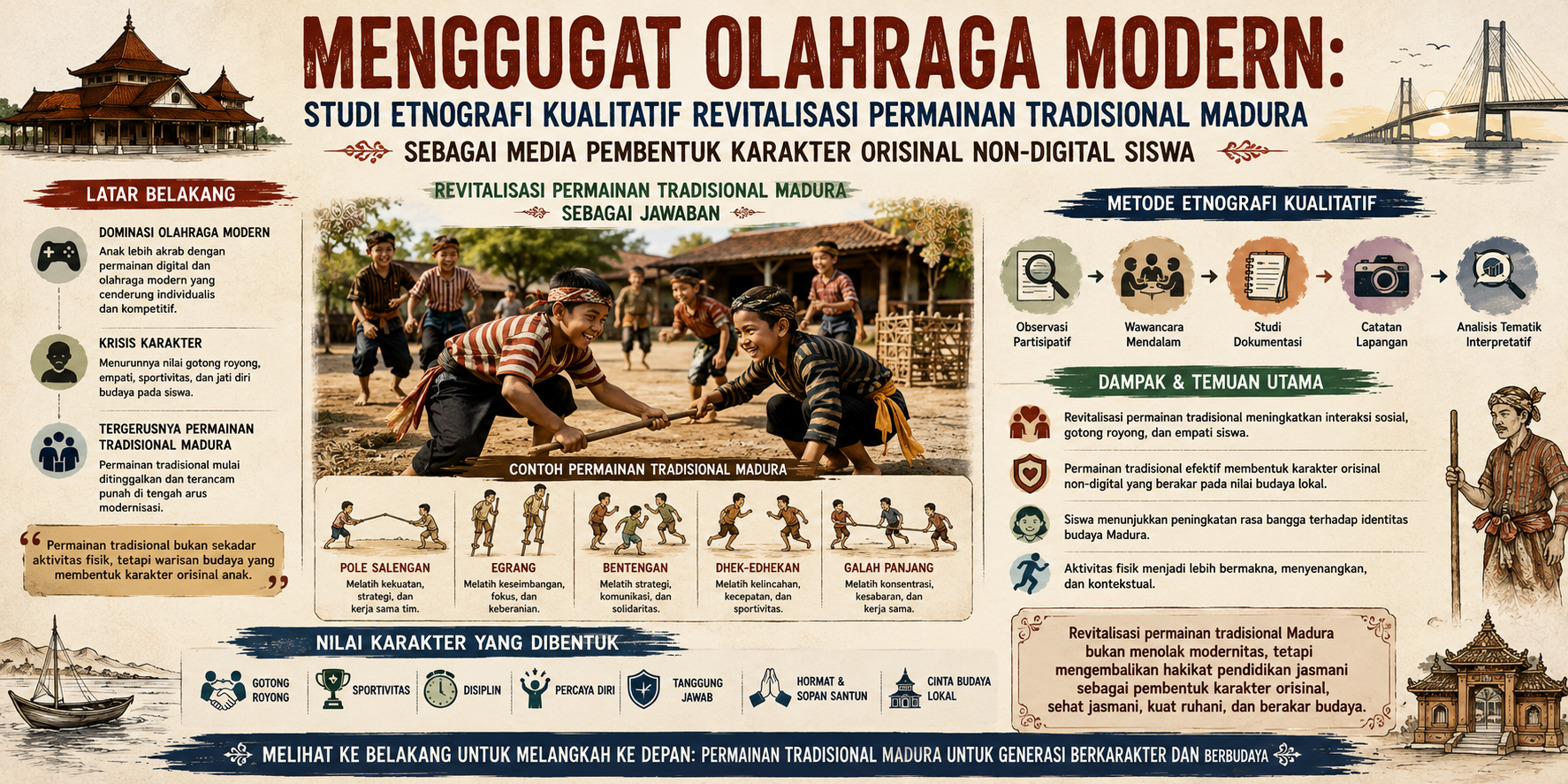
Di era digital dan kecerdasan buatan saat ini, pembentukan karakter orisinal non-digital serta keterampilan motorik otentik menjadi sangat krusial bagi siswa. Revitalisasi permainan tradisional dipandang sebagai strategi pengajaran yang efektif, kreatif, dan menarik untuk mengimbangi dominasi gawai. Selama ini, penelitian lebih banyak berfokus pada modernisasi olahraga berbasis teknologi, sehingga penelitian ini hadir untuk mengevaluasi devaluasi nilai budaya serta dampak degradasi karakter sosial-afektif terhadap perilaku siswa. Penelitian ini bertujuan untuk mendekonstruksi hegemoni olahraga modern dan merevitalisasi permainan tradisional Madura sebagai media pembentuk karakter psikomotorik, kognitif, dan afektif siswa. Metode yang digunakan adalah studi etnografi kualitatif dengan desain deskriptif-analitis. Teknik pengumpulan data meliputi observasi partisipatif mendalam, wawancara klinis, dan dokumentasi, dengan cakupan interaksi sosial budaya siswa di lingkungan sekolah. Analisis data menerapkan model interaktif Miles dan Huberman, berbantuan perangkat lunak analisis data kualitatif NVivo untuk pengkodean temuan. Hasil penelitian menunjukkan bahwa revitalisasi permainan tradisional Madura memberikan dampak positif yang signifikan berupa penguatan scaffolding moral, kerja sama, ketangkasan fisik, dan regulasi emosi siswa. Karakter sosial bertindak sebagai variabel utama yang mempercepat internalisasi nilai etis, sementara ketergantungan gawai yang tinggi ditemukan tidak berpengaruh secara signifikan ketika siswa sepenuhnya terlibat dalam dinamika permainan fisik yang interaktif. Kesimpulannya, penelitian ini berimplikasi pada pentingnya integrasi kurikulum berbasis kearifan lokal sebagai media pemulihan karakter orisinal anak.
Downloads
References
Albalawee, N., & Fahoum, A. A. (2024). A novel legal analysis of Jordanian corporate governance legislation in the age of artificial intelligence. Cogent Business and Management, 11(1). https://doi.org/10.1080/23311975.2023.2297465
Ali, F., Singh, N., & Chauhan, S. S. (2025). The Smart Industrial Transformation: The Integration of Big Data, Artificial Intelligence (AI), Internet of Things (IoT), and Virtual Reality (VR) Technologies. Proceedings - 2025 5th International Conference on Internet of Things: Smart Innovation and Usage, IoT-SIU 2025. https://doi.org/10.1109/IOT-SIU65919.2025.11402773
Anggita, G. M., & Rachman, H. A. (2014). Pengaruh Aktivitas Bermain dan Perseptual Motorik Terhadap Keterampilan Motorik Siswa Sekolah Dasar Kelas Bawah. Jurnal Keolahragaan. https://journal.uny.ac.id/index.php/jolahraga/article/view/2612
Awad, K. R., Abbas, S. H., & Obed, M. K. (2023). Analysis of the relationship between some indicators of sustainable development and economic growth in Iraq for the period (2004-2020). Revenue Journal: Management and Entrepreneurship, 1(1), 15–21. https://doi.org/10.61650/rjme.v1i1.177
Balade, J., Rodríguez, C., & Jiménez, J. E. (2024). Curriculum-based Measurement for Early Writing Struggles in Kindergarten: A Systematic Review. Psicologia Educativa, 30(2), 101–110. https://doi.org/10.5093/psed2024a11
Basri, M. H., Prasetyo, D. A., & Mas’odi, M. (2024). Penerapan Game-Based Learning dalam Meningkatkan Keterampilan Motorik pada Calon Guru PJOK. Jurnal Penelitian Tindakan Kelas, 2(3), 172–184.
Basri, M. H., Prasetyo, D. A., & Mas’odi, M. (2025a). Integrasi Karapan Pesapean dalam Pembelajaran PJOK untuk Pengembangan Keterampilan Berpikir Kritis. Jurnal Penelitian Tindakan Kelas, 3(1), 01–06. https://doi.org/10.61650/jptk.v3i1.786
Basri, M. H., Prasetyo, D. A., & Mas’odi, M. (2025b). Peran Karapan Pesapean dalam Mengembangkan Critical Thinking. Jurnal Penelitian Tindakan Kelas, 3(1), 172–184.
Bellibaş, M. Ş., Özgenel, M., & Bozkurt, A. (2026). Principals’ Artificial Intelligence Literacy and Leadership Self-Efficacy: The Technology Acceptance Model. Asia-Pacific Education Researcher, 35(3), 631–641. https://doi.org/10.1007/s40299-025-01059-w
Bormane, S., & Blaus, E. (2024). Artificial intelligence in the context of digital marketing communication. Frontiers in Communication, 9. https://doi.org/10.3389/fcomm.2024.1411226
Du, Q., Wei, Y., Ma, Y., Liu, C., Du, S., Zhang, Q., Gong, X., Yang, J., Li, Q., & Li, K. (2025). Efficacy of Virtual Reality–Based Interventions on Cognitive Function in Patients With Neuropsychiatric Disorders: Systematic Review and Meta-Analysis of Randomized Controlled Trials. In JMIR Serious Games (Vol. 13). https://doi.org/10.2196/67501
Dullah, M., Limgiani, L., & Suwardi, L. A. (2023). Work environment analysis to improve employee performance. Revenue Journal: Management and Entrepreneurship, 1(2). https://doi.org/10.61650/rjme.v1i2.328
Dzhugudzha, N. T., Uys, C. J. E., & Ramano, E. M. (2025). Current practices influencing school-to-work transition for learners with mild intellectual disability: A scoping review. South African Journal of Education, 45(2). https://doi.org/10.15700/saje.v45n2a2502
Edison, P. (2024). Brain Connectivity: A Journal of Clinical Neurology, Neuroscience, & Neuroimaging. Brain Connectivity, 14(1), 1–3. https://doi.org/10.1089/brain.2024.29059.editorial
Enns, J. E., Reid-Westoby, C., Detillieux, G. R., Brownell, M., Nickel, N. C., Gadermann, A., Guttmann, A., Bennett, T., Duku, E., Forer, B., Petteni, M. G., Georgiades, K., Guhn, M., Hanlon-Dearman, A., Poon, B. T., & Janus, M. (2025). Mental health disorders among children with special health needs: A population-based cohort study using linked administrative data from Manitoba, Canada. Plos One, 20(6 June). https://doi.org/10.1371/journal.pone.0326672
Fintz, H. (2024). Multicultural Education in a Divided Society: Perspectives of Jewish and Arab Kindergarten Teachers in Israel. Curriculum and Teaching, 39(1), 7–22. https://doi.org/10.7459/ct/390102
Firdausi, N., Fithriyah, N. N., Ummah, R., Abidin, M. A., Nirwana, R., Achmad, W., & Kuswanto, F. (2024). Integrating Smart Education in Basic Education: A Systematic Review of Roles and Challenges. 11th International Conference on ICT for Smart Society: Integrating Data and Artificial Intelligence for a Resilient and Sustainable Future Living, ICISS 2024 - Proceeding. https://doi.org/10.1109/ICISS62896.2024.10751462
Fitriana, L., Hendriyanto, A., Sahara, S., Muhaimin, L. H., Wintarti, A., Listiawan, T., Dwi Saputro, A., & Dewi, D. A. (2025). The Role of Digital Technology in the Design of Mathematics Teaching and Learning: A Systematic Literature Review. Journal of Educational Technology and Learning Creativity, 3(2), 282–297. https://doi.org/10.37251/jetlc.v3i2.2503
Guarrella, C., van Driel, J., & Cohrssen, C. (2023). Toward assessment for playful learning in early childhood: Influences on teachers’ science assessment practices. Journal of Research in Science Teaching, 60(3), 608–642. https://doi.org/10.1002/tea.21811
Haanurat, A. I., Vedianty, A. S. A., & Tollentino, S. A. (2023). Instagram’s impact on sharia economic law literacy in the digital age and Indonesia’s sharia economy strengthening. Revenue Journal: Management and Entrepreneurship, 1(2). https://doi.org/10.61650/rjme.v1i2.317
Hastert, M., Chrisman, M., Endsley, P., Skarbek, A., & Marchello, N. (2022). Familiarity and Use of MyPlate: An Online Focus Group Exploration Among Midwestern K–12 Teachers. Journal of Nutrition Education and Behavior, 54(12), 1125–1131. https://doi.org/10.1016/j.jneb.2022.08.017
Hima, M. (2025). Artificial Intelligence in the Albanian Educational System Current Developments, Applications, and Future Directions. Interdisciplinary Journal of Research and Development, 12(3), 186–194. https://doi.org/10.56345/ijrdv12n321
Huzaifah, A. S., & Adriansyah, R. A. F. (2024). Peningkatan Keterampilan Motorik Halus Terhadap Siswa TK Darul Ilmi Murni Melalui Kegiatan Merakit Robot Dengan Barang Bekas Sebagai Permainan Edukatif. Jurnal Pengabdian …. https://jurnal.aksaraglobal.co.id/index.php/jpbmi/article/view/357
Jennah, H., Astuti, C., Indraswari, N. F., & Weldani, F. (2023). Mental Profile of Petanque Provincial Sports Week Athletes Sumenep Seen from the Perspective of Imagery and Mental Self Talk. In Jurnal Pendidikan Olahraga (Vol. 6, Issue 1, pp. 118–123). https://scholar.google.com/citations?view_op=view_citation&hl=en&user=Flo5L6EAAAAJ&pagesize=100&citation_for_view=Flo5L6EAAAAJ:ufrVoPGSRksC
Jennah, H., Astutik, C., Indraswari, N. F., & Weldani, F. (2023). Profil Mental Atlet Pekan Olahraga Provinsi (Porprov) Vii Petanque Sumenep Dilihat Dari Perspektif Imagery Dan Self Talk. In Riyadhoh : Jurnal Pendidikan Olahraga (Vol. 6, Issue 1, p. 118). https://doi.org/10.31602/rjpo.v6i1.8131
Kearney, P. E. (2024). The adaptable coach – A critical review of the practical implications for traditional and constraints–led approaches in sports coaching: A commentary. International Journal of Sports Science and Coaching, 19(3), 1255–1261. https://doi.org/10.1177/17479541241247411
Khalaf, A. Z., & Hamad, S. Ben. (2023). An exploratory and analytical study of a sample of control and audit professionals’ opinions on green audit techniques and methods. Revenue Journal: Management and Entrepreneurship, 1(1), 1–4. https://doi.org/10.61650/rjme.v1i1.173
Lindsay, R. (2024). The adaptable coach – a critical review of the practical implications for traditional and constraints-led approaches in sport coaching. International Journal of Sports Science and Coaching, 19(3), 1240–1254. https://doi.org/10.1177/17479541241240853
Listyaningrum, P., Retnawati, H., Harun, & Ibda, H. (2025). Realistic Mathematics Education in Digital Era Elementary Schools: A Systematic Literature Review. International Journal on Advanced Science, Engineering and Information Technology, 15(1), 67–74. https://doi.org/10.18517/ijaseit.15.1.20123
Liu, X., & Jiang, X. (2025). Artificial Intelligence Generated Content Enabling Education Meta-Universe: Development Status and Path Optimization. Proceedings of The 2nd International Conference on Intelligent Education and Computer Technology, IECT 2025, 65–69. https://doi.org/10.1145/3764206.3764216
Lu, C. C., Lin, S. Y., & Wang, Y. C. (2022). An Immersive Hakka Learning System Using Human Centered Artificial Intelligence. Global Chinese Conference on Computers in Education Main Conference Proceedings (English Paper), 2022, 21–24. https://www.scopus.com/pages/publications/86000066610?origin=resultslist
Muthukrishnan, H., George, J. G., & Aggarwal, A. (2025). A Policy-Aware Framework for Data Masking: Secure Integration of Applications and Artificial Intelligence in Healthcare and Financial Services. Proceedings - 2025 International Seminar on Application for Technology of Information and Communication: Advancing Electrical Engineering and Informatics Through Quantum Computing and Intelligence Technologies, ISemantic 2025, 468–473. https://doi.org/10.1109/isemantic67418.2025.11291786
Nasirun, H., Mulyono, S., Hapsari, A. W. D., Wiradinata, H. H., & Ratu, M. (2026). Generative AI and intelligent tutoring systems in nursing education: A systematic review of impacts on higher-order thinking skills and clinical competency. Nurse Education in Practice, 93. https://doi.org/10.1016/j.nepr.2026.104847
Nicoletti, B., & Appolloni, A. (2023). Artificial Intelligence for the Management of Servitization 5.0. Sustainability (Switzerland), 15(14). https://doi.org/10.3390/su151411113
Niemir, M., Mrugalska, B., Grajewska, D., & Nitoń, B. (2025). LEVERAGING GENERATIVE ARTIFICIAL INTELLIGENCE FOR ENHANCING THE QUALITY OF PRODUCT DATA. Logforum, 21(3), 317–326. https://doi.org/10.17270/J.LOG.001164
Nuraisyah, W., Rasyid, A., Weldani, F., Prasetyo, D. A., & Firdauz, N. W. R. (2023). Efektivitas Model Pembelajaran Langsung, Kooperatif Tipe TGT Dan Media Audio Visual Terhadap Hasil Keterampilan Tendangan Lurus Pada Mata Kuliah Pencak Silat. In PENJAGA : Pendidikan Jasmani dan Olahraga (Vol. 3, Issue 2, pp. 33–43). https://doi.org/10.55933/pjga.v3i2.514
Patrick, P. M., Yip, S. Y., & Campbell, C. (2025). Artificial Intelligence and Higher-Order Thinking: A Systematic Review of Educator and Student Experiences and Perspectives in Higher Education. Higher Education Quarterly, 79(4). https://doi.org/10.1111/hequ.70069
Prasetyo, D. A. (2018). Buku Ajar Bolatangan. In Wineka Media. https://scholar.google.com/citations?view_op=view_citation&hl=en&user=9BgPsc8AAAAJ&pagesize=100&citation_for_view=9BgPsc8AAAAJ:2osOgNQ5qMEC
Prasetyo, D. A., Weldani, F., Basri, M. H., & Masodi, M. (2025). Mengenal Olahraga Bolatangan:(Pendekatan Teknik, Taktik, dan Peraturan Permainan). In UNU PASURUAN PRESS (Vol. 2, pp. 1–198). https://scholar.google.com/citations?view_op=view_citation&hl=en&user=9BgPsc8AAAAJ&pagesize=100&citation_for_view=9BgPsc8AAAAJ:J_g5lzvAfSwC
Prasetyo, D. A., Weldani, F., Masodi, M., & Basri, M. H. (2023). Transformasi Bolatangan Modern: Inovasi teknologi, Karakter Bangsa, dan strategi PJBL In Kurikulim Merdeka. In UNU PASURUAN PRESS (Vol. 1, pp. 1–150). https://scholar.google.com/citations?view_op=view_citation&hl=en&user=Flo5L6EAAAAJ&pagesize=100&citation_for_view=Flo5L6EAAAAJ:UebtZRa9Y70C
Puttajanyawong, N., Suamuang, W., & Chomsuwan, K. (2025). Utilizing Generative AI to Develop Programming Skill Through Self-Directed and Interactive Learning. In IEEE Global Engineering Education Conference, EDUCON. https://doi.org/10.1109/EDUCON62633.2025.11016488
Ren, C., Mustafa, Z. B., Li, B., & Zhang, G. (2024). Exploring digital learning environments to improve employability skills of vocational college students:The mediating role of artificial intelligence applications. ACM International Conference Proceeding Series, 162–168. https://doi.org/10.1145/3696952.3696975
Renta-Davids, A.-I., Camarero-Figuerola, M., & Camacho, M. (2025). Navigating the challenges and opportunities of artificial intelligence in educational leadership: A scoping review. Review of Education, 13(2). https://doi.org/10.1002/rev3.70101
Rosenboom, A. (2023). Marketing and Artificial Intelligence: Responsible Management (and Marketing) Education at the Nexus of Today and Tomorrow. In Humanism in Business Series: Vol. Part F4240 (pp. 115–137). https://doi.org/10.1007/978-3-031-15632-8_7
Safira, O. M., Endah, N. S., & Hasanah, M. (2022). Peningkatan keterampilan motorik halus melalui kegiatan menggunting pada siswa TK A. Altruis: Journal of …. https://ejournal.umm.ac.id/index.php/altruis/article/view/22997
Said, O., & Nahid, A. (2026). Adoption of artificial intelligence in human resource management: Systematic review and bibliometric analysis. Multidisciplinary Reviews, 9(10). https://doi.org/10.31893/multirev.2026510
Schmidt, H., Brandt, D., Bischof, A., Bischof, G., Sürig, S., Gürtler, D., Bläsing, D., Möhring, A., Meyer, C., Rehbein, F., Neumann, M., Dreißigacker, A., Haug, S., & Rumpf, H. J. (2023). App-Based Coaching to Prevent Addictive Behaviors among Young Adults: Study Protocol of a Cluster-Randomized Controlled Trial. Sucht, 69(2), 65–74. https://doi.org/10.1024/0939-5911/a000811
Sherfinski, M. (2023). “Confidence” problems and literacy coaching: How a suburban kindergarten divided “good” and “bad” teachers in the accountability shove-down. Journal of Early Childhood Literacy, 23(2), 288–316. https://doi.org/10.1177/1468798420980085
Spencer, D. (2024). The challenges of coaching non-traditional students in higher education: Applying a coaching intervention at a UK University. International Journal of Evidence Based Coaching and Mentoring, 22(1), 199–213. https://doi.org/10.24384/14c4-yj08
Stutz, D., de Assis, J. T., Laghari, A. A., Khan, A. A., Andreopoulos, N., Terziev, A., Deshpande, A., Kulkarni, D., & Grata, E. G. H. (2024). Enhancing Security in Cloud Computing Using Artificial Intelligence (AI). In Applying Artificial Intelligence in Cybersecurity Analytics and Cyber Threat Detection (pp. 181–220). https://doi.org/10.1002/9781394196470.ch11
Sudiantini, D., Rizky, P. P., & Hazarika, A. (2023). Digital economy and financial inclusion in reviving the national economy: A Management Strategy. Revenue Journal: Management and Entrepreneurship, 1(1). https://doi.org/10.61650/rjme.v1i1.245
Taefi, T. T., Lou, L., Reddy, D., Phan, J., Spree, U., Pellicer, J. L., Suutari, M., Kabel, P., Kuik, W., Yin, P., & Tropmann-Frick, M. (2025). Digital Transformation in Higher Education: Artificial Intelligence Tools, Pedagogical Practice, and Data Literacy Development. 2025 Annual IEEE Conference on Information Communication Technology and Society, ICTAS 2025 - Proceedings. https://doi.org/10.1109/ICTAS64866.2025.11155231
Tam, N. T., & Van, N. T. A. (2026). The Relationship Between Digital Transformation and Sustainable Performance: The Moderation Role of Artificial Intelligence Application. Lecture Notes in Electrical Engineering, 1530 LNEE, 779–792. https://doi.org/10.1007/978-981-95-6063-9_50
Terefe, A., Kant, S., Adula, M., & Gonfa, K. K. (2025). Reshaping Brand Interactions in the Experience-Driven Economy by Mediation of AI-Powered Marketing in the Horn of Africa. In Leveraging AI-Powered Marketing in the Experience-Driven Economy (pp. 181–202). https://doi.org/10.4018/979-8-3693-9561-5.ch006
Theodorakopoulos, L., & Theodoropoulou, A. (2026). Business Intelligence and Business Process Management in the Era of Generative AI: A Review of Big Data Analytics, Process Mining, and Decision Support Systems. Applied Sciences (Switzerland), 16(10). https://doi.org/10.3390/app16104603
Toker, Z., & Doğan, M. F. (2023). A Professional Development Model Proposal Including Lesson Supervision Practices: School-Based Reflective Mathematics Coaching. Milli Egitim, 52(238), 1475–1500. https://doi.org/10.37669/milliegitim.1138739
Tran, S. N., Anh, T. N., & Quynh, N. L. N. (2025). Consumer’s brand loyalty in the fashion shopping industry on e-commerce platforms: Understanding the role of artificial intelligence efforts. Edelweiss Applied Science and Technology, 9(5), 3046–3066. https://doi.org/10.55214/25768484.v9i5.7645
Tur, J. A., & González-Gross, M. (2025). School Plays a Crucial Role in Children’s Healthy Nutrition and Lifestyle. Nutrients , 17(13). https://doi.org/10.3390/nu17132169
Weldani, F., & Muhammad, H. N. (2015). Penerapan Terapi Nlp (Neuro Linguistic Programming) Untuk Menurunkan Kecemasan Dalam Melakukan Lompat Kangkang Pada Siswa Kelas X. In Jurnal Pendidikan Olahraga dan Kesehatan: Vol. Volume 03 (Issue 2, pp. 303–307). http://ejournal.unesa.ac.id/index.php/jurnal-pendidikan-jasmani/issue/archive303
Wilfred Blessing, N. R., Gunasekaran, H., Hariharan, B., Jabri, J. S. S. A., Kavitha, S. J., & Sutherlin Subitha, G. (2025). Artificial Intelligence in Health Care Computing and Assessments in Oman: an Effectual Study. 2nd International Conference on Machine Learning and Autonomous Systems, ICMLAS 2025 - Proceedings, 544–549. https://doi.org/10.1109/ICMLAS64557.2025.10968222
Wilson, D., & Richards, P. (2024). Building a case for coaching: informing an innovative, pedagogical approach to dancer development. Research in Dance Education, 25(3), 313–330. https://doi.org/10.1080/14647893.2022.2097656
Xiang, Y., Shi, H., Ren, K., Yang, X., Li, L., Zhao, Q., & Huang, H. (2026). An artificial intelligence application framework for nursing education: a scoping review based on the KAS model. BMC Medical Education, 26(1). https://doi.org/10.1186/s12909-026-09209-4
Yang, X., Qiao, X., & Wen, B. (2025). Beyond the Digital Cave: Reshaping Educational Values and Exploring Practical Pathways in the Era of Generative Artificial Intelligence. 2025 International Conference on Artificial Intelligence and Education, ICAIE 2025, 226–230. https://doi.org/10.1109/ICAIE64856.2025.11158117
Yuniwati, E. D., Darmayanti, R., & Karim, S. (2023). Is it feasible to establish a connection between cassava and rice in terms of their image? Revenue Journal: Management and Entrepreneurship, 1(2), 54–58. https://doi.org/10.61650/rjme.v1i2.271
Published
How to Cite
Issue
Section
License
Copyright (c) 2026 Dyas Andry Prasetyo, Mas Odi

This work is licensed under a Creative Commons Attribution-ShareAlike 4.0 International License.