Teori Aset dalam Perspektif Fiqih Islam dan Pengembangan Industri Halal
Authors
-
 M. Luthfillah Habibi
Universitas Islam Negeri Maulana Malik Ibrahim Malang, Indonesia dan Universitas Islam Negeri Sunan Ampel Surabaya, Indonesia
M. Luthfillah Habibi
Universitas Islam Negeri Maulana Malik Ibrahim Malang, Indonesia dan Universitas Islam Negeri Sunan Ampel Surabaya, Indonesia
-
Kasuwi Saiban
Universitas Merdeka Malang, Indonesia
-
Misbahul Munir
Universitas Islam Negeri Maulana Malik Ibrahim Malang, Indonesia
DOI:
https://doi.org/10.55757/tasharruf.v3i1.112Keywords:
Aset, Halal, Haram, FiqihAbstract
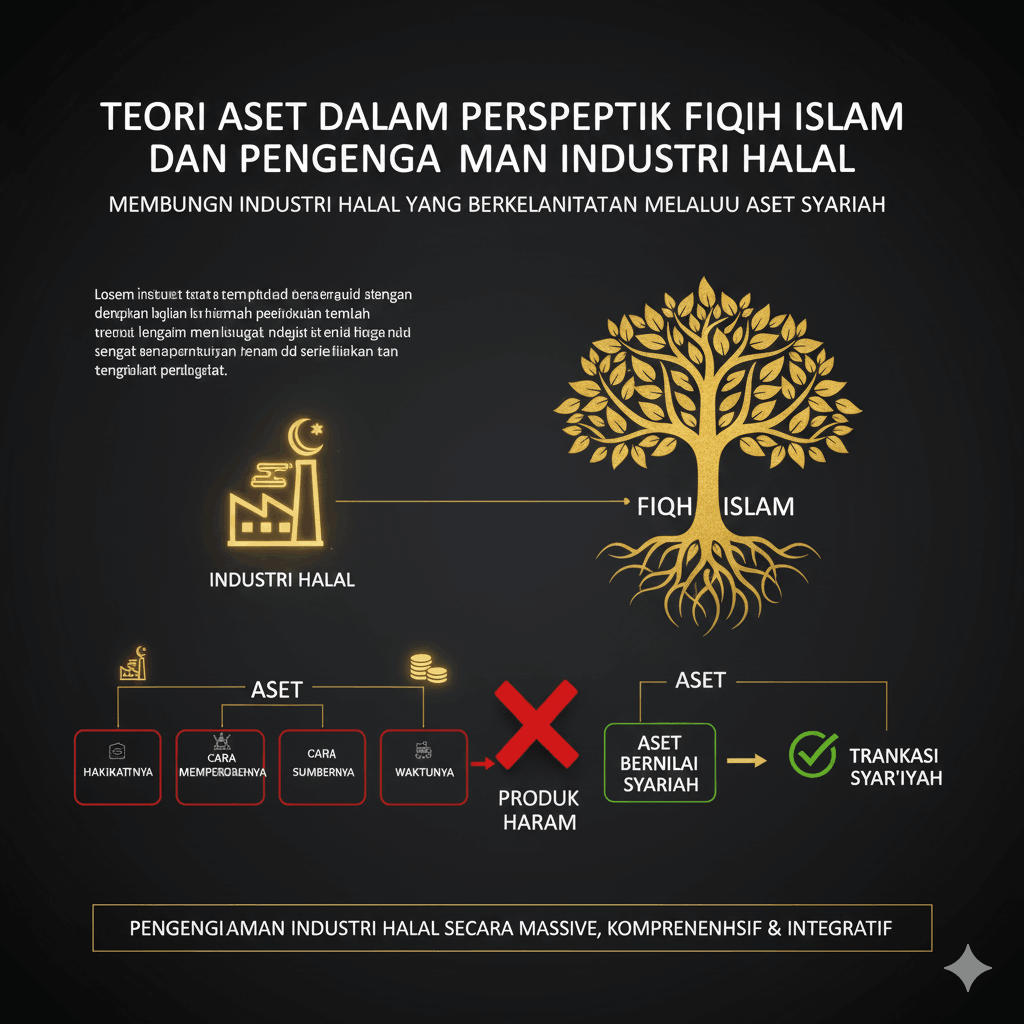
An understanding of assets from a sharia perspective is very important in relation to the halal industry. This is because assets are the object of the transaction as well as one of the pillars of ta'aqud which is the majority of the Intiqolul Milkiyah method. By looking at the urgency of understanding assets from a sharia perspective, this study attempts to conduct a study of assets to produce a systematic asset description. The method used is a literature study. Excavation of this asset description refers to the Qur'an, Al Hadith and books of fiqh to obtain depth of analysis. Finally, this research formulates that haram products are divided into four, namely from the aspect of its essence, how to get it, where to get it and when to get it. In addition, this study also formulates that only assets that have sharia value can be transacted with syar'iyah contracts. And understanding fiqh in relation to the development of the halal industry will greatly help the growth and development of the halal industry in a massive, comprehensive and integrative manner.
References
Curty, M. G. (2020). Planejamento da Expansão da Geração Considerando Aspectos da Programação Diária da Operação com Fontes Renováveis Intermitentes. UFRJ/COPPE/Programa de Engenharia Elétrica, 2(1).
Kusumanti, M., Ferse, S., & Glaser, M. (2021). Sustainable livelihoods frameworks in investigating household assets in Jakarta Bay, Indonesia. … , Aquarium, Conservation & …. https://search.proquest.com/openview/e61983c00a2721f7a8751f1eacb3e3bb/1?pq-origsite=gscholar%5C&cbl=2046424
Omar, S., Shah, S. R. A., & Pathan, H. (2020). Perceptions on Status of ‘Urdu’’ - the Pakistani National Language, in the UAE: Reflections on the Pakistani Diaspora.’ International Research Journal of Arts and Humanities, 48(48).
Romero-Lopez, A., Ramos, F., Ochoa, C. Y., Mataran, A., Olmo, R. M., Lopez, J. C. F. M., Fuentes-Guerra, R., Givens, G., Dunning, R., Michel-Villarreal, R., Vilalta-Perdomo, E. L., Hingley, M., Ruppen, S., Wolfgramm, B., Scheidegger, R., Bader, H. P., Kiss, K., Ruszkai, C., Szucs, A., … Trestini, S. (2020). MARKET RESEARCH ABOUT AGRISO MOBILE APPLICATION FOR FARMERS. SUSTAINABILITY, 12(1).
Skhosana, R. M. (2025). Harnessing local strengths: Asset-based community development and sustainable livelihoods in South Africa. Inkanyiso. https://doi.org/10.4102/ink.v17i1.151
Wajdi, M. B. N., Ekaningsih, L. A. F., Rizal, H. S., & Fathurrohman, A. (2024). Asset-Based Community Development. Engagement: Jurnal Pengabdian Kepada Masyarakat, 8(1), 308–325.
Downloads
Published
How to Cite
Issue
Section
License
Copyright (c) 2022 M. Luthfillah Habibi, Kasuwi Saiban, Misbahul Munir

This work is licensed under a Creative Commons Attribution-NonCommercial 4.0 International License.