Jejak Ekologi Sebagai Pendekatan Integratif Sustainable Development Goals (Sdgs) dan Green Economy di Indonesia
Authors
-
 Inud Danis Ikhwan Meranti
STAI Darul Ulum Banyuwangi
Inud Danis Ikhwan Meranti
STAI Darul Ulum Banyuwangi
-
Zainal Aris Masruchi
STAI Darul Ulum Banyuwangi
DOI:
https://doi.org/10.55757/tasharruf.v6i1.1148Keywords:
Ecological Footprint, Economic Growth, Green Economy, Sustainable Development GoalsAbstract
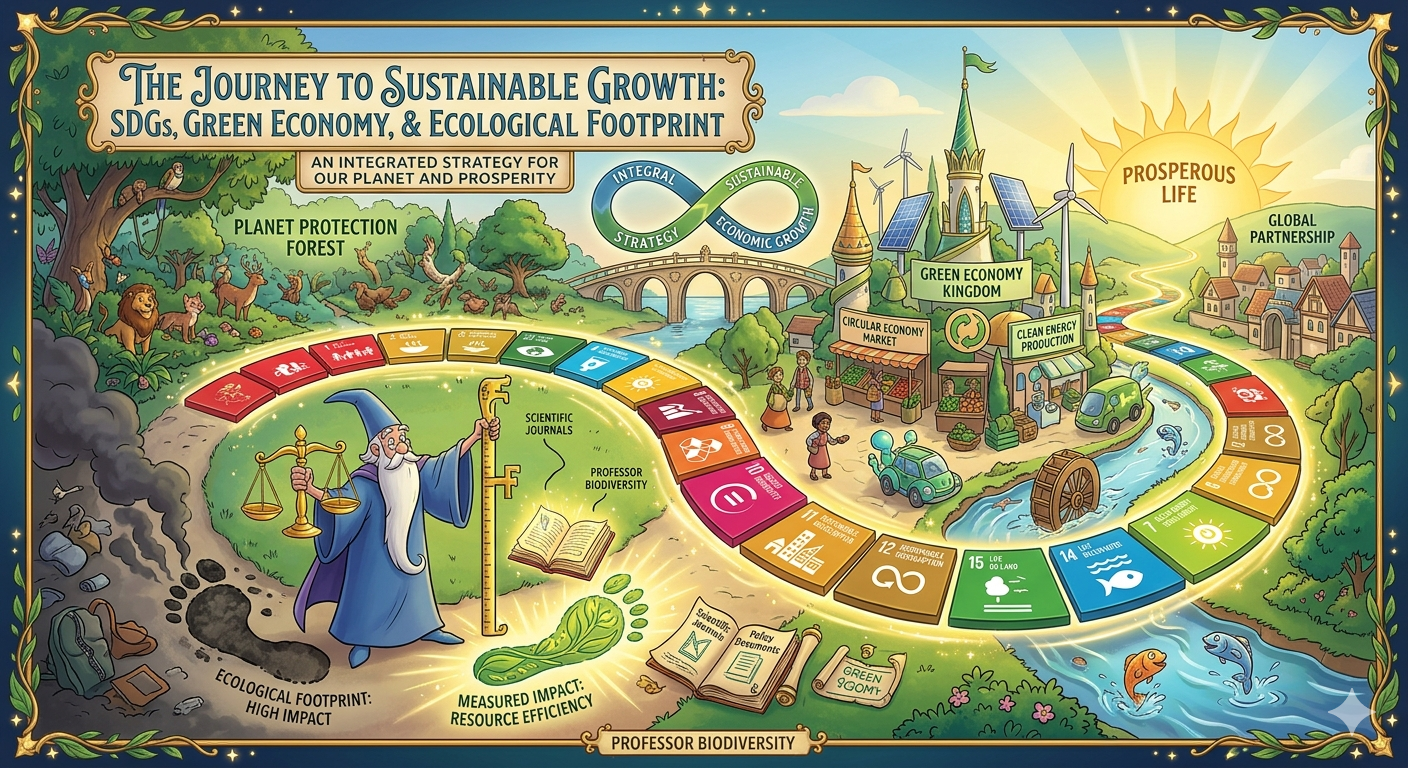
Sustainable Development Goals (SDGs) set a set of goals to end poverty, protect the planet, and ensure a peaceful and prosperous life for all. One of the important aspects in the integration of the SDGs with the concept of Green Economy is the role of ecological footprints. Ecological footprint refers to the impact of human activities on the environment, including the consumption of natural resources and waste production. In the context of the Green Economy, ecological footprint is an important indicator to measure the efficiency of natural resource use and the environmental impact of economic activities. This research uses relevant literature analysis and synthesis methods from various sources such as scientific journals, books, research reports, and policy documents. The Sustainable Development Goals (SDGs) with the concept of Green Economy, which is applied with an ecological footprint approach, are an integral strategy to achieve sustainable and environmentally friendly economic growth.
References
abduh, M. A., Budianta, D., Arinafril, A., & ... (2020). Linking Local Government
And Demographics To Ecological Footprint. Sriwijaya
Ahdiat, A. (2024). Realisasi Dan Target Bauran Ebt Indonesia (2018-2023).
Annur, C. M. (2023). Indonesia Penghasil Emisi Karbon Terbesar Kedua Dunia
Dari Sektor Alih Fungsi Lahan.
Chatenet, M. (2022). Water Electrolysis: From Textbook Knowledge To The Latest
Scientific Strategies And Industrial Developments. Chemical Society Reviews,
51(11), 4583–4762. Https://Doi.Org/10.1039/D0cs01079k
Depan, H. (N.D.). Green Economy. In Researchgate.Net.
Ferrari, A. J. (2024). Global Incidence, Prevalence, Years Lived With Disability
(Ylds), Disability-Adjusted Life-Years (Dalys), And Healthy Life Expectancy
(Hale) For 371 Diseases And Injuries In 204 Countries And Territories And
811 Subnational Locations, 1990–2021: A Systematic Analysis For The Global Burden Of Disease Study 2021. Lancet, 403(10440), 2133–2161.
Https://Doi.Org/10.1016/S0140-6736(24)00757-8
Haleem, A. (2022). Understanding The Role Of Digital Technologies In Education:
A Review. Sustainable Operations And Computers, 3, 275–285.
Https://Doi.Org/10.1016/J.Susoc.2022.05.004
Jiakui, C. (2023). Green Technological Innovation, Green Finance, And Financial
Development And Their Role In Green Total Factor Productivity: Empirical
Insights From China. Journal Of Cleaner Production, 382.
Https://Doi.Org/10.1016/J.Jclepro.2022.135131
Jiao, K. (2021). Designing The Next Generation Of Proton-Exchange Membrane
Fuel Cells. Nature, 595(7867), 361–369. Https://Doi.Org/10.1038/S41586-
021-03482-7
Klhk, D. P. (2022). Praktik Ekonomi Sirkular Yang Baik Terhadap Kualitas
Lingkungan Dan Kesehatan.
Kristianto, A. H. (2020). Sustainable Development Goals (Sdgs) Dalam Konsep
Green Economy Untuk Pertumbuhan Ekonomi Berkualitas Berbasis Ekologi.
Business, Economics
Laporan Kinerja Kementerian Lingkungan Hidup Dan Kehutanan. (2023).
Marganingrum, D. (2019). Jejak Ekologis Kawasan Regional Bandung Ecological
Footprint Of Bandung Regional Area. In Jurnal Teknologi Lingkungan ….
Download.Garuda.Kemdikbud.Go.Id.
Moreno, C. (2021). Introducing The “15-Minute City”: Sustainability, Resilience
And Place Identity In Future Post-Pandemic Cities. Smart Cities, 4(1), 93–
111. Https://Doi.Org/10.3390/Smartcities4010006
Nuringsih, K., Nuryasman, M. N., & Rosa, J. A. (2022). Mendorong Green
Entrepreneurial Intention Melalui Green Economy Dan Green Entrepreneurial
Orientation. Jurnal Ekonomi.
Pudianti, A., & Vitasurya, V. R. (2019). Pendekatan Antropologi Sebagai
Penyeimbang Model Perhitungan Jejak Ekologis Di Desa Wisata. Arteks:
Jurnal Teknik Arsitektur.
Ramadhan, I. (2023). Pengaruh Pertumbuhan Ekonomi, Konsumsi Energi, Inovasi
Teknologi, Dan Tik Terhadap Jejak Ekologis Di Asean-6 Tahun 2009-2018.
Eprints2.Undip.Ac.Id.
Supriatna, J. (2021). Pengelolaan Lingkungan Berkelanjutan. Books.Google.Com.
Van Dijk, M. (2021). A Meta-Analysis Of Projected Global Food Demand And
Population At Risk Of Hunger For The Period 2010–2050. Nature Food, 2(7),
494–501. Https://Doi.Org/10.1038/S43016-021-00322-9
Wicaksono, R. A. (2024). Hari Hutan Sedunia: Deforestasi Indonesia 2023 Capai
257 Ribu Ha.
Wilkinson, J. L. (2022). Pharmaceutical Pollution Of The World’s Rivers.
Proceedings Of The National Academy Of Sciences Of The United States Of
America, 119(8). Https://Doi.Org/10.1073/Pnas.2113947119
Yamin, M. (2023). Sustainable Development Goals Dalam Perspektif Intermestik
(Internasional Domestik). Repository.Unsoed.Ac.Id.
Zakari, A. (2022). Energy Efficiency And Sustainable Development Goals (Sdgs).
Energy, 239. Https://Doi.Org/10.1016/J.Energy.2021.122365
Published
How to Cite
Issue
Section
License
Copyright (c) 2026 Inud Danis Ikhwan Meranti, Zainal Aris Masruchi

This work is licensed under a Creative Commons Attribution-NonCommercial 4.0 International License.