Fintech Untuk Semua Menjembatani Kesenjangan Akses Keuangan di Pedesaan Indonesia 2025
Authors
-
 Nur Aima Shafie1
Universiti Teknologi MARA
Nur Aima Shafie1
Universiti Teknologi MARA
-
 Saiful Bakhri
Universitas Nahdlatul Ulama Pasuruan
Saiful Bakhri
Universitas Nahdlatul Ulama Pasuruan
-
Risa Umami
Universitas Nahdlatul Ulama Pasuruan
DOI:
https://doi.org/10.55757/tasharruf.v6i2.1153Keywords:
Financial Inclusion, MSMEs, Progressive Regulation, QRIS, Rural Fintech, Triple-HelixAbstract
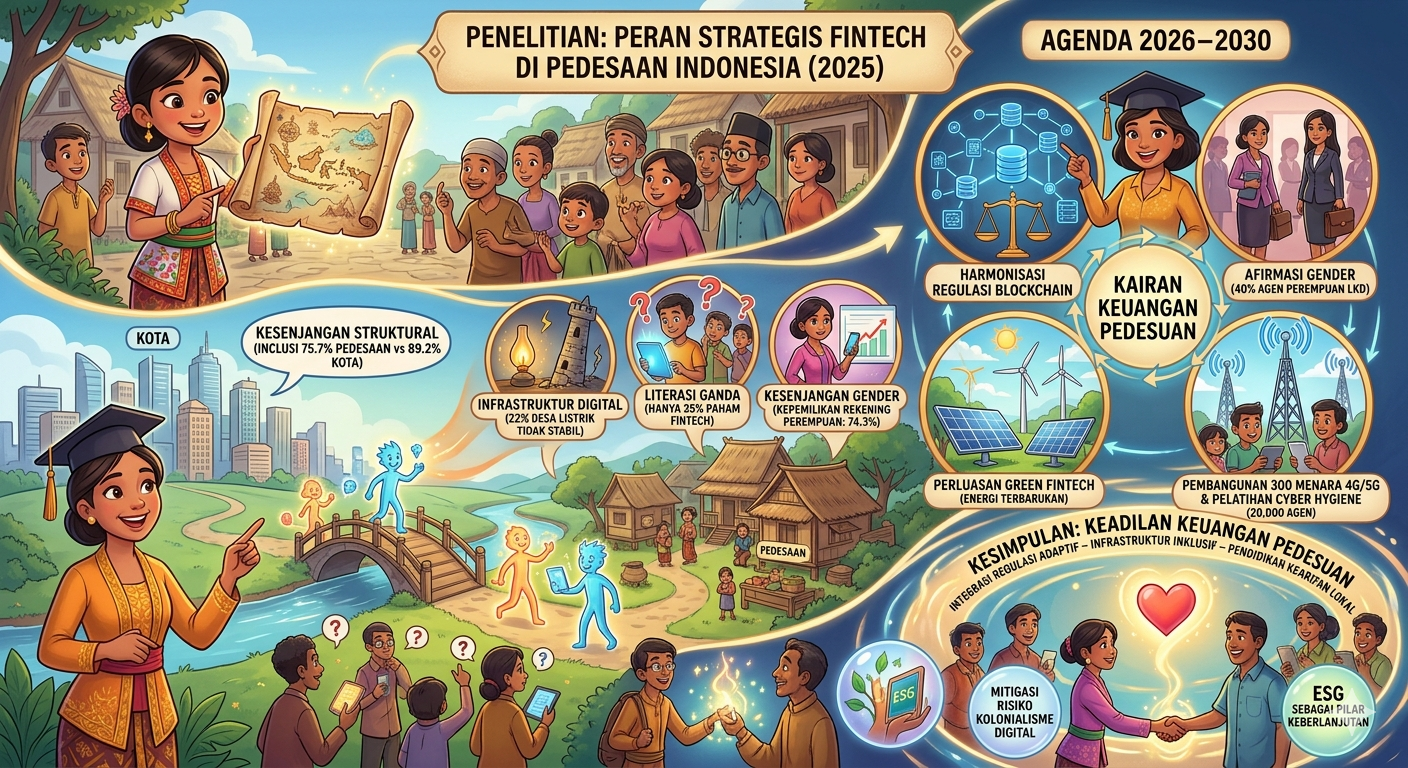
This study analyzes the strategic role of fintech in addressing the gap in access to rural finance in Indonesia in 2025, using a qualitative approach by applying the literature review method. Structural gaps remain critical (rural financial inclusion index: 75.7% vs urban 89.2%), triggered by a triad of digital infrastructure problems(22% of villages have unstable electricity), dual literacy (only 35% understand fintech products), and gender gap (female account ownership: 74.3%).Through a qualitative approach, the 2026-2030 Agenda focuses on regulatory harmonization.blockchain, gender affirmation (40% quota of female LKD agents), expansiongreen fintechfor renewable energy, as well as the construction of 300 4G/5G towers and trainingcyber hygiene20,000 agents. Research concludes that rural financial justice can only be achieved through the integration of adaptive regulation-inclusive infrastructure-local wisdom-based education,with risk mitigationdigital colonialism and ESG principles as pillars of sustainability.
References
Abimbola, S. (2021). Addressing power asymmetries in global health: Imperatives in the wake of the COVID-19 pandemic. Plos Medicine, 18(4). https://doi.org/10.1371/journal.pmed.1003604
Ahmad, M. (2021). Digital financial inclusion and economic growth: provincial data analysis of China. China Economic Journal, 14(3), 291–310. https://doi.org/10.1080/17538963.2021.1882064
Choiruddin, M. N. (2025). Financial Literacy, FinTech, and Contemporary Innovation in Islamic Economic Law: An Analysis of MSME Performance Sustainability in Indonesia and Malaysia. Milrev Metro Islamic Law Review, 4(2), 976–1008. https://doi.org/10.32332/milrev.v4i2.10164
Demir, A. (2022). Fintech, financial inclusion and income inequality: a quantile regression approach. European Journal of Finance, 28(1), 86–107. https://doi.org/10.1080/1351847X.2020.1772335
Ediagbonya, V. (2023). The role of fintech in driving financial inclusion in developing and emerging markets: issues, challenges and prospects. Technological Sustainability, 2(1), 100–119. https://doi.org/10.1108/TECHS-10-2021-0017
Hartatik. (2021). Go-Payment: Towards Cashless Payment System for Smart Village Application in Indonesia. 3rd International Conference on Cybernetics and Intelligent Systems Icoris 2021. https://doi.org/10.1109/ICORIS52787.2021.9649644
Hasan, M. (2021). How does financial literacy impact on inclusive finance? Financial Innovation, 7(1). https://doi.org/10.1186/s40854-021-00259-9
Hasan, M. (2023). Rural Consumers’ Financial Literacy and Access to FinTech Services. Journal of the Knowledge Economy, 14(2), 780–804. https://doi.org/10.1007/s13132-022-00936-9
Hidayat, M. S. (2022). Risiko Dan Mitigasi Bank Syariah.
Irma Yuliani, S.E., M. S. (2023). Manajemen Sumber Daya Manusia. In Sustainability (Switzerland) (Vol. 11, Issue 1).
Kass-Hanna, J. (2022). Building financial resilience through financial and digital literacy in South Asia and Sub-Saharan Africa. Emerging Markets Review, 51. https://doi.org/10.1016/j.ememar.2021.100846
Khoirudin, M. A., Shafrani, Shofwa, Y., Muliawati, N., Wildan, K., & Rinardi, A. I. (2024). Analisis Peran Bank Syariah Melalui Pelayanan Qris Dalam Pengembangan Pariwisata Halal. Jurnal Organisasi Dan Manajemen Indonesia, 3(1), 50–57.
Marhadi, M. (2024). Continuance intention of Fintech Peer-to-Peer (P2P) financing Shariah: Moderation role of brand schematicity and digital financial literacy. Journal of Open Innovation Technology Market and Complexity, 10(2). https://doi.org/10.1016/j.joitmc.2024.100301
Rufaidah, F. (2023). A Review of the Implementation of Financial Technology (Fintech) in the Indonesian Agricultural Sector: Issues, Access, and Challenges. International Journal of Financial Studies, 11(3). https://doi.org/10.3390/ijfs11030108
Sandhu, K. (2025). Fintech innovation for financial inclusion: can India make it? International Journal of Accounting and Information Management, 33(2), 268–286. https://doi.org/10.1108/IJAIM-07-2023-0168
Umar, U. H. (2025). Digital finance and SME financial inclusion in Africa. African Journal of Economic and Management Studies, 16(1), 18–33. https://doi.org/10.1108/AJEMS-08-2023-0323
Usman, M. (2021). Does financial inclusion, renewable and non-renewable energy utilization accelerate ecological footprints and economic growth? Fresh evidence from 15 highest emitting countries. Sustainable Cities and Society, 65. https://doi.org/10.1016/j.scs.2020.102590
Published
How to Cite
Issue
Section
License
Copyright (c) 2026 Nur Aima Shafie1, Saiful Bakhri, Risa Umami

This work is licensed under a Creative Commons Attribution-NonCommercial 4.0 International License.