Analisis Perilaku Konsumen Generasi Z dalam Pengambilan Keputusan Pembelian Melalui Media Sosial TikTok
Authors
-
 Ahmad Dzul Ilmi Syarifuddin
Institut Agama Islam Negeri Parepare
Ahmad Dzul Ilmi Syarifuddin
Institut Agama Islam Negeri Parepare
-
Ferri Alfadri
UIN Syekh Ali Hasan Ahmad Addary Padangsidimpuan
-
Ulfa Hidayati
Institut Agama Islam Negeri Parepare
DOI:
https://doi.org/10.55757/tasharruf.v7i1.1306Keywords:
Fenomenologi, Generasi Z, Keputusan Pembelian, Perilaku Konsumen, TikTokAbstract
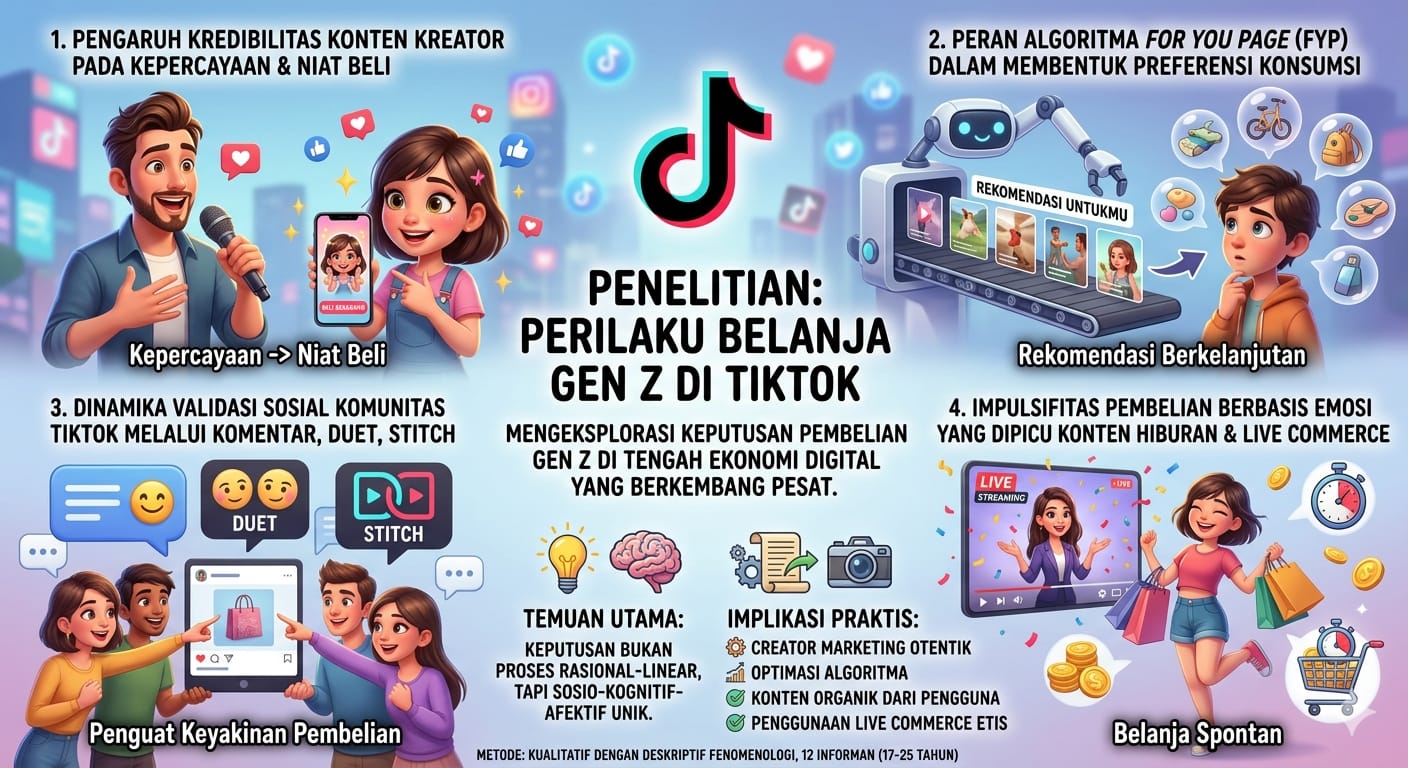
This study aims to explore the consumer behavior of Generation Z in purchase decision-making through TikTok social media amidst the rapidly evolving digital economy. Employing a qualitative approach with a descriptive phenomenological design, data were collected through semi-structured in-depth interviews with 12 purposive informants aged 17–25 years who are active TikTok users and have made purchases influenced by platform content. Data analysis was conducted using Interpretative Phenomenological Analysis (IPA) to uncover the essence of informants' lived experiences. Four interrelated themes emerged: first, the influence of content creator credibility on consumer trust and purchase intention; second, the role of the For You Page (FYP) algorithm in persistently shaping consumption preferences; third, the dynamics of TikTok community social validation through comments, duets, and stitches as purchase conviction reinforcers; and fourth, emotion-driven purchase impulsivity triggered by entertainment content and live commerce features. Findings affirm that Generation Z does not form purchasing decisions through a rational-linear process, but rather through a unique, complex socio-cognitive-affective process fundamentally distinct from prior generations. Practical implications include the importance of authenticity-based creator marketing strategies, algorithm optimization, facilitation of organic user-generated content, and the ethical use of live commerce features.
References
Aisyah, N., & Fadhillah, I. (2023). Pengaruh Promosi Penjualan, Impulsive Buying Behaviour Pada Keputusan Pembelian Mahasiswa Surabaya Melalui Media Tiktok Shop. Jurnal Bina Bangsa Ekonomika, 16(2), 407–420. 10.46306/jbbe.v16i2
Blackwell, D., Leaman, C., Tramposch, R., Osborne, C., & Liss, M. (2021). Extraversion, neuroticism, attachment style and fear of missing out as predictors of social media use and addiction. Personality and Individual Differences, 116, 69–72. https://doi.org/10.1016/j.paid.2017.04.039
Cialdini, R. B. (2021). Influence: The psychology of persuasion (New and ex). Harper Business.
Creswell, J. W., & Poth, C. N. (2022). Qualitative inquiry and research design: Choosing among five approaches (4th ed.). SAGE Publications.
Dwivedi, Y. K. (2021). Setting the future of digital and social media marketing research: Perspectives and research propositions. International Journal of Information Management, 59. https://doi.org/10.1016/j.ijinfomgt.2020.102168
Indonesia, K. P. R. (2023). Perkembangan e-commerce Indonesia 2023: Laporan tahunan. Kemendag RI.
Lou, C., & Yuan, S. (2019). Influencer marketing: How message value and credibility affect consumer trust of branded content on social media. Journal of Interactive Advertising, 19(1), 58–73. https://doi.org/10.1080/15252019.2018.1533501
Mahfiyah, & Muthmainnah, M. (2023). Pengaruh Kemudahan, Manfaat Dan Pengetahuan Terhadap Minat Penggunaan E-Commerce Pada Generasi Z. Tasharruf : Journal of Islamic Economics and Business, 4(1), 58–74. https://doi.org/10.55757/tasharruf.v4i1.221
Misbah, H., Bakhri, S., Umami, R., & Arifia, K. (2025). Mekanisme Pembiayaan Berbasis Digital Pada Fintech Syariah Peer To Peer Lending. 06(01), 33–45.
Moleong, L. J. (2021). Metodologi penelitian kualitatif (Edisi Revi). PT Remaja Rosdakarya.
Nafidatun Nikmah, N. Z. (2022). Pentingnya Social Proof dalam Digital Marketing (Study Kasus pada Marketplace Shoppee). Dialogika Manajemen Dan Administrasi, 4(1), 26–32.
Rahmawati, S., & Santoso, B. (2023). Pengaruh konten TikTok terhadap perilaku impulse buying mahasiswa di Indonesia. Jurnal Manajemen Dan Kewirausahaan, 25(1), 45–58. https://doi.org/10.9744/jmk.25.1.45-58
Rahmi, A., Nilasari, E., & Gafur, A. (2024). Penggunaan Media Sosial Tik Tok, Dompet Digital, Dan Literasi Keuangan Syariah Terhadap Perilaku Konsumtif Berbelanja Online Pada Generasi Z Di Kota Banjarmasin. Al-Ujrah | Jurnal Ekonomi Syariah, 2(01), 10–35. https://doi.org/10.63216/al-ujrah.v2i01.289
Shintarahayu, B., & Solehudin, R. H. (2022). Pengaruh Instagram pada Kewirausahaan Islami: Memperbarui Pemasaran Digital dalam Praktik Bisnis Syariah. Tasharruf : Journal of Islamic Economics and Business, 3(2), 142–162. https://doi.org/10.55757/tasharruf.v3i2.358
Smith, J. A., Flowers, P., & Larkin, M. (2022). Interpretative phenomenological analysis: Theory, method and research (2nd ed.). SAGE Publications.
Social, W. A. (2024). Digital 2024: Global overview report. We Are Social & Meltwater. https://wearesocial.com/uk/blog/2024/01/digital-2024/
Tapscott, D. (2021). Growing up digital: The rise of the net generation (2nd ed.). McGraw-Hill.
Utamanyu, R. A., & Darmastuti, R. (2022). Budaya belanja online Generasi Z dan Generasi Milenial di Jawa Tengah (Studi Kasus Produk Kecantikan di Online Shop Beauty by ASAME). Scriptura, 12(1), 58–71. https://doi.org/10.9744/scriptura.12.1.58-71
Yusuf, & Hanum, F. (2020). Peran Teknologi Fintech Dalam Menumbuhkembangkan Iklim Investasi Reksa Dana Syariah Di Indonesia. Tasharruf : Journal of Islamic Economics and Business, 1(2), 1–12. https://doi.org/10.55757/tasharruf.v1i2.68
Zhang, L., & Liu, Y. (2023). How TikTok’s recommendation algorithm shapes consumer purchase behavior: An empirical investigation. Journal of Retailing and Consumer Services, 72, 103284. https://doi.org/10.1016/j.jretconser.2023.103284
Zhu, L., Li, H., Nie, K., & Gu, C. (2021). How do anchors’ characteristics influence consumers’ behavioral intention in livestream shopping? A moderated chain-mediation model. Frontiers in Psychology, 12, 730388. https://doi.org/10.3389/fpsyg.2021.730388
Published
How to Cite
Issue
Section
License
Copyright (c) 2026 Ahmad Dzul Ilmi Syarifuddin, Ferri Alfadri, Ulfa Hidayati

This work is licensed under a Creative Commons Attribution-ShareAlike 4.0 International License.