Pengaruh Budaya dalam Strategi Pemasaran: Studi Promosi Ramadhan dan Loyalitas Konsumen (2020-2022)
Authors
-
 A. Ifayani Haanurat
Universitas Muhammadiyah Makasar, Indonesia
A. Ifayani Haanurat
Universitas Muhammadiyah Makasar, Indonesia
-
Rani Darmayanti
Universitas Muhammadiyah Malang, Indonesia
DOI:
https://doi.org/10.55757/tasharruf.v3i2.637Keywords:
Budaya, loyalitas konsumen, promosi Ramadhan, marketplace Indonesia, strategi pemasaran berbasis budayaAbstract
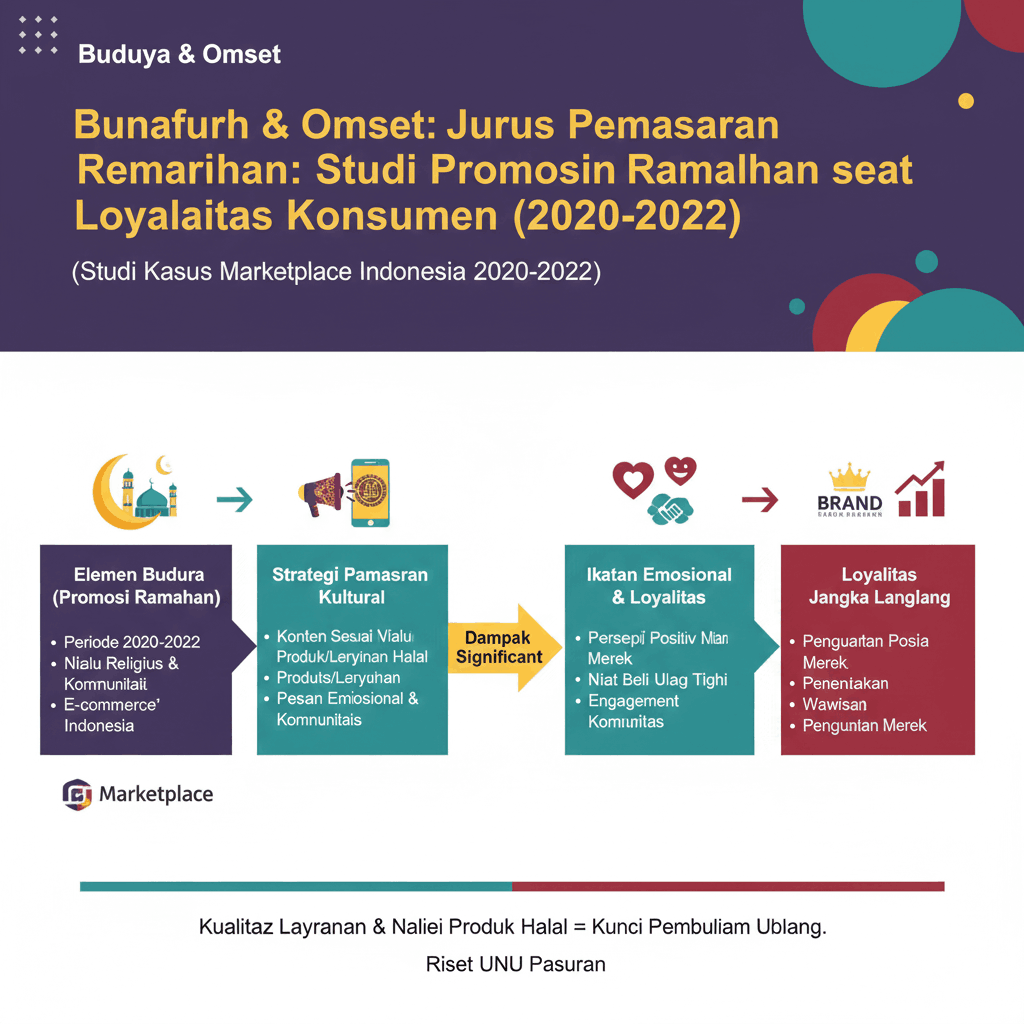
Penelitian ini mengeksplorasi pengaruh elemen budaya terhadap strategi pemasaran, khususnya dalam konteks promosi Ramadhan dan loyalitas konsumen di marketplace Indonesia pada periode 2020-2022. Penelitian ini menggunakan data dari studi sebelumnya serta analisis berbagai dimensi budaya untuk menggali hubungan antara strategi pemasaran yang berbasis budaya dan perilaku konsumen. Hasil menunjukkan bahwa budaya lokal memiliki dampak signifikan terhadap persepsi konsumen terhadap merek, terutama saat strategi pemasaran disesuaikan dengan nilai-nilai budaya lokal. Promosi Ramadhan, yang terkait dengan nilai religius, menciptakan ikatan emosional yang kuat dengan konsumen, sehingga meningkatkan loyalitas jangka panjang terhadap marketplace. Selain itu, kualitas layanan dan nilai produk berperan penting dalam niat konsumen untuk melakukan pembelian ulang, terutama pada merek yang berstandar halal. Penelitian ini menekankan pentingnya pemahaman mendalam terhadap elemen budaya dalam merancang strategi pemasaran yang efektif di pasar Indonesia. Dengan memanfaatkan momen budaya dan religius seperti Ramadhan, perusahaan dapat meningkatkan loyalitas konsumen dan memperkuat posisi mereknya di pasar
References
Ahmed, M., Usmiyatun, U., Nurhidayah, N., Darmayanti, R., & Azizah, I. N. (2021). PDKT: Introducing numbers 1-10 for kindergarten students using card media, does It improve? AMCA Journal of Education and Behavioral Change, 1(2), 69–73.
Ali, M. H., Iranmanesh, M., Tan, K. H., Zailani, S., & Omar, N. A. (2022). Impact of supply chain integration on halal food supply chain integrity and food quality performance. Journal of Islamic Marketing, 13(7), 1515 – 1534. https://doi.org/10.1108/JIMA-08-2020-0250
Alka, T. A., Raman, R., & Suresh, M. (2024). Research trends in innovation ecosystem and circular economy. Discover Sustainability, 5(1). https://doi.org/10.1007/s43621-024-00535-5
Azhar, A., & Tu, Y. T. (2021). The investigation of key factors for successful implementation of sustainable halal food supply chain management. Food Research, 5(6), 221 – 228. https://doi.org/10.26656/fr.2017.5(6).235
Badollahi, I., Haanurat, A. I., & Hasyim, K. (2020). PENGARUH CORPORATE ACTION TERHADAP PENGAMBILAN KEPUTUSAN DALAM PEMBELIAN SAHAM (STUDI PADA INVESTOR DI KOTA MAKASSAR). INVOICE : JURNAL ILMU AKUNTANSI, 2(1). https://doi.org/10.26618/inv.v2i1.3186
Bakhri, S., Saiban, K., & Munir, M. (2022). Peran Lembaga Keuangan Syariah dalam Industri Halal sudut Pandang Maqosid Syariah. Tasharruf: Journal of Islamic Economics and Business, 3(1), 11–29.
Budiarti, E., & Darmayanti, R. (2019). Why may kindergarten-aged children’s cognitive capacities be enhanced by" MOM" learning? Jurnal Caksana: Pendidikan Anak Usia Dini, 2(1), 69–78.
Budiarti, E., & Darmayanti, R. (2020). Why is Loose Part an important learning medium for early childhood development? Jurnal Caksana: Pendidikan Anak Usia Dini, 3(1), 1–15.
Choi, S. L., Harrell, E. R., & Watkins, K. (2022). The Impact of the COVID-19 Pandemic on Business Ownership Across Racial/Ethnic Groups and Gender. Journal of Economics, Race, and Policy, 5(4), 307 – 317. https://doi.org/10.1007/s41996-022-00102-y
Choirudin, C., Darmayanti, R., Usmiyatun, U., Sugianto, R., & Ananthaswamy, V. (2021). Mathematics teacher vs. media development, What are the learning problems in MTs? AMCA Journal of Religion and Society, 1(1), 19–24.
Dang, A., & Raska, D. (2022). National cultures and their impact on electronic word of mouth: a systematic review. International Marketing Review, 39(5), 1182 – 1225. https://doi.org/10.1108/IMR-12-2020-0316
Darmayanti, R., Milshteyn, Y., & Kashap, A. M. (2023). Green economy, sustainability and implementation before, during, and after the covid-19 pandemic in Indonesia. Revenue Journal: Management and Entrepreneurship, 1(1), 27–33.
Darmayanti, R., Sah, R. W. A., & Azizah, I. N. (2021). Covid-19 Pandemic: Teacher Problems-Early Childhood Learning (PAUD)-The Solution. Jurnal Caksana: Pendidikan Anak Usia Dini, 4(2), 55–65.
Diana-Elena, V. C., Lucian, B., & Alexandra, H. (2022). Considerations Upon the Effects of Covid-19 Pandemic on the Romanian Economic Environment. Studies in Business and Economics, 17(1), 272 – 289. https://doi.org/10.2478/sbe-2022-0018
Erdilla, N. (2020). Analisis Penerapan Manajemen Risiko Kredit Pada PT. Bank Rakyat Indonesia (Persero) Tbk Cabang Sombaopu Makassar. Akrab Juara, 5(1).
Fairlie, R., & Fossen, F. M. (2022a). Did the Paycheck Protection Program and Economic Injury Disaster Loan Program get disbursed to minority communities in the early stages of COVID-19? Small Business Economics, 58(2), 829 – 842. https://doi.org/10.1007/s11187-021-00501-9
Fairlie, R., & Fossen, F. M. (2022b). The early impacts of the COVID-19 pandemic on business sales. Small Business Economics, 58(4), 1853 – 1864. https://doi.org/10.1007/s11187-021-00479-4
Fauza, M. R., Inganah, S., Darmayanti, R., Maryanto, B. P. A., & Lony, A. (2022). Problem solving ability: strategy analysis of working backwards based on polya steps for Middle School Students YALC Pasuruan. JEMS: Jurnal Edukasi Matematika Dan Sains, 10(2), 353–363.
Gogo, A. F. C., & Masaki, E. (2022). Sustainability of Cultural Tourism in East African Community. Advances in Science, Technology and Innovation, 187 – 194. https://doi.org/10.1007/978-3-031-07819-4_16
González-Tejero, C. B., Ulrich, K., & Carrilero, A. (2022). The entrepreneurial motivation, Covid-19, and the new normal. Entrepreneurial Business and Economics Review, 10(2), 205 – 217. https://doi.org/10.15678/EBER.2022.100212
Haanurat, A. I. (2013). pengaruh karakteristik perusahaan dn ekonomi makro terhadap return saham syariah yang listing di jakarta islamic index. Journal of Chemical Information and Modeling, 53(9).
Hassan, S. H., Mat Saad, N., Masron, T. A., & Ali, S. I. (2022). Buy Muslim-made first – does halal consciousness affect Muslims’ intention to purchase? Journal of Islamic Marketing, 13(2), 466 – 480. https://doi.org/10.1108/JIMA-05-2019-0102
Hertina, D., Effendi, K. A., & Ichsani, S. (2021). Technological Education and Its Influence on Digital Economic Readiness during the COVID-19 Pandemic. Review of International Geographical Education Online, 11(1), 699 – 711. https://doi.org/10.33403/rigeo.800609
Huggins, R., & Thompson, P. (2022). Cities, innovation and entrepreneurial ecosystems: assessing the impact of the COVID-19 pandemic. Cambridge Journal of Regions, Economy and Society, 15(3), 635 – 661. https://doi.org/10.1093/cjres/rsac023
Jaya, A., Haanurat, A. I., & Santi, N. (2021). Stock Decision Investment of Millennial Generation in Covid 19 Pandemic. In Proceedings of International Seminar Society 5.0 Fostering Spirituality and Humanity.
Kalenkoski, C. M., & Pabilonia, S. W. (2022). Impacts of COVID-19 on the self-employed. Small Business Economics, 58(2), 741 – 768. https://doi.org/10.1007/s11187-021-00522-4
Khoiriyah, B., Darmayanti, R., & Astuti, D. (2022). Design for Development of Canva Application-Based Audio-Visual Teaching Materials on the Thematic Subject" Myself (Me and My New Friends)" Elementary School Students. Jurnal Pendidikan Dan Konseling (JPDK), 4(6), 6287–6295.
Kim, T., Kim, D., Kwon, J., & Gim, G. (2022). An Empirical Study on the Economic Factors Affecting on the Export of Defense Industry Using Hofstede’s Culture Dimension Theory. Studies in Computational Intelligence, 1074, 107 – 120. https://doi.org/10.1007/978-3-031-19604-1_8
Kryeziu, L., Bağış, M., Kurutkan, M. N., Krasniqi, B. A., & Haziri, A. (2022). COVID-19 impact and firm reactions towards crisis: Evidence from a transition economy. Journal of Entrepreneurship, Management and Innovation, 18(1), 169 – 196. https://doi.org/10.7341/20221816
Latipun, L., Darmayanti, R., & In’am, A. (2022). Designing video-assisted scientific learning in mathematics learning: does it vave an effect? AMCA Journal of Science and Technology, 2(2).
Lin, M., & Huang, Y. (2023). Research on User Experience Design Strategy of Digital Aquarium Based on UTAUT2 Model. Lecture Notes in Computer Science (Including Subseries Lecture Notes in Artificial Intelligence and Lecture Notes in Bioinformatics), 14031 LNCS, 167 – 188. https://doi.org/10.1007/978-3-031-35696-4_13
Norsalehe, N. I., & Idris, A. (2023a). Review on entrepreneurial orientation, economic stimulus packages, differentiation strategy and SME performance in Malaysia during the COVID-19 pandemic. Journal of Research in Marketing and Entrepreneurship, 25(2), 286 – 309. https://doi.org/10.1108/JRME-02-2022-0019
Norsalehe, N. I., & Idris, A. (2023b). Review on entrepreneurial orientation, economic stimulus packages, differentiation strategy and SME performance in Malaysia during the COVID-19 pandemic. Journal of Research in Marketing and Entrepreneurship, 25(2), 286 – 309. https://doi.org/10.1108/JRME-02-2022-0019
Nurfitriyani, R., Setiawan, A., & Darmayanti, R. (2021). The Effect of the Merdeka Curriculum on Student Creativity in Elementary Schools in Indonesia. Journal of Primary Education, 10(2), 102–112.
Okpatrioka, Darmayanti, R., Sugianto, R., Baiduri, B., Choirudin, C., Wawan, W., Studi, P., Biologi, T., Ilmu, F., Dan, T., Syarif, U. I. N., Jakarta, H., UMKC Writing Studio, Wright, A., Michailova, S., Hidayah, N., Ramli, M., Hanafi, H., Khairunnisa, S. N., … Ahmad, H. A. (2022). Critical Reviews and Literature Reviews. Jurnal Pendidikan, Bahasa Dan Budaya, 8(1).
Olkiewicz, M. (2022). The Impact of Economic Indicators on the Evolution of Business Confidence during the COVID-19 Pandemic Period. Sustainability (Switzerland), 14(9). https://doi.org/10.3390/su14095073
Onyango, H. O., & Ochiewo, J. (2023). The impact of culture on market competitiveness and food security for small indigenous species: An examination of the Dagaa fishery in Lake Victoria, Kenya. Aquatic Ecosystem Health and Management, 25(3), 34 – 41. https://doi.org/10.14321/aehm.025.03.34
Pereira, I., & Patel, P. C. (2022). Impact of the COVID-19 pandemic on the hours lost by self-employed racial minorities: evidence from Brazil. Small Business Economics, 58(2), 769 – 805. https://doi.org/10.1007/s11187-021-00529-x
Pimlott-Wilson, H., & Holloway, S. L. (2021). Supplementary education and the coronavirus pandemic: Economic vitality, business spatiality and societal value in the private tuition industry during the first wave of Covid-19 in England. Geoforum, 127, 71 – 80. https://doi.org/10.1016/j.geoforum.2021.09.009
Pinkovetskaia, I. (2022). Impact of Covid-19 pandemic on household income: Results of a survey of the economically active population. Studia Universitatis Vasile Goldis Arad, Economics Series, 32(1), 43 – 57. https://doi.org/10.2478/sues-2022-0003
Sabaria, Haanurat, A. I., & Muchran, M. (2022). PENGARUH TINGKAT INFLASI, NILAI TUKAR RUPIAH DAN TINGKAT SUKU BUNGA TERHADAP INDEKS SAHAM SYARIAH INDONESIA (ISSI) TAHUN 2016 – 2020. SEMNAS DAN PROSIDING.
Salman, T. N., Aos, & Permana, A. D. (2023). Strategic foresight: Scenario planning for business development of the Indonesian Orchid Association (IOA), West Java, Indonesia. Economia Agro-Alimentare, 25(3), 11 – 33. https://doi.org/10.3280/ecag2023oa16178
Shintarahayu, B., & Solehudin, Rd. H. (2022). Strategi Politik Pemanfaatan Instrumen Ekonomi Islam untuk Menjembatani Kesenjangan Pendidikan pada Keluarga Berpenghasilan Tidak Tetap di Jakarta. Tasharruf : Journal of Islamic Economics and Business, 1, 73–87.
Solehudin, R. H. (2022). Optimization of Business Strategies for Residential Properties. KnE Social Sciences, 223–237-, 223–237.
Solehudin, R. H., & Amin, M. (2022a). Fostering an Entrepreneurial Mindset Through Political Engagement in Society 5.0: A Critical Review at SPS UHAMKA Jakarta. Dedikasi, 19(1), 40–56.
Solehudin, R. H., & Darmayanti, R. (2018a). Does token economy behaviour modification affect young children’s discipline? Jurnal Caksana: Pendidikan Anak Usia Dini, 1(2), 202–215.
Solehudin, R. H., & Darmayanti, R. (2018b). What are the main lessons from Indonesia’s CSR financial literacy education investment for early childhood? Jurnal Caksana: Pendidikan Anak Usia Dini, 1(1), 95–106.
Solehudin, Rd. H., & Amin, M. (2022b). Fostering an Entrepreneurial Mindset Through Political Engagement in Society 5.0: A Critical Review at SPS UHAMKA Jakarta. Dedikasi, 1, 40–56.
Sugianto, R., & Darmayanti, R. (2021). Teachers in their perceptions and influences on LINU, positive or negative? AMCA Journal of Science and Technology, 1(1), 20–24.
Sugianto, R., Darmayanti, R., Aprilani, D., Amany, L., Rachmawati, L. N., Hasanah, S. N., & Aji, F. B. (2017). Experiment on Ability to Understand Three-Dimensional Material Concepts Related to Learning Styles Using the Geogebra-Supported STAD Learning Model Abstra ct. Jurnal Pendidikan Matematika, 8(2).
Sun, Y., Leng, K., & Xiong, H. (2022). Research on the influencing factors of consumers’ green purchase behavior in the post-pandemic era. Journal of Retailing and Consumer Services, 69. https://doi.org/10.1016/j.jretconser.2022.103118
Sung, C. E. (2022). Escapism Motive on a Virtual Platform during the Pandemic: An Abstract. Developments in Marketing Science: Proceedings of the Academy of Marketing Science, 379 – 380. https://doi.org/10.1007/978-3-030-95346-1_119
Sungkawati, E. (2021). SMEs CREATIVE ECONOMY IN THE COVID-19. Archives of Business Research, 9(1). https://doi.org/10.14738/abr.91.9581
Syahrivar, J., Hermawan, S. A., Gyulavári, T., & Chairy, C. (2022). Religious compensatory consumption in the Islamic context: the mediating roles of religious social control and religious guilt. Asia Pacific Journal of Marketing and Logistics, 34(4), 739 – 758. https://doi.org/10.1108/APJML-02-2021-0104
Syaiful, M., Haanurat, I., & Arsal, M. (2020). Pengaruh Leverage , Efektivitas Aset dan Sales Terhadap Profitabilitas dan Pengaruhnya Pada Nilai Perusahaan Sektor Industri Konsumsi Di Bursa Efek Indonesia Periode Tahun 2014-2018. Competitiveness, 9(2).
Usmiyatun, U., Darmayanti, R., Safitri, N. D., & Afifah, A. (2021). Cognitive style, thinking ability, mathematical problems, how do students solve open-ended problems? AMCA Journal of Science and Technology, 1(2).
Vescovi, T. (2022). Chinese Consumer Culture and Marketing Choice. Three Case Studies; [Cultura cinese e scelte di marketing. Tre casi di studio]. Micro and Macro Marketing, 31(3), 525 – 544. https://doi.org/10.1431/105552
Veselica-Majhut, S. (2022). THE CHALLENGES OF TRANSLATING CULTURAL EMBEDDEDNESS IN CRIME FICTION: A PICTURE FROM CROATIA. Przekladaniec, 2022(Special Issue), 93 – 116. https://doi.org/10.4467/16891864EPC.22.005.16519
Vidyastuti, A. N., Darmayanti, R., & Sugianto, R. (2018). The Role of Teachers and Communication Information Technology (ICT) Media in the Implementation of Mathematics Learning in the Digital Age. Al-Jabar: Jurnal Pendidikan Matematika, 9(2), 221–230.
Yang, M., Jaafar, N., Yeng, S. K., & Mamun, A. Al. (2022). MODELLING THE SIGNIFICANCE OF GLOBAL MIND-SET AND HALAL BRAND TRUST TO DETERMINE THE PERFORMANCE OF HALAL SMES. International Journal of Business and Society, 23(2), 987 – 1004. https://doi.org/10.33736/IJBS.4854.2022
Yiu, S. C. (2022). Sociocultural Motivators of Decision-making in Fashion Brands: A Case of Chinese Generation Z. Textile Bioengineering and Informatics Symposium Proceedings, TBIS, 353 – 361. https://www.scopus.com/inward/record.uri?eid=2-s2.0-85141344946&partnerID=40&md5=da4fa7822633fdfdbccb3d6d2ec55aea
You, J. E., & Choi, J. W. (2022). An analysis of food culture and technology acceptance for youth: Using a choice experiment and a latent class model. Managerial and Decision Economics, 43(2), 510 – 522. https://doi.org/10.1002/mde.3398
Downloads
Published
How to Cite
Issue
Section
License
Copyright (c) 2022 A. Ifayani Haanurat, Rani Darmayanti

This work is licensed under a Creative Commons Attribution-NonCommercial 4.0 International License.