Analisis Manajemen Risiko Likuiditas Dimasa Pandemi pada lembaga Keuangan Mikro Syariah
(Studi Kasus BMT Maslahah)
Authors
-
 Saiful Bakhri
Sekolah Tinggi Agama Islam Salahuddin Pasuruan, Indonesia
Saiful Bakhri
Sekolah Tinggi Agama Islam Salahuddin Pasuruan, Indonesia
-
Muhammad Alwi
Sekolah Tinggi Agama Islam Salahuddin Pasuruan, Indonesia
DOI:
https://doi.org/10.55757/tasharruf.v2i1.75Keywords:
risk management, BMT maslahah, professional and systematicAbstract
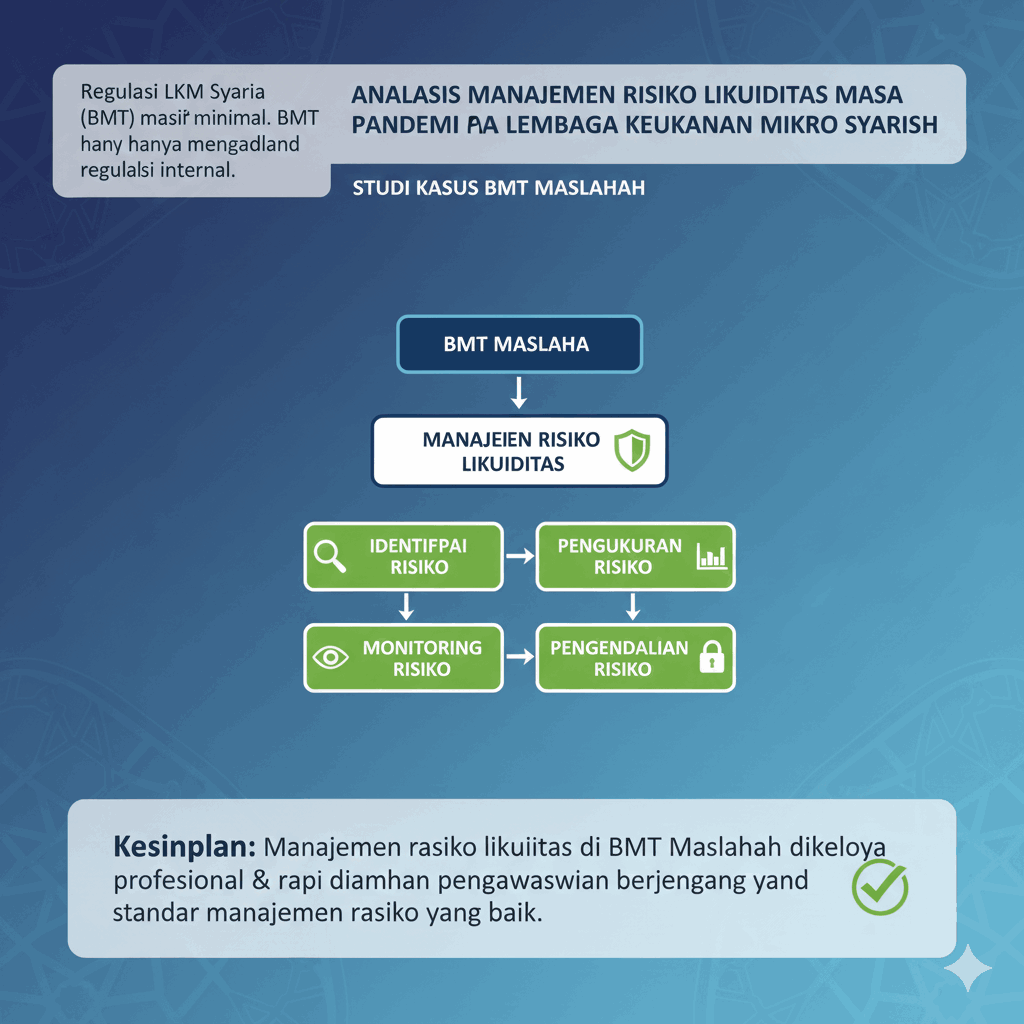
In contrast to banking-based financial institutions, regulations or regulations governing risk management and supervision of Islamic microfinance institutions with cooperative legal entities (BMT) are still minimal and still very weak. BMT as a microfinance institution only relies on internal regulations. This study aims to determine the implementation of liquidity risk management in BMT Maslahah. This study concluded that liquidity risk management at BMT Maslahah is managed professionally and neatly with layered supervision. the risk management process includes identification, measurement, monitoring and control carried out systematically with good risk management standards
References
Darmayanti, R., & Sah, R. W. A. (2021). Covid-19 Pandemic: Teacher Problems-Early Childhood Learning (PAUD)-The Solution. Jurnal Caksana: Pendidikan Anak Usia Dini. http://trilogi.ac.id/journal/ks/index.php/PAUD/article/view/1557
Heo, H. (2021). Enhancing learning engagement during COVID-19 pandemic: Self-efficacy in time management, technology use, and online learning environments. Journal of Computer Assisted Learning, 37(6), 1640–1652. https://doi.org/10.1111/jcal.12603
Lee, C. T. (2022). Economic Resilience in the Early Stage of the COVID-19 Pandemic: An Across-Economy Comparison. Sustainability Switzerland, 14(8). https://doi.org/10.3390/su14084609
Mishra, P. K. (2023). Do Banking and Financial Services Sectors Show Herding Behaviour in Indian Stock Market Amid COVID-19 Pandemic? Insights from Quantile Regression Approach. Millennial Asia, 14(1), 54–84. https://doi.org/10.1177/09763996211032356
Okafor, L. E. (2022). Does the level of a country’s resilience moderate the link between the tourism industry and the economic policy response to the COVID-19 pandemic? Current Issues in Tourism, 25(2), 303–318. https://doi.org/10.1080/13683500.2021.1956441
Pressley, T. (2021). Teaching during a Pandemic: United States Teachers’ Self-Efficacy During COVID-19. Teaching and Teacher Education, 106. https://doi.org/10.1016/j.tate.2021.103465
Rice, A. M. (2023). ‘With agroecology, we can defend ourselves’: examining campesino resilience and economic solidarity during pandemic-era economic shock in Guatemala. Agroecology and Sustainable Food Systems, 47(2), 273–305. https://doi.org/10.1080/21683565.2022.2140378
Simonetti, V. (2021). Anxiety, sleep disorders and self-efficacy among nurses during COVID-19 pandemic: A large cross-sectional study. Journal of Clinical Nursing, 30(9), 1360–1371. https://doi.org/10.1111/jocn.15685
Wahab Ali, M. K. (2020). Mediating Educational Challenges Amidst Covid-19 Pandemic. Asia Pacific Institute of Advanced Research (APJCECT), 6(2).
Zhou, C. (2021). Self-efficacy and mental health problems during COVID-19 pandemic: A multiple mediation model based on the Health Belief Model. Personality and Individual Differences, 179. https://doi.org/10.1016/j.paid.2021.110893.
Downloads
Published
How to Cite
Issue
Section
License
Copyright (c) 2021 Tasharruf : Jurnal Kajian Ekonomi dan Bisnis Syariah

This work is licensed under a Creative Commons Attribution-NonCommercial 4.0 International License.