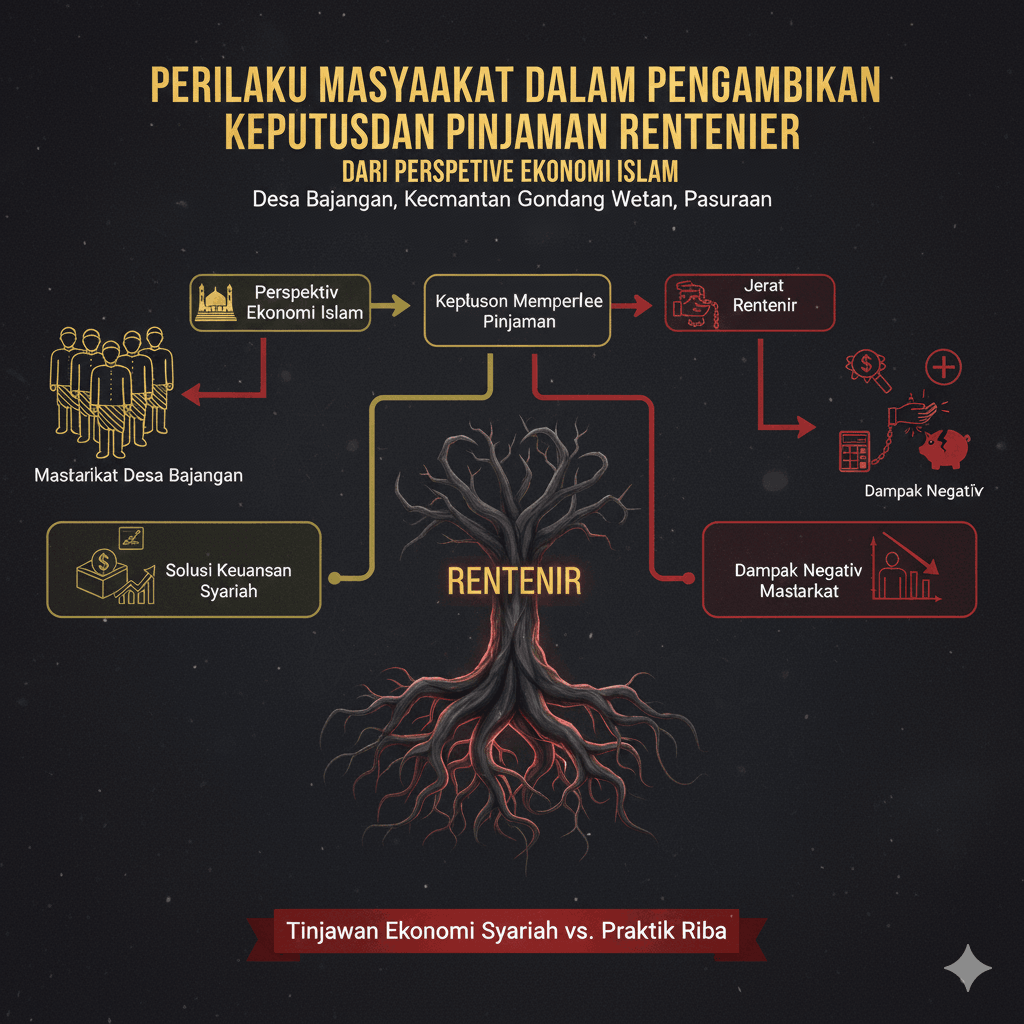
Perilaku Masyarakat dalam Mengambil Keputusan Memperoleh Pinjaman Uang pada Rentenir Ditinjauan dari Ekonomi Islam
di Desa Bajangan Kecamatan Gondang Wetan Pasuruan
Authors
-
 Nailatul Khoiriyah C
Sekolah Tinggi Agama Islam Salahuddin Pasuruan, Indonesia
Nailatul Khoiriyah C
Sekolah Tinggi Agama Islam Salahuddin Pasuruan, Indonesia
-
silda Labibi
Sekolah Tinggi Agama Islam Salahuddin Pasuruan, Indonesia
DOI:
https://doi.org/10.55757/tasharruf.v3i1.87Keywords:
Behavior, Islamic Economics., moneylendersAbstract
This study shows people's behavior in making decisions to get money loans to moneylenders, to increase economic income, because not all people have sufficient capital to build their businesses. This condition makes it difficult for people, including small traders, to build their businesses. So that most people turn to borrow from moneylenders.
This type of research uses qualitative research, while the research location is carried out in Bajangan Village, Gondangwetan District, Pasuruan. The approach used in this study uses a phenomenological approach model, in this study using two data sources, namely primary data and secondary data. Data analysis is done by working with data, organizing data, sorting it into units so that it can be managed.
The results of the study show that people's behavior knows the law about the prohibition of usury carried out by moneylenders. However, there are many needs that force people to use the services of loan sharks. There are also many people who feel helped by the existence of the moneylender market because their presence can help the community's needs which sometimes suddenly become urgent. Furthermore, the ease of the loan process and without making agreements on paper only uses the basis of trust between the community and moneylenders, besides that there are no guarantees and there are no restrictions on borrowing.
References
Musiimenta, A. (2023). Digital Adherence Technologies and Mobile Money Incentives for Management of Tuberculosis Medication Among People Living With Tuberculosis: Mixed Methods Formative Study. Jmir Formative Research, 7. https://doi.org/10.2196/45301
Musiimenta, A. (2024). Digital Adherence Technologies Linked to Mobile Money Incentives for Medication Adherence Among People Living With Tuberculosis: Mixed Methods Feasibility and Acceptability Study. Jmir Human Factors, 11. https://doi.org/10.2196/47996
Petach, L. (2021). It’s a wonderful loan: local financial composition, community banks, and economic resilience. Journal of Banking and Finance, 126. https://doi.org/10.1016/j.jbankfin.2021.106077
Yin, K., Lan, Q., Kan, S., & Su, Y. (2020). Empirical Research on the Risk Measurement of Mortgage Loans on Rural Land Contract and Management Rights: A Case Study of Heilongjiang Province. Journal of Coastal Research, 103(sp1). https://doi.org/10.2112/SI103-049.1
Downloads
Published
How to Cite
Issue
Section
License
Copyright (c) 2022 Tasharruf : Jurnal Kajian Ekonomi dan Bisnis Syariah

This work is licensed under a Creative Commons Attribution-NonCommercial 4.0 International License.