Keaktifan dalam Organisasi Siswa dan Hasil Belajar Pendidikan Agama Islam: Studi Korelasional pada Sekolah Islam
Authors
-
 Aulia Rosyida
Institut Islam Mamba’ul ‘Ulum Surakarta, Indonesia
Aulia Rosyida
Institut Islam Mamba’ul ‘Ulum Surakarta, Indonesia
-
Sukari Sukari
Institut Islam Mamba’ul ‘Ulum Surakarta, Indonesia
DOI:
https://doi.org/10.55757/ashlach.v4i01.893Keywords:
Organisasi siswa, hasil belajar, pendidikan agama Islam, sekolah islamAbstract
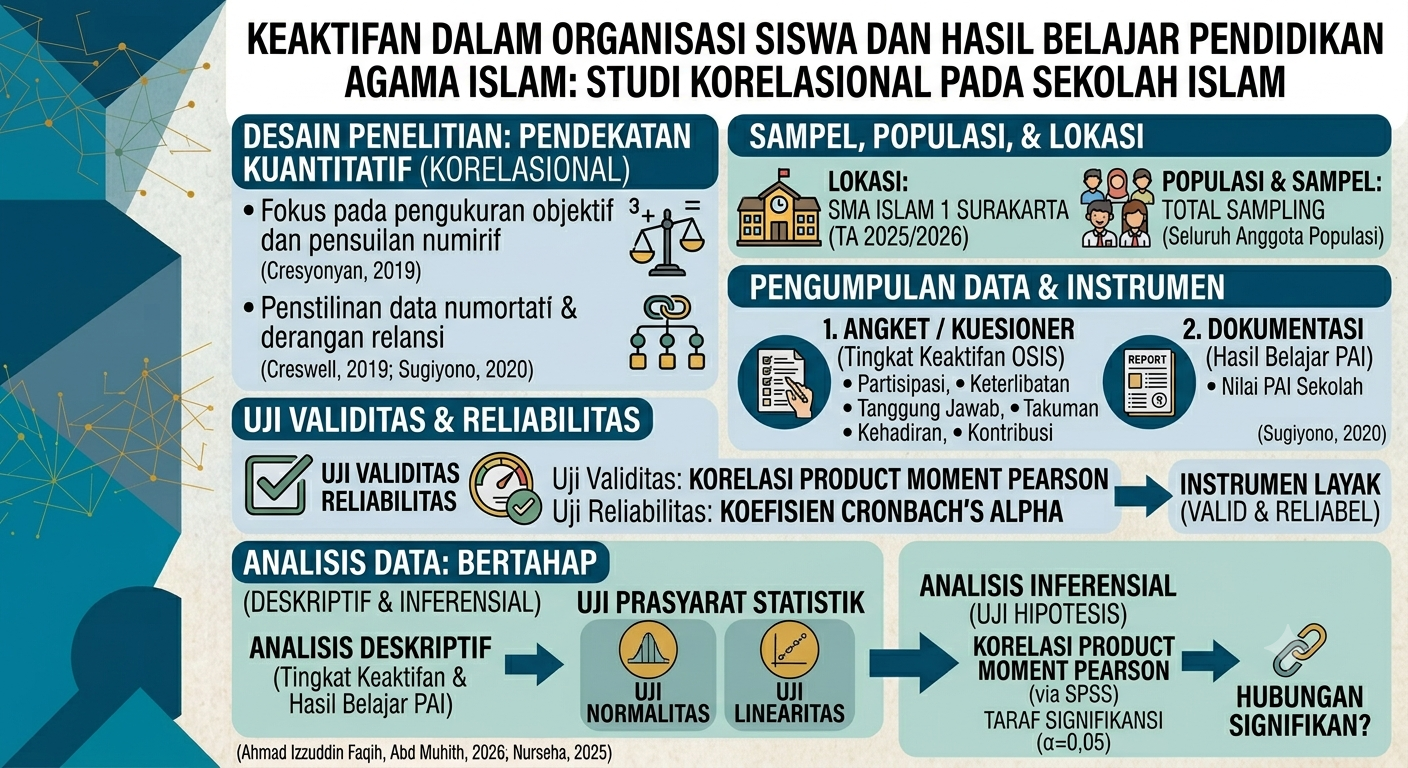
Penelitian ini bertujuan untuk menganalisis hubungan antara tingkat keaktifan siswa dalam Organisasi Siswa Intra Sekolah (OSIS) dan hasil belajar Pendidikan Agama Islam (PAI) di SMA Islam 1 Surakarta Tahun Ajaran 2025/2026. Penelitian menggunakan pendekatan kuantitatif dengan desain korelasional. Sampel penelitian berjumlah 30 siswa yang aktif dalam kegiatan OSIS dan ditentukan menggunakan teknik total sampling. Data keaktifan OSIS diperoleh melalui angket yang telah memenuhi kriteria validitas dan reliabilitas (Cronbach’s Alpha = 0,912), sedangkan data hasil belajar PAI diperoleh melalui dokumentasi nilai siswa. Analisis data dilakukan menggunakan statistik deskriptif, uji normalitas, uji linearitas, dan korelasi Pearson Product Moment dengan bantuan IBM SPSS. Hasil penelitian menunjukkan bahwa tingkat keaktifan OSIS memiliki nilai rata-rata 79,80, sedangkan hasil belajar PAI memiliki nilai rata-rata 81,73. Hasil uji korelasi menunjukkan nilai koefisien korelasi sebesar r = 0,155 dengan nilai signifikansi p = 0,413 (> 0,05). Temuan ini menunjukkan bahwa terdapat hubungan positif antara keaktifan OSIS dan hasil belajar PAI, namun hubungan tersebut berada pada kategori sangat lemah dan tidak signifikan secara statistik. Dengan demikian, keaktifan siswa dalam organisasi sekolah tidak secara langsung berhubungan dengan hasil belajar Pendidikan Agama Islam. Hasil penelitian mengindikasikan bahwa capaian belajar PAI kemungkinan lebih dipengaruhi oleh faktor lain, seperti motivasi belajar, regulasi diri, lingkungan keluarga, dan dukungan akademik. Penelitian ini memberikan kontribusi empiris terhadap kajian pendidikan Islam mengenai hubungan antara aktivitas organisasi siswa dan capaian akademik keagamaan pada konteks sekolah Islam.
References
Abdalla, M., Chown, D., & Abdullah, M. (2018). Islamic schooling in the West. Cham: Springer International Publishing. Doi, 10, 973–978.
Anti, N. D. K., & Arifin, S. (2025). Strengthening Students’ Religious Character through REMAS Organizations: Synergistic School Culture and Education Strategies. Managere: Indonesian Journal of Educational Management, 7(3), 275–287.
Aspanizam, A. A. B., & Ahmed, A. S. (2024). The Effect of Self-Concept and Family Environment on the Learning Outcomes of High School Students. Khalifa: Journal of Islamic Education, 8(2), 73–82.
Astin, A. W. (2014). Student involvement: A developmental theory for higher education. In College student development and academic life (pp. 251–262). Routledge.
Azzaky, W. H., Junaedi, M., & Wahib, A. (2024). The Contribution of Islamic Religious Education in Building Students’ Character. TOFEDU: The Future of Education Journal, 3(5), 1441–1451.
Chetioui, Y., Lebdaoui, H., Bakkali, A., Elalamy, A., & Aallali, A. (2025). Extracurricular Activities and academic performance among University Students.
Deng, N., & Li, L. (2025). Study on the Effect of Association Participation on Academic Achievement of College Students. Education Insights, 2(9), 213–226. https://doi.org/10.70088/fwrf3g57
Dewanti, L., Soelistiyono, A., Astuty, H. S., & Rinovian, R. (2025). The role of student-led organizations in developing leadership and soft skills in higher education. Journal of Educational Development, 4(4), 517–532.
Dugan, J. P., & Komives, S. R. (2010). Influences on college students’ capacities for socially responsible leadership. Journal of College Student Development, 51(5), 525–549.
Eccles, J. S., Barber, B. L., Stone, M., & Hunt, J. (2003). Extracurricular activities and adolescent development. Journal of Social Issues, 59(4), 865–889.
Farb, A. F., & Matjasko, J. L. (2012). Recent advances in research on school-based extracurricular activities and adolescent development. Developmental Review, 32(1), 1–48. https://doi.org/10.1016/j.dr.2011.10.001
Fauzi, M., Darwis, M., & Nasrullah, M. (2024). The Influence of Student Participation in Student Organizations on Academic Achievement. Pinisi Journal of Education and Management, 90–101.
Hadi, M. Y., & Prayogi, D. S. T. (2025). Managing Islamic school culture to develop students’ religious character. Journal of Educational Research and Practice, 3(2), 255–275.
La Ode, S., Widiningsih, S., & Setiawan, M. K. A. (2020). OSIS sebagai wadah siswa penggerak jenjang SMP.
Lastra, D. A., Amallarinto, A. J., Deiparine, B. N. A., Montero, D. J., Calugay, L., & Rulona, J. (2024). The Relationship between Extracurricular Activities and Academic Performance among High School Students. Psychology and Education: A Multidisciplinary Journal, 21(5). https://doi.org/10.5281/zenodo.12594232
Mahdi, I., & Hamdan, M. F. (2025). The Influence of Motivation on the Learning Outcomes of Islamic Religious Education for Students at As-Shofa Islamic High School Pekanbaru. Journal of Comprehensive Science (JCS), 4(1), 105–119.
Munawir, K., Rahim, A., Ismawati, I., & Mutmainna, F. (2024). Islamic religious education in student character development. Al-Hayat: Journal of Islamic Education, 8(1), 236–247.
Nirwana, A., Mahmudulhassan, Muthoifin, & Waston. (2024). Bibliometric Analysis of Islamic Education and Character Development in Religious Education Practices in Indonesia. Pakistan Journal of Life & Social Sciences, 22(2), 1231–1245.
Ryan, R. M., & Deci, E. L. (2020). Intrinsic and extrinsic motivation from a self-determination theory perspective: Definitions, theory, practices, and future directions. Contemporary Educational Psychology, 61, 101860. https://doi.org/10.1016/j.cedpsych.2020.101860
Sahin, A. (2018). Critical issues in islamic education studies: Rethinking islamic and western liberal secular values of education. Religions, 9(11). https://doi.org/10.3390/rel9110335
Sandoval, A., Muschkin, C. G., & Arrau-Garcia, M. (2026). Participation in Extracurricular Activities and High School Academic Performance: Does Breadth and Type of Activity Matter?. International Journal of Research in Education and Science, 12(2), 455–478.
Septianingsih, W., Amalia, R., & Oktafiani, D. (2024). Strategic Role of Islamic Religious Education in Character Building in the Digital Era: A Theoretical and Practical Analysis. PPSDP International Journal of Education, 3(2), 556–568.
Verner-Filion, J., Holding, A. C., Gingras, I., & Koestner, R. (2025). Extracurricular Activities-Extra Beneficial: The Role of Motivation for Extracurricular Activities on Outcomes in High-School Students. Journal of Adolescence, 97(7), 1869–1881. https://doi.org/10.1002/jad.70008
Vispo, G. B., & Macalinao, Z. A. (2024). Extent of Students Involvement in Extracurricular Activities and Academic Performance Among Grade 8 Students. International Journal of Multidisciplinary: Applied Business and Education Research, 5(6), 2151–2161.
Wang, M.-T., & Eccles, J. S. (2012). Social Support Matters: Longitudinal Effects of Social Support on Three Dimensions of School Engagement From Middle to High School. Child Development, 83(3), 877–895. https://doi.org/10.1111/j.1467-8624.2012.01745.x
Warsah, I., Morganna, R., Warsah, B. A. A., & Warsah, B. H. H. (2024). Islamic psychology-based educational strategies for student character development. AJIS: Academic Journal of Islamic Studies, 9(2), 305–354.
Zhao, Z., Ren, P., & Yang, Q. (2023). Student self-management, academic achievement: Exploring the mediating role of self-efficacy and the moderating influence of gender insights from a survey conducted in 3 universities in America. Journal of Integrated Social Sciences and Humanities, 1–12.
Published
How to Cite
Issue
Section
License
Copyright (c) 2026 Aulia Rosyida, Sukari Sukari

This work is licensed under a Creative Commons Attribution-ShareAlike 4.0 International License.