Produksi Glukosa Cair dari Pati Singkong Varietas Mentega dan Ketan Melalui Hidrolisis Enzimatis Menggunakan Amilase.
Authors
-
 Sindy Nindia Maretha Haristanti
Universitas Trunodjoyo Madura, Indonesia
-
 Samuel Karim
DOI:
https://doi.org/10.55757/ekliptika.v6i2.1206Keywords:
Cassava butter and glutinous rice, enzymes, hydrolysis, liquid glucoseAbstract
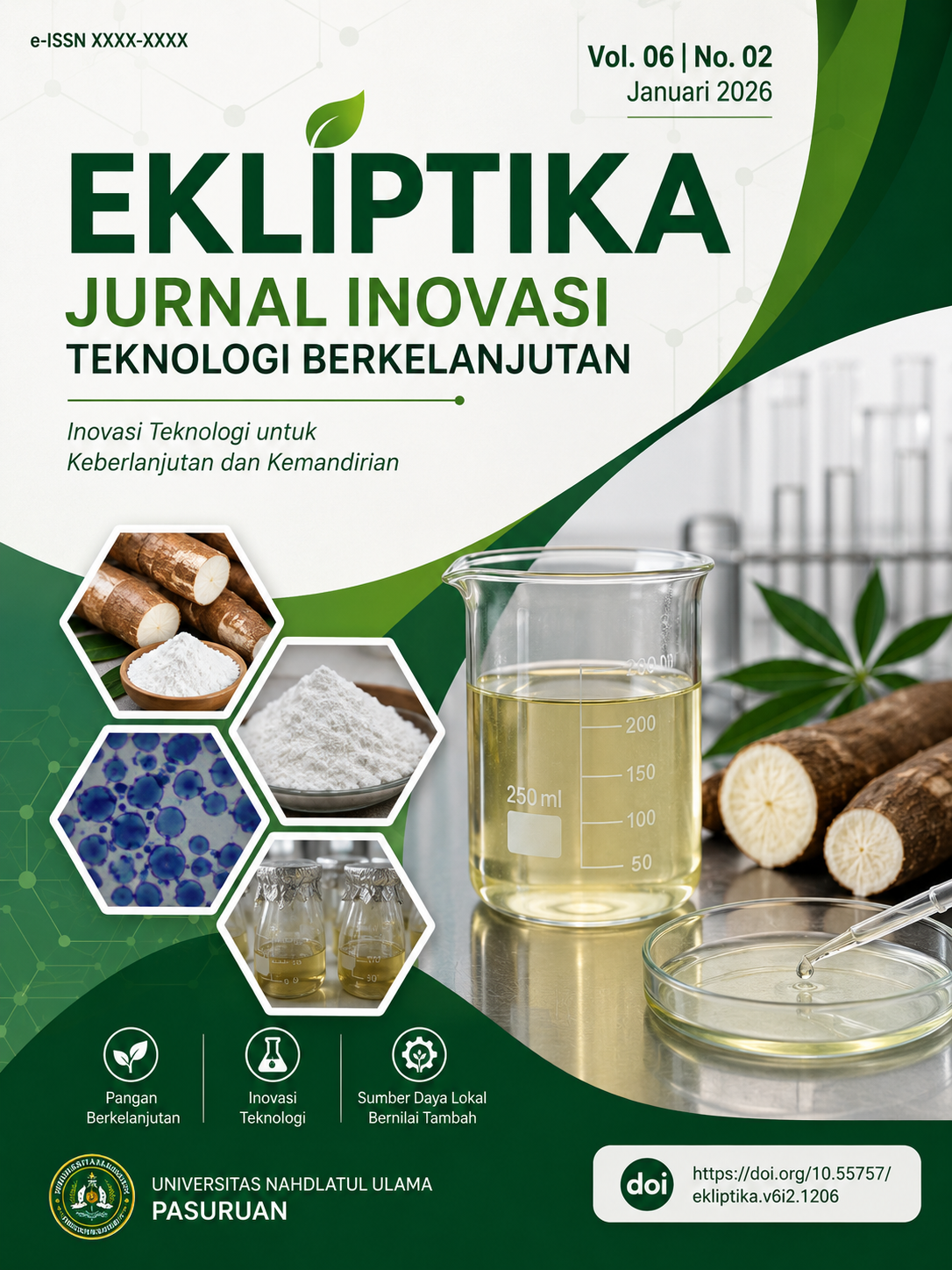
Glucose is a type of sugar widely used in the food and beverage industry. Liquid glucose can be produced from various starch sources, including cassava. This study aims to determine the effect of cassava types butter and glutinous and the concentration of α-amylase enzyme 0.1%; 0.2%; and 0.3% on the production of liquid glucose through enzymatic hydrolysis. The study used a Randomized Block Design RBD with testing parameters including qualitative starch analysis, yield, and sugar content using a refractometer. Cassava starch was obtained through extraction, precipitation, and drying processes, then hydrolyzed using the α-amylase enzyme. The results showed that the best treatment was obtained in butter cassava with an enzyme concentration of 0.3%, resulting in a yield of 60.44 ± 1.57% and a sugar content of 28.70 ± 2.81 °Brix. Starch analysis showed a color change from dark blue to purple indicating the presence of starch. These results indicate that the type of cassava and enzyme concentration affect the production of liquid glucose.
References
[1] R. Caspi, “The MetaCyc database of metabolic pathways and enzymes-a 2019 update,” Nucleic Acids Res., vol. 48, 2020, doi: 10.1093/nar/gkz862.
[2] V. Tournier, “Enzymes’ Power for Plastics Degradation,” 2023. doi: 10.1021/acs.chemrev.2c00644.
[3] M. A. Kalas, “Abnormal liver enzymes: A review for clinicians,” World J. Hepatol., vol. 13, no. 11, pp. 1688–1698, 2021, doi: 10.4254/wjh.v13.i11.1688.
[4] S. Thapa, “Microbial cellulolytic enzymes: diversity and biotechnology with reference to lignocellulosic biomass degradation,” 2020. doi: 10.1007/s11157-020-09536-y.
[5] H. El-Gendi, “A Comprehensive Insight into Fungal Enzymes: Structure, Classification, and Their Role in Mankind’s Challenges,” 2022. doi: 10.3390/jof8010023.
[6] X. Zhang, “Global Nitrogen Cycle: Critical Enzymes, Organisms, and Processes for Nitrogen Budgets and Dynamics,” 2020. doi: 10.1021/acs.chemrev.9b00613.
[7] P. Intasian, “Enzymes, in Vivo Biocatalysis, and Metabolic Engineering for Enabling a Circular Economy and Sustainability,” 2021. doi: 10.1021/acs.chemrev.1c00121.
[8] R. Zhang, “Nanozymes Inspired by Natural Enzymes,” Acc. Mater. Res., vol. 2, no. 7, pp. 534–547, 2021, doi: 10.1021/accountsmr.1c00074.
[9] S. Bhandari, “Microbial Enzymes Used in Bioremediation,” 2021. doi: 10.1155/2021/8849512.
[10] O. Einsle, “Structural Enzymology of Nitrogenase Enzymes,” 2020. doi: 10.1021/acs.chemrev.0c00067.
[11] K. Chen, “Engineering new catalytic activities in enzymes,” 2020. doi: 10.1038/s41929-019-0385-5.
[12] M. E. E. Temporiti, “Fungal Enzymes Involved in Plastics Biodegradation,” 2022. doi: 10.3390/microorganisms10061180.
[13] Y. Jiang, “Alcohol metabolizing enzymes, microsomal ethanol oxidizing system, cytochrome P450 2E1, catalase, and aldehyde dehydrogenase in alcohol-associated liver disease,” 2020. doi: 10.3390/biomedicines8030050.
[14] M. M. Refaey, “Fresh Azolla, Azolla pinnata as a Complementary Feed for Oreochromis niloticus: Growth, Digestive Enzymes, Intestinal Morphology, Physiological Responses, and Flesh Quality,” Aquac. Nutr., vol. 2023, 2023, doi: 10.1155/2023/1403704.
[15] S. P. H. Alexander, “The Concise Guide to PHARMACOLOGY 2023/24: Enzymes,” Br. J. Pharmacol., vol. 180, 2023, doi: 10.1111/bph.16181.
[16] A. Amobonye, “Plastic biodegradation: Frontline microbes and their enzymes,” 2021. doi: 10.1016/j.scitotenv.2020.143536.
[17] S. P. H. Alexander, “THE CONCISE GUIDE TO PHARMACOLOGY 2021/22: Enzymes,” Br. J. Pharmacol., vol. 178, 2021, doi: 10.1111/bph.15542.
[18] S. Huang, “‘Armor-Plating’ Enzymes with Metal–Organic Frameworks (MOFs),” 2020. doi: 10.1002/anie.201916474.
[19] D. O. Gaffney, “Non-enzymatic Lysine Lactoylation of Glycolytic Enzymes,” Cell Chem. Biol., vol. 27, no. 2, pp. 206–213, 2020, doi: 10.1016/j.chembiol.2019.11.005.
[20] J. Qiu, “Microbial enzymes catalyzing keratin degradation: Classification, structure, function,” 2020. doi: 10.1016/j.biotechadv.2020.107607.
[21] M. Zhao, “Cytochrome p450 enzymes and drug metabolism in humans,” 2021. doi: 10.3390/ijms222312808.
[22] J. Vašková, “Glutathione-Related Enzymes and Proteins: A Review,” 2023. doi: 10.3390/molecules28031447.
[23] R. Buller, “From nature to industry: Harnessing enzymes for biocatalysis,” 2023. doi: 10.1126/SCIENCE.ADH8615.
[24] K. Jomova, “Several lines of antioxidant defense against oxidative stress: antioxidant enzymes, nanomaterials with multiple enzyme-mimicking activities, and low-molecular-weight antioxidants,” 2024. doi: 10.1007/s00204-024-03696-4.
[25] B. A. Pandian, “Role of cytochrome P450 enzymes in plant stress response,” 2020. doi: 10.3390/antiox9050454.
[26] J. F. Wardman, “Carbohydrate-active enzymes (CAZymes) in the gut microbiome,” 2022. doi: 10.1038/s41579-022-00712-1.
[27] N. A. Snyder, “Deubiquitinating enzymes (DUBs): Regulation, homeostasis, and oxidative stress response,” 2021. doi: 10.1016/j.jbc.2021.101077.
[28] Z. Ashkan, “Immobilization of enzymes on nanoinorganic support materials: An update,” 2021. doi: 10.1016/j.ijbiomac.2020.11.127.
Published
How to Cite
Issue
Section
License
Copyright (c) 2026 Sindy Nindia Maretha Haristanti, Samuel Karim

This work is licensed under a Creative Commons Attribution-ShareAlike 4.0 International License.