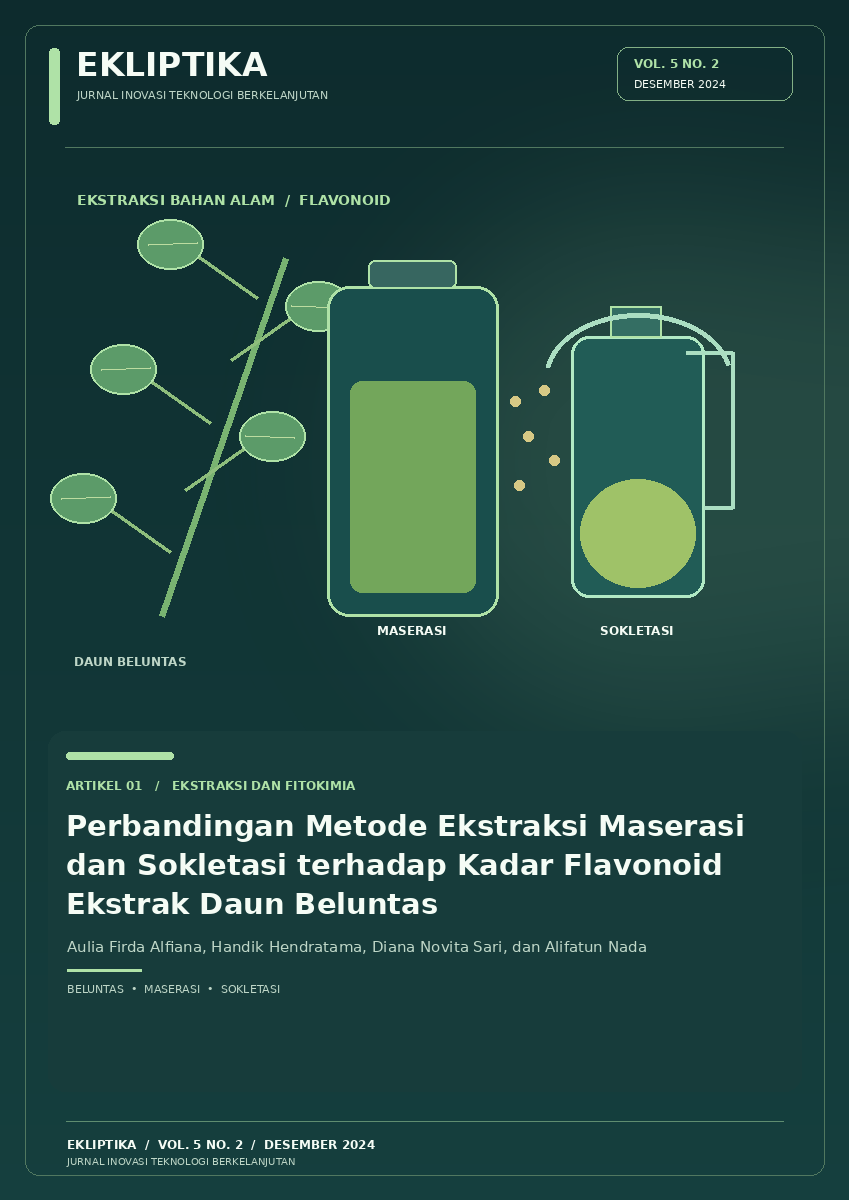
Perbandingan Metode Ekstraksi Maserasi dan Sokletasi terhadap Kadar Flavonoid Ekstrak Daun Beluntas
Penulis
-
 Aulia Firda Alfiana
Universitas Nahdlatul Ulama Pasuruan, Indonesia
-
Handik Hendratama
-
Diana Novita Sari
-
Alifatun Nada
DOI:
https://doi.org/10.55757/ekliptika.v5i2.576Kata Kunci:
daun beluntas, flavonoid, maserasi, metanol, sokletasiAbstrak
Daun beluntas (Pluchea indica (L.) Less.) mengandung senyawa fenolik yang dapat diperoleh
melalui ekstraksi. Penelitian ini membandingkan kadar flavonoid ekstrak daun beluntas
menggunakan maserasi dan sokletasi dengan pelarut metanol 96%. Simplisia sebanyak 10 g
diekstraksi pada rasio massa terhadap volume pelarut 1:10, 1:15, dan 1:20 b/v. Maserasi
berlangsung selama tiga hari pada suhu ruang, sedangkan sokletasi dilakukan selama 60, 120, dan
180 menit dengan suhu pemanasan yang dilaporkan 80 °C. Identifikasi kualitatif menggunakan uji
Shinoda dan pengukuran kuantitatif menggunakan spektrofotometri UV-Vis dengan pereaksi AlCl₃
serta standar kuersetin. Seluruh perlakuan menunjukkan respons warna kuning atau jingga. Kadar
yang dilaporkan pada maserasi berkisar 50,62–51,52 mg QE/g, sedangkan pada sokletasi berkisar
40,59–53,96 mg QE/g. Nilai tertinggi diperoleh pada rasio 1:20, yaitu 51,52 mg QE/g untuk
maserasi dan 53,96 mg QE/g untuk sokletasi 180 menit. Selisih kedua nilai tersebut sebesar 2,44
mg QE/g atau 4,74% relatif terhadap maserasi. Namun, grafik pemindaian dan skala persamaan
kalibrasi belum konsisten dengan uraian pengukuran, sementara data absorbansi mentah, dasar
massa, dan pengulangan tidak tersedia. Karena itu, hasil diperlakukan sebagai perbandingan
deskriptif atas kadar yang dilaporkan. Penetapan keunggulan metode memerlukan verifikasi
kalibrasi, pengulangan independen, serta evaluasi kebutuhan pelarut dan energi.
Referensi
[1] S. Kumar dan A. K. Pandey, “Chemistry and biological activities of flavonoids: An overview,” The
Scientific World Journal, artikel 162750, 2013, doi: 10.1155/2013/162750.
[2] P. G. Pietta, “Flavonoids as antioxidants,” Journal of Natural Products, vol. 63, no. 7, hlm. 1035
1042, 2000, doi: 10.1021/np9904509.
[3] N. P. S. Mahasuari, N. L. P. V. Paramita, dan A. A. G. R. Y. Putra, “Effect of methanol concentration as a
solvent on total phenolic and flavonoid content of beluntas leaf extract (Pulchea indica L.),” Journal
Pharmaceutical Science and Application, vol. 2, no. 2, hlm. 77–84, 2020, doi:
10.24843/JPSA.2020.v02.i02.p05.
[4] S. Kongkiatpaiboon, S. Chewchinda, dan B. Vongsak, “Optimization of extraction method and HPLC
analysis of six caffeoylquinic acids in Pluchea indica leaves from different provenances in
Thailand,” Revista Brasileira de Farmacognosia, vol. 28, no. 2, hlm. 145–150, 2018, doi:
10.1016/j.bjp.2018.03.002.
[5] A. Pujiastuti, A. R. Erwiyani, dan I. Sunnah, “Perbandingan kadar flavonoid total dan aktivitas
antioksidan ekstrak labu kuning dengan variasi pelarut,” Journal of Holistics and Health Sciences,
vol. 4, no. 2, hlm. 324–339, 2022, doi: 10.35473/jhhs.v4i2.215.
[6] Q. W. Zhang, L. G. Lin, dan W. C. Ye, “Techniques for extraction and isolation of natural products: A
comprehensive review,” Chinese Medicine, vol. 13, artikel 20, 2018, doi: 10.1186/s13020-018
0177-x.
[7] J. Azmir dkk., “Techniques for extraction of bioactive compounds from plant materials: A review,”
Journal of Food Engineering, vol. 117, no. 4, hlm. 426–436, 2013, doi:
10.1016/j.jfoodeng.2013.01.014.
[8] J. Dai dan R. J. Mumper, “Plant phenolics: Extraction, analysis and their antioxidant and anticancer
properties,” Molecules, vol. 15, no. 10, hlm. 7313–7352, 2010, doi: 10.3390/molecules15107313.
[9] C. D. Stalikas, “Extraction, separation, and detection methods for phenolic acids and flavonoids,”
Journal of Separation Science, vol. 30, hlm. 3268–3295, 2007, doi: 10.1002/jssc.200700261.
[10] M. D. Luque de Castro dan F. Priego-Capote, “Soxhlet extraction: Past and present panacea,”
Journal of Chromatography A, vol. 1217, no. 16, hlm. 2383–2389, 2010.
[11] C. C. Chang, M. H. Yang, H. M. Wen, dan J. C. Chern, “Estimation of total flavonoid content in
propolis by two complementary colorimetric methods,” Journal of Food and Drug Analysis, vol. 10,
no. 3, hlm. 178–182, 2002, doi: 10.38212/2224-6614.2748.
[12] A. Pękal dan K. Pyrzynska, “Evaluation of aluminium complexation reaction for flavonoid content
assay,” Food Analytical Methods, vol. 7, hlm. 1776–1782, 2014, doi: 10.1007/s12161-014-9814-x.
[13] D. Mammen dan M. Daniel, “A critical evaluation on the reliability of two aluminum chloride
chelation methods for quantification of flavonoids,” Food Chemistry, vol. 135, no. 3, hlm. 1365
1368, 2012, doi: 10.1016/j.foodchem.2012.05.109.
[14] A. M. Shraim, T. A. Ahmed, M. M. Rahman, dan Y. M. Hijji, “Determination of total flavonoid content
by aluminum chloride assay: A critical evaluation,” LWT, vol. 150, artikel 111932, 2021, doi:
10.1016/j.lwt.2021.111932.
Ekstraksi Flavonoid Daun Beluntas
[15] Suharyanto dan T. N. Hayati, “Penetapan kadar flavonoid total ekstrak buah gambas (Luffa
acutangula (L.) Roxb.) dengan metode spektrofotometri UV-Vis,” Pharmacon: Jurnal Farmasi
Indonesia, vol. 18, no. 1, hlm. 82–88, 2021, doi: 10.23917/pharmacon.v18i01.10916.
[16] International Council for Harmonisation, ICH Harmonised Guideline Q2(R2) Validation of
Analytical Procedures, versi final 30 November 2023. Tersedia:
https://database.ich.org/sites/default/files/ICH_Q2(R2)_Guideline_2023_1130.pdf.
[17] B. Magnusson dan U. Örnemark, ed., Eurachem Guide The Fitness for Purpose of Analytical
Methods A Laboratory Guide to Method Validation and Related Topics, ed. ke-2. Eurachem, 2014,
ISBN 978-91-87461-59-0. Tersedia:
https://www.eurachem.org/images/stories/Guides/pdf/MV_guide_2nd_ed_EN.pdf.
[18] S. Chewchinda dan B. Vongsak, “Simultaneous HPTLC quantification of three caffeoylquinic acids
in Pluchea indica leaves and their commercial products in Thailand,” Revista Brasileira de
Farmacognosia, vol. 29, hlm. 177–181, 2019, doi: 10.1016/j.bjp.2018.12.007.
[19] F. Chemat, M. Abert Vian, dan G. Cravotto, “Green extraction of natural products: Concept and
principles,” International Journal of Molecular Sciences, vol. 13, no. 7, hlm. 8615–8627, 2012, doi:
10.3390/ijms13078615.
[20] F. Chemat, N. Rombaut, A. G. Sicaire, A. Meullemiestre, A. S. Fabiano-Tixier, dan M. Abert-Vian,
“Ultrasound assisted extraction of food and natural products. Mechanisms, techniques,
combinations, protocols and applications. A review,” Ultrasonics Sonochemistry, vol. 34, hlm. 540
560, 2017.
Diterbitkan
Cara Mengutip
Terbitan
Bagian
Lisensi
Hak Cipta (c) 2025 Ekliptika

Artikel ini berlisensiCreative Commons Attribution-ShareAlike 4.0 International License.