
Pengaruh Konsentrasi Temulawak (Curcuma Xanthoriza Roxb) Terhadap Karakteristik Organoleptik Kombucha
Authors
-
 Yunita Khilyatun Nisak
Institut Teknologi dan Sains Nahdlatul Ulama Pasuruan, Indonesia
-
Anis Nurhayati
-
Maylina Ilhami Khurniyati
-
Pinctada Putri Pamungkas
-
Silvi Laini
DOI:
https://doi.org/10.55757/ekliptika.v6i1.578Keywords:
hedonic, kombucha, konsentrasi, organoleptik, temulawakAbstract
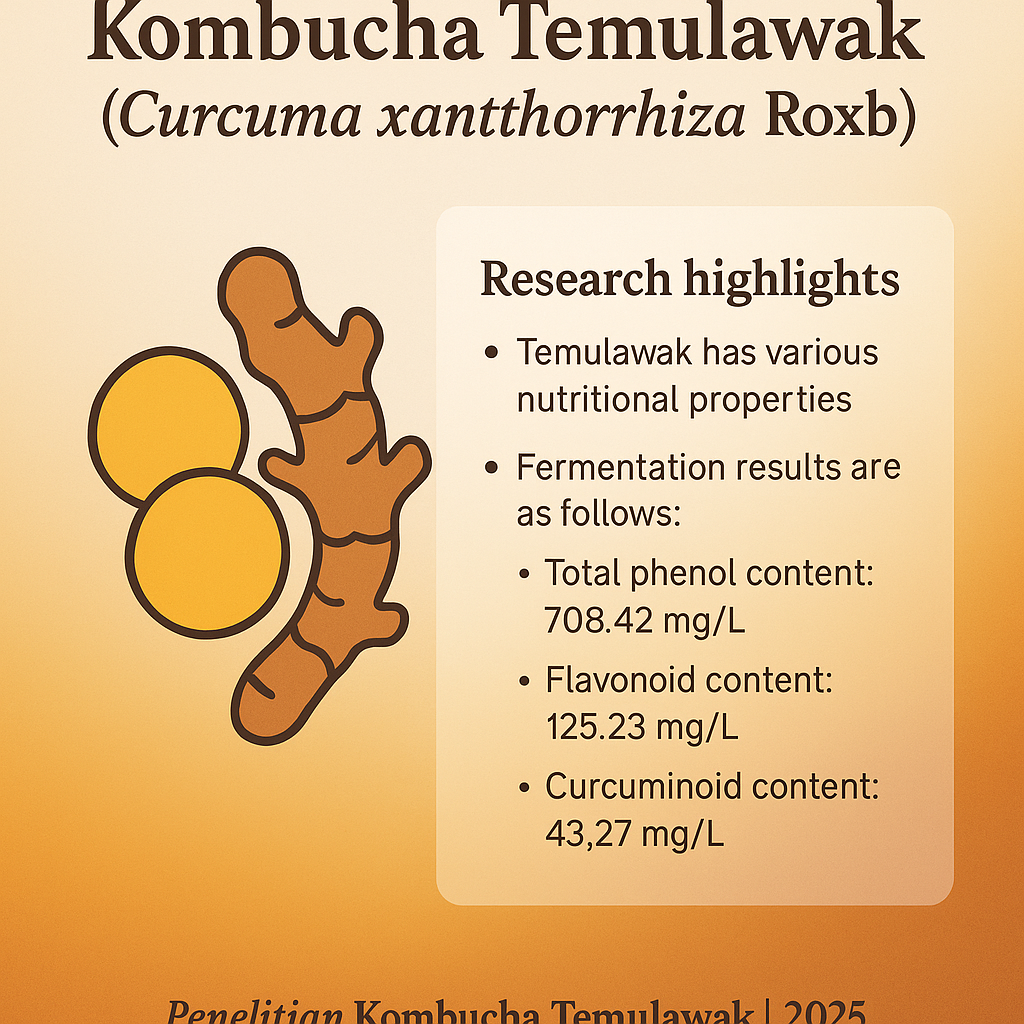
Temulawak (Curcuma Xanthoriza Roxb) adalah tanaman obat – obatan yang tergolong dalam suku temu – temuan (Zingiberaceae). Rimpang temulawak mengandung pati, kurkuminoid, serat kasar, abu, protein, mineral dan minyak atsiri. Kombucha merupakan produk minuman hasil fermentasi larutan teh dan gula sukrosa sebagai nutrient yang difermentasi oleh bakteri Acetobacter Xylinum dan beberapa jenis khamir lainnya yang mengubah kandungan gula menjadi asam amino essensial yang bermanfaat bagi tubuh. Berdasarkan hasil uji hedonic, kombucha temulawak yang paling disukai panelis dari segi aroma adalah kombucha temulawak dengan konsentrasi 0,2% dengan skor 2,82; rasa kombucha yang paling disukai adalah dengan temulawak konsentrasi 0,6% yang mempunyai skor 3.48 sedangkan warna kombucha yang paling disukai adalah kombucha teh dengan skor uji hedonic 3.38.
References
. V. Malbaša, E. S. Lončar, J. S. Vitas, and M. Sathishkumar, “A review on
kombucha tea—Microbiology, composition, fermentation, beneficial effects, toxicity, and
tea fungus,” Comprehensive Reviews in Food Science and Food Safety, vol. 13, no. 4, pp. 538–550, 2014, doi: 10.1111/1541-4337.12073.
[5] S. A. Villarreal-Soto, S. Beaufort, J. Bouajila, J.-P. Souchard, and P. Taillandier,
“Understanding kombucha tea fermentation: A review,” Journal of Food Science, vol. 83, no.
3, pp. 580–588, 2018, doi: 10.1111/1750-3841.14068.
[6] A. J. Marsh, O. O’Sullivan, C. Hill, R. P. Ross, and P. D. Cotter, “Sequence-based analysis of the
bacterial and fungal compositions of multiple kombucha (tea fungus) samples,” Food
Microbiology, vol. 38, pp. 171–178, 2014, doi: 10.1016/j.fm.2013.09.003.
29
Ekliptika : Jurnal Inovasi Teknologi Berkelanjutan
Yunita Khilyatun Nisak dkk.
│
Organoleptik Kombucha Temulawak
[7] S. Chakravorty, S. Bhattacharya, A. Chatzinotas, W. Chakraborty, D. Bhattacharya, and R.
Gachhui, “Kombucha tea fermentation: Microbial and biochemical dynamics,”
International Journal of Food Microbiology, vol. 220, pp. 63–72, 2016, doi:
10.1016/j.ijfoodmicro.2015.12.015.
[8] M. L. Marco et al., “The International Scientific Association for Probiotics and Prebiotics
(ISAPP) consensus statement on fermented foods,” Nature Reviews Gastroenterology &
Hepatology, vol. 18, pp. 196–208, 2021, doi: 10.1038/s41575-020-00390-5.
[9] Y. K. Nisak, M. I. Khurniyati, S. R. Nurbaya, and E. D. Nugroho, “Hedonic test and hedonic
quality test of kombucha from various types of Indonesian herbs,” Jurnal IPTEK, vol. 27,
no. 2, pp. 141–150, 2023, doi: 10.31284/j.iptek.2023.v27i2.5061.
[10] M. Fauzi, S. S. Harsono, and Y. Nurana, “Karakteristik minuman kombucha temulawak
(Curcuma xanthorrhiza Roxb) hasil fermentasi pada berbagai konsentrasi ekstrak dan
lama inkubasi,”
[11] H. T. Lawless and H. Heymann, Sensory Evaluation of Food: Principles and Practices, ed. 2.
New York: Springer, 2010, doi: 10.1007/978-1-4419-6488-5.
[12] International Organization for Standardization, ISO 11136:2014 Sensory analysis—
Methodology—General guidance for conducting hedonic tests with consumers in a
controlled area. Geneva: ISO, 2014.
[13] International Organization for Standardization, ISO 8589:2007 Sensory analysis—General
guidance for the design of test rooms. Geneva: ISO, 2007.
[14] M. Friedman, “The use of ranks to avoid the assumption of normality implicit in the
analysis of variance,” Journal of the American Statistical Association, vol. 32, no. 200, pp.
675–701, 1937, doi: 10.1080/01621459.1937.10503522.
[15] W. H. Kruskal and W. A. Wallis, “Use of ranks in one-criterion variance analysis,” Journal of
the American Statistical Association, vol. 47, no. 260, pp. 583–621, 1952, doi:
10.1080/01621459.1952.10483441.
[16] M. Obanda, P. O. Owuor, R. Mang’oka, and M. M. Kavoi, “Changes in thearubigin fractions
and theaflavin levels due to variations in processing conditions and their influence on
black tea liquor brightness and total colour,” Food Chemistry, vol. 85, no. 2, pp. 163–173,
2004, doi: 10.1016/S0308-8146(02)00183-8.
[17] K. I. Purnami, A. A. G. N. A. Jambe, and N. W. Wisaniyasa, “Pengaruh jenis teh terhadap
karakteristik teh kombucha,” Jurnal Ilmu dan Teknologi Pangan, vol. 7, no. 2, pp. 1–10,
2018, doi: 10.24843/itepa.2018.v07.i02.p01.
[18] N. S. Dosoky and W. N. Setzer, “Chemical composition and biological activities of essential
oils of Curcuma species,” Nutrients, vol. 10, no. 9, Art. no. 1196, 2018, doi:
10.3390/nu10091196.
[19] Nurhayati, S. Yuwanti, and A. Urbahillah, “Karakteristik fisikokimia dan sensori kombucha
cascara (kulit kopi ranum),” Jurnal Teknologi dan Industri Pangan, vol. 31, no. 1, pp. 38–49,
2020, doi: 10.6066/jtip.2020.31.1.38.
[20] E. Zubaidah, Y. K. Nisak, I. Susanti, T. D. Widyaningsih, I. Srianta, and I. Tewfik, “Turmeric
kombucha as effective immunomodulator in Salmonella typhi-infected experimental
animals,” Biocatalysis and Agricultural Biotechnology, vol. 37, Art. no. 102181, 2021, doi:
10.1016/j.bcab.2021.102181.
Published
How to Cite
Issue
Section
License
Copyright (c) 2025 Ekliptika : Jurnal Fakultas Teknik Universitas Nahdlatul Ulama Pasuruan

This work is licensed under a Creative Commons Attribution-ShareAlike 4.0 International License.