Analisis Perbandingan Kualitas Pakan dan Pertumbuhan Ikan Lele pada Kolam Beton Sederhana
Penulis
-
 Dedik Budiyanto
Fakultas Pertanian, Universitas Dr. Soetomo, Indonesia
-
Totok Hendarto
-
Sutarmin Sutarmin
-
Ardianik ardianik
DOI:
https://doi.org/10.55757/ekliptika.v6i1.970Kata Kunci:
ikan lele, kolam beton, konversi pakan, kualitas pakan, pertumbuhanAbstrak
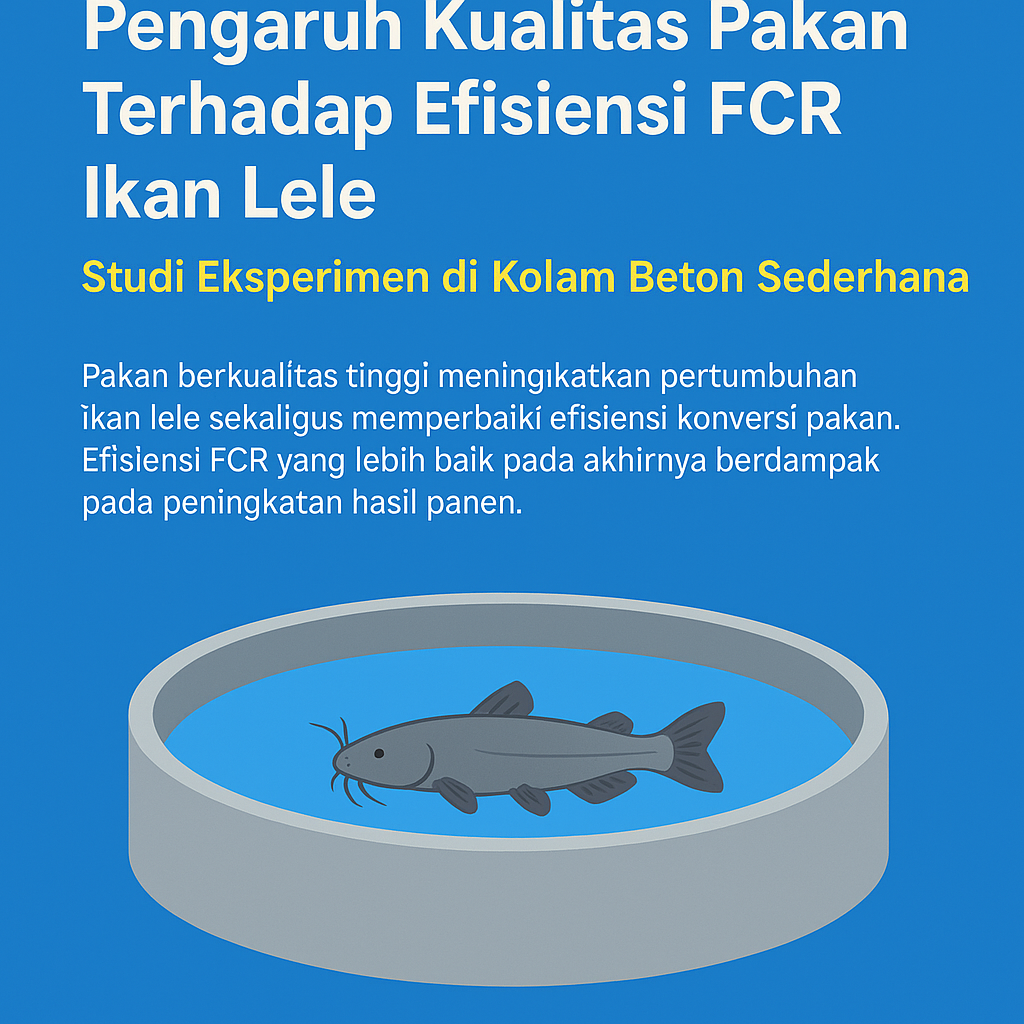
Penelitian ini membandingkan pertumbuhan ikan lele pada tiga kategori kualitas pakan
dalam kolam beton sederhana. Panjang dan bobot diamati pada bulan pertama hingga ketiga
dan dianalisis secara deskriptif karena jumlah unit percobaan, ulangan, serta data individual
tidak tersedia. Seluruh kelompok awalnya memiliki panjang 5 cm dan bobot 3 g. Pada bulan
ketiga, kelompok pakan rendah, sedang, dan tinggi mencapai panjang 15, 18, dan 24 cm serta
bobot 46, 74, dan 86 g. Pertambahannya masing-masing 10, 13, dan 19 cm serta 43, 71, dan
83 g; kelompok pakan tinggi menunjukkan pertumbuhan terbesar. Rentang harga
merupakan skenario naskah. Jumlah pakan, biomassa, kelangsungan hidup, dan biaya
operasional tidak dilaporkan sehingga konversi pakan, produksi panen, serta keuntungan
belum dapat dihitung. Rekomendasi ekonomi memerlukan pengujian nutrisi dan pencatatan
produksi lengkap.
Referensi
[1] National Research Council, Nutrient Requirements of Fish and Shrimp. Washington, DC:
The National Academies Press, 2011, doi: 10.17226/13039.
[2] O. M. Millamena, R. M. Coloso, and F. P. Pascual, ed., Nutrition in Tropical Aquaculture:
Essentials of Fish Nutrition, Feeds, and Feeding of Tropical Aquatic Species. Tigbauan:
SEAFDEC Aquaculture Department, 2002.
[3] S. Langi, S. Maulu, O. J. Hasimuna, V. K. Kapula, and M. Tjipute, “Nutritional requirements
and effect of culture conditions on the performance of the African catfish (Clarias
gariepinus): A review,” Cogent Food & Agriculture, vol. 10, no. 1, Art. no. 2302642, 2024,
doi: 10.1080/23311932.2024.2302642.
[4] G. de Graaf and H. Janssen, Artificial Reproduction and Pond Rearing of the African Catfish
Clarias gariepinus in Sub-Saharan Africa: A Handbook. FAO Fisheries Technical Paper No.
362. Rome: FAO, 1996.
[5] M. A. M. Machiels and A. M. Henken, “Growth rate, feed utilization and energy metabolism
of the African catfish, Clarias gariepinus (Burchell, 1822), as affected by dietary protein
and energy content,” Aquaculture, vol. 44, no. 4, pp. 271–284, 1985, doi: 10.1016/0044
8486(85)90226-1.
[6] A. Oliva Teles, A. Couto, P. Enes, and H. Peres, “Dietary protein requirements of fish—A
meta-analysis,” Reviews in Aquaculture, vol. 12, no. 3, pp. 1445–1477, 2020, doi:
10.1111/raq.12391.
[7] M. R. Hasan and M. B. New, ed., On-farm Feeding and Feed Management in Aquaculture. FAO
Fisheries and Aquaculture Technical Paper No. 583. Rome: FAO, 2013.
[8] M. R. Hasan, ed., Economics of Aquaculture Feeding Practices in Selected Asian Countries.
FAO Fisheries Technical Paper No. 505. Rome: FAO, 2007.
[9] K. J. Rana, S. Siriwardena, and M. R. Hasan, Impact of Rising Feed Ingredient Prices on
Aquafeeds and Aquaculture Production. FAO Fisheries and Aquaculture Technical Paper
No. 541. Rome: FAO, 2009.
[10] R. Froese, “Cube law, condition factor and weight–length relationships: History, meta
analysis and recommendations,” Journal of Applied Ichthyology, vol. 22, no. 4, pp. 241–253,
2006, doi: 10.1111/j.1439-0426.2006.00805.x.
[11] S. H. Hurlbert, “Pseudoreplication and the design of ecological field experiments,”
Ecological Monographs, vol. 54, no. 2, pp. 187–211, 1984, doi: 10.2307/1942661.
[12] N. Percie du Sert et al., “The ARRIVE guidelines 2.0: Updated guidelines for reporting
animal research,” PLOS Biology, vol. 18, no. 7, Art. no. e3000410, 2020, doi:
10.1371/journal.pbio.3000410.
[13] C. E. Boyd and C. S. Tucker, Pond Aquaculture Water Quality Management. Boston: Kluwer
Academic Publishers, 1998, doi: 10.1007/978-1-4615-5407-3.
[14] C. E. Boyd, Water Quality: An Introduction, ed. 2. Cham: Springer, 2015, doi: 10.1007/978
3-319-17446-4.
[15] C. Y. Cho and D. P. Bureau, “A review of diet formulation strategies and feeding systems to
reduce excretory and feed wastes in aquaculture,” Aquaculture Research, vol. 32, supl. 1,
pp. 349–360, 2001, doi: 10.1046/j.1355-557x.2001.00027.x.
[16] D. P. Bureau and K. Hua, “Towards effective nutritional management of waste outputs in
aquaculture, with particular reference to salmonid aquaculture operations,” Aquaculture
Research, vol. 41, no. 5, pp. 777–792, 2010, doi: 10.1111/j.1365-2109.2009.02431.x.
[17] S. H. Sugiura, D. D. Marchant, K. Kelsey, T. Wiggins, and R. P. Ferraris, “Effluent profile of
commercially used low-phosphorus fish feeds,” Environmental Pollution, vol. 140, no. 1, pp.
95–101, 2006, doi: 10.1016/j.envpol.2005.06.020.
[18] A. G. J. Tacon and M. Metian, “Global overview on the use of fish meal and fish oil in
industrially compounded aquafeeds: Trends and future prospects,” Aquaculture, vol. 285,
no. 1–4, pp. 146
Diterbitkan
Cara Mengutip
Terbitan
Bagian
Lisensi
Hak Cipta (c) 2025 Dedik Budiyanto, Hendarto, Sutarmin, ardianik

Artikel ini berlisensiCreative Commons Attribution-ShareAlike 4.0 International License.