Pengaruh Pembelajaran PjBL berbasis Green Curriculum dalam Mata Pelajaran IPA dalam Menumbuhkembangkan Metakognitif Santri Pondok Pesantren
Authors
-
 Arga Triyandana
Universitas Nahdlatul Ulama Pasuruan
Arga Triyandana
Universitas Nahdlatul Ulama Pasuruan
-
Amang Fathurrohman
STAI Salahuddin Pasuruan
-
Nuril Hidayati
Universitas Nahdlatul Ulama Pasuruan
DOI:
https://doi.org/10.55757/tarbawi.v13i1.1056Keywords:
Project-Based Learning; Green Curriculum, Metacognitive Skills, Islamic Boarding School, Science EducationAbstract
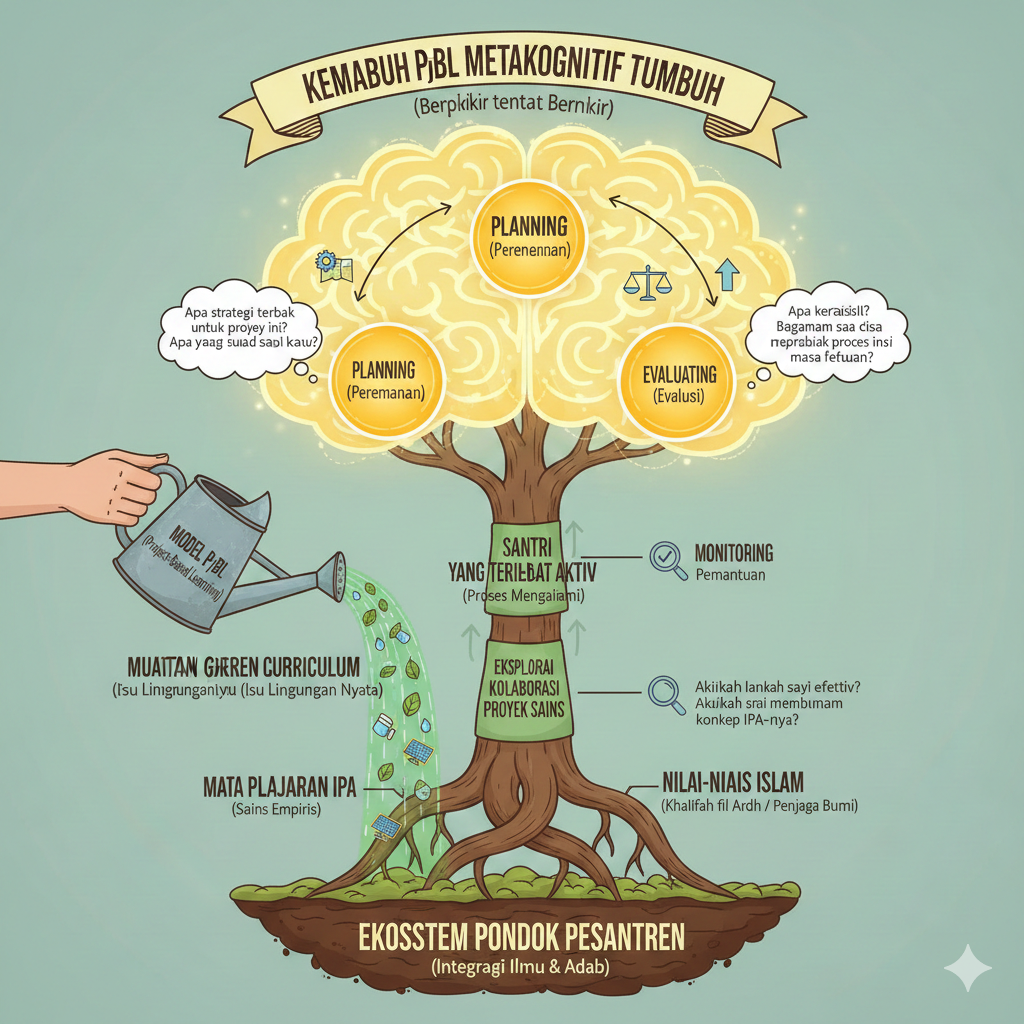
Abstract Purpose: This study investigates the effect of implementing Green Curriculum-based Project Based Learning (PjBL) on the development of metacognitive skills among students at PIQ Singosari Malang Islamic Boarding School, while simultaneously fostering environmental awareness through practical ecological projects.
Design/methodology/approach: The research employed a quasi-experimental design with pretest-posttest nonequivalent control group model, involving 50 students divided into experimental and control groups. Data were collected using the validated Metacognitive Awareness Inventory and analyzed through independent samples t-test to compare mean differences in metacognitive skills between groups receiving Green Curriculum-integrated PjBL and conventional instruction.
Research limitations/implications: While limited by sample size and intervention duration, the findings strongly suggest that integrating Green Curriculum with PjBL effectively enhances metacognitive skills. This implies that educators should consider incorporating environmental projects into science education to simultaneously develop cognitive abilities and ecological awareness.
Findings: The results demonstrated statistically significant improvements in the experimental group across all metacognitive dimensions, with planning showing a mean difference of 9.08 (p=0.012), monitoring 13.72 (p=0.001), and evaluation 24.52 (p=0.000). The 95% confidence intervals confirmed the reliability of these differences, indicating substantial enhancement in students' abilities to plan, monitor, and evaluate their learning processes.
Originality/value: This study presents a novel integration of Green Curriculum with PjBL specifically designed for Islamic educational contexts, offering empirical evidence of how environmental projects enhance metacognitive abilities while aligning with Islamic environmental values, thus providing a replicable model for sustainable education development
References
Aningsih, Zulela, M. S., Neolaka, A., Iasha, V., & Setiawan, B. (2022). How is the education character implemented? The case study in Indonesian elementary school. *Journal of Educational and Social Research*, 12(1), 371-380. https://doi.org/10.36941/jesr-2022-0029
Ardoin, N. M., & Bowers, A. W. (2020). Early childhood environmental education: A systematic review of the research literature. *Educational Research Review*, 31, 100353. https://doi.org/10.1016/j.edurev.2020.100353
Aurélio, L., Sequeira, V., França, S., Amoroso, S., Boaventura, D., Cardoso, I., Amorim, A., & Cabral, H. N. (2022). Bridging the gap between formal and non-formal science education: Traditional fish markets as a tool to promote ocean literacy. *Applied Environmental Education & Communication*, 21(3), 238-253. https://doi.org/10.1080/1533015X.2022.2043207
Barron, B. J. S., Schwartz, D. L., Vye, N. J., Moore, A., Petrosino, A., Zech, L., & Bransford, J. D. (1998). Doing with understanding: Lessons from research on problem- and project-based learning. *The Journal of the Learning Sciences*, 7(3-4), 271-311. https://doi.org/10.1080/10508406.1998.9672056
Bhandari, B., & Abe, O. (2000). Environmental education in Asia Pacific region: Some problems and prospect. *Journal of Environmental Education*, 1(1), 57-77.
Bradley, K. (2009). Planning for eco-friendly living in diverse societies. *Local Environment*, 14(4), 347-363. https://doi.org/10.1080/13549830902764738
Branch, R. M. (2009). *Instructional design: The ADDIE approach*. Springer.
Creswell, J. W., & Creswell, J. D. (2018). *Research design: Qualitative, quantitative, and mixed methods approaches* (5th ed.). Sage Publications.
Daher, W. (2022). Elementary school students' perceptions of democratic practices in the project-based science classroom. *International Journal of Mathematical Education in Science and Technology*, 53(8), 2045-2060. https://doi.org/10.1080/0020739X.2022.2039793
Flavell, J. H. (1979). Metacognition and cognitive monitoring: A new area of cognitive-developmental inquiry. *American Psychologist*, 34(10), 906-911. https://doi.org/10.1037/0003-066X.34.10.906
Fraenkel, J. R., Wallen, N. E., & Hyun, H. H. (2019). *How to design and evaluate research in education* (10th ed.). McGraw-Hill Education.
Gobena, A. E., & Kant, S. (2022). Assessing the effect of endogenous culture, local resources, eco-friendly environment and modern strategy development on entrepreneurial development. *Journal of Entrepreneurship, Management, and Innovation*, 4(1), 118-135. https://doi.org/10.52633/jemi.v4i1.153
Gunansyah, G., Zuhdi, U., Supriyono, S., & Aisy, M. R. (2021). Sustainable development education practices in elementary schools. *Journal of Education and Learning*, 15(2), 178-187. https://doi.org/10.11591/edulearn.v15i2.17091
International Electronic Journal of Elementary Education. (2024). Retraction notice: "Teachers' Management of Everyday-Living Skills of Intellectually Challenged Learners". *International Electronic Journal of Elementary Education*, 16(4), 495-508. https://doi.org/10.26822/iejee.2024.348
Komariah, M., & Sa'ud, U. S. (2024). Integration education for sustainable development (ESD) into the learning process in elementary school: A systematic literature review. In J.-C. Hong (Ed.), *New Technology in Education and Training* (pp. 217-229). Springer Nature Singapore.
Louw, W. (2013). Green curriculum: Sustainable learning at a higher education institution. *International Review of Research in Open and Distance Learning*, 14(1), 1-15. https://doi.org/10.19173/irrodl.v14i1.1310
Lowan-Trudeau, G. (2023). Digital technologies and environmental education. *The Journal of Environmental Education*, 54(1), 1-7. https://doi.org/10.1080/00958964.2022.2152413
Ni, L., Ahmad, S. F., Alsanie, G., Lan, N., Irshad, M., Saeed, R. H. B., Ahmad, A. B., & Khan, Y. (2024). Investigating the role of green curriculum in shaping pro-environmental behaviors and environmental values orientation for sustainability. *International Journal of Sustainability in Higher Education*, 25(7), 1537-1557. https://doi.org/10.1108/IJSHE-05-2023-0207
Parker, L., & Prabawa-Sear, K. (2019). *Environmental education in Indonesia: Creating responsible citizens in the global South?* Routledge.
Purwaningsih, H., Suyono, S., & Prasetyo, Z. K. (2023). The impact of project-based learning in physics education on university students' motivation to learn and metacognition. *Zbornik Instituta za Pedagoska Istrazivanja*, 55(1), 117-141. https://doi.org/10.2298/ZIPI2301117P
Sass, W., Boeve-de Pauw, J., Olsson, D., Gericke, N., De Maeyer, S., & Van Petegem, P. (2025). Project-based learning as a catalyst for fostering metacognitive skills in preservice science teachers. *European Journal of Educational Research*, 14(1), 1-15. https://doi.org/10.12973/eu-jer.14.1.1
Schraw, G., & Dennison, R. S. (1994). Assessing metacognitive awareness. *Contemporary Educational Psychology*, 19(4), 460-475. https://doi.org/10.1006/ceps.1994.1033
Shulla, K., Filho, W. L., Lardjane, S., Sommer, J. H., & Borgemeister, C. (2020). Sustainable development education in the context of the 2030 Agenda for sustainable development. *International Journal of Sustainable Development and World Ecology*, 27(5), 458-468. https://doi.org/10.1080/13504509.2020.1721378
Su, C.-Y., Hu, Y., & Zhang, J. (2025). Synergistic approaches in education: Elevating computational thinking and metacognitive skills through combined project-based and pair programming learning in high schools. *Educational Technology Research and Development*, 73(2), 451-470. https://doi.org/10.1007/s11423-025-10278-1
Thomas, J. W. (2000). *A review of research on project-based learning*. The Autodesk Foundation.
Triyandana, T., Ibrahim, I., Yanuwiyadi, B., Amin, M., & Hajar, M. U. (2024). Strategies to enhance eco-friendly culture and environmental awareness by green curriculum integration in Indonesian elementary science classroom. *International Electronic Journal of Elementary Education*, 17(1), 217-232. https://doi.org/10.26822/iejee.2024.374
UNESCO. (2017). *Education for sustainable development goals: Learning objectives*. United Nations Educational, Scientific and Cultural Organization.
Valentin, A., & Spangenberg, J. H. (2019). Three pillars of sustainability: In search of conceptual origins. *Sustainability Science*, 14(3), 681-695. https://doi.org/10.1007/s11625-018-0627-5
Wals, A. E. J. (2015). *Beyond unreasonable doubt: Education and learning for socio-ecological sustainability in the anthropocene*. Wageningen University.
Yustina, Syafii, W., & Vebrianto, R. (2020). The effects of blended learning and project-based learning on pre-service biology teachers' creative thinking through online learning in the COVID-19 pandemic. *Jurnal Pendidikan IPA Indonesia*, 9(3), 408-420. https://doi.org/10.15294/jpii.v9i3.24706
Zubaidah, S. (2023). Green curriculum implementation in Islamic boarding schools: Challenges and opportunities. *Journal of Islami
Downloads
Published
How to Cite
Issue
Section
License
Copyright (c) 2025 arga triyandana

This work is licensed under a Creative Commons Attribution-ShareAlike 4.0 International License.