
Peran Madrasah Dalam Membentuk Identitas Muslim di Bali: Studi Etnografi di Jimbaran Bali
Authors
-
 Suaidi Suaidi
STAI Denpasar
-
Novena Ade F S
STAI Denpasar Bali, Indonesia
Keywords:
Madrasah , Identitas Muslim Bali , Etnografi , Akulturasi , Toleransi AktifAbstract
Purpose: This study aims to investigate the strategic role of madrasas in shaping, preserving, and negotiating Muslim identity in Bali, a unique socio-cultural context dominated by Hindu majority and massive global tourism influence.
Design/methodology/approach: This research employs a qualitative ethnographic approach, focusing on several madrasas in Taman Griya, Jimbaran Village, South Kuta, Badung, Bali. Data were collected through participant observation, in-depth interviews with 15 key informants (teachers, parents, students, and community leaders), focus group discussions, and documentary studies. Data analysis followed the Miles and Huberman interactive model.
Research limitations/implications: This study is limited to one locality (Taman Griya, Jimbaran) over a three-month period (June-August 2024). Findings may not be generalizable to all Muslim communities in Bali without further comparative studies.
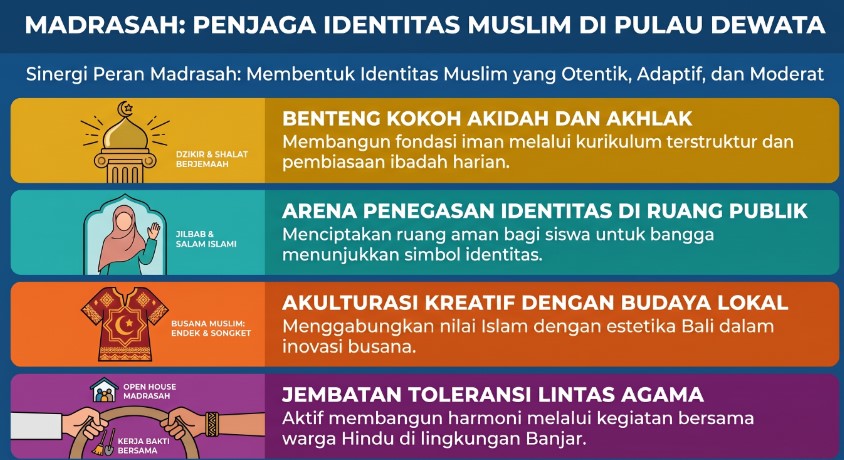
Findings: The findings reveal that madrasas function as: (1) an epistemological and ideological fortress, building the foundations of aqidah, sharia, and akhlaq through a comprehensive curriculum and ritualization of daily religious practices; (2) an arena for socialization and identity affirmation, creating a safe space for symbolic expression (jilbab, Islamic greetings, dhikr) and strengthening communal solidarity; (3) a creative acculturation laboratory, facilitating dialogue between Islamic norms and Balinese local culture (e.g., Muslim attire made from endek/songket fabrics); and (4) an agent of moderation and social bridge, actively fostering harmonious relations with the Hindu community through various interfaith social programs.
Originality/value: Unlike previous macro-level studies on Muslim minorities in Bali focusing on political identity or interfaith relations, this research offers a micro-ethnographic analysis of madrasas as sites of daily identity production. It demonstrates how madrasas perform cultural work—preserving, adapting, and transmitting Islamic identity—through adaptive, moderate, and contextual approaches in a minority setting.
References
Al-Qur'an al-Karim dan Terjemahannya. (2019). Kementerian Agama RI.
Arsyad, J. (2024). History of madrasah education in Indonesia and Malaysia: A perspective of change and continuity. Logos, 121, 167-184. https://doi.org/10.24101/logos.2024.79
Aziz, N. S., Ismail, A. S., & Mohidin, H. H. B. (2017). Building communal values for quality sustainable living in traditional madrassa—The case of Madrassa Quran Kubang Bujuk, Trengganu. Advanced Science Letters, 23(9), 8384-8388. https://doi.org/10.1166/asl.2017.9896
Barth, F. (1969). Ethnic groups and boundaries: The social organization of culture difference. Little, Brown and Company.
Bourdieu, P. (1986). The forms of capital. In J. Richardson (Ed.), Handbook of theory and research for the sociology of education (pp. 241-258). Greenwood.
Creswell, J. W., & Poth, C. N. (2018). Qualitative inquiry and research design: Choosing among five approaches (4th ed.). Sage Publications.
Fatmawati, R., & Kurniawan, A. (2020). Identitas Muslim dalam konteks budaya Bali. Jurnal Kajian Islam dan Budaya, 8(3), 45-60.
Hauser-Schäublin, B., & Harnish, D. D. (2014). Between harmony and discrimination: Negotiating religious identities within majority-minority relationships in Bali and Lombok. Brill. https://doi.org/10.1163/9789004271494
Jamil, M. M. (2018). Islam dan lokalitas: Dialektika agama dan budaya di Bali. Pustaka Pelajar.
Miles, M. B., Huberman, A. M., & Saldaña, J. (2014). Qualitative data analysis: A methods sourcebook (3rd ed.). Sage Publications.
Qomar, A. (2015). Pola hubungan Muslim dan Hindu di Bali. Aspirasi, 9(1), 70-80.
Rasyad, A., Tohri, A., Basri, H., & Chaer, H. (2026). Islamic education in the transitional era: The educational system of Nahdlatul Wathan in Lombok, Indonesia, 1936-1960. Multidisciplinary Science Journal, 8(4), e2026272. https://doi.org/10.31893/multiscience.2026272
Safitri, E. (2020). Large tradition in building tolerance: A study in Madrasah Diniyah Takmiliyah Al-Mubarok, Sleman Yogyakarta in developing inter-religious harmony. Millah: Journal of Religious Studies, 19(2), 345-371. https://doi.org/10.20885/millah.vol19.iss2.art7
Spradley, J. P. (1980). Participant observation. Holt, Rinehart and Winston.
Subhan, A. (2023). Al-madrasah (Madrasah) am al-madrasah al-’āmmah (Sekolah): al-Mufaḍḍalah ‘inda atbā’ jam’iyyah al-Muḥammadiyyah wa Nahḍah al-’Ulamā` fī Indūnīsiyā. Studia Islamika, 30(3), 561-594. https://doi.org/10.36712/sdi.v30i3.38201
Sumanti, S. T., Nunzairina, & Salminawati. (2024). The evolution of Islamic educational institutions in North Sumatra Indonesia. Nazhruna: Jurnal Pendidikan Islam, 7(1), 1-19. https://doi.org/10.31538/nzh.v7i1.4419
Sunhaji. (2017). Between social humanism and social mobilization: The dual role of madrasah in the landscape of Indonesian Islamic education. Journal of Indonesian Islam, 11(1), 125-144. https://doi.org/10.15642/JIIS.2017.11.1.125-144
Published
How to Cite
Issue
Section
License
Copyright (c) 2026 Suaidi Suaidi, Novena Ade F S

This work is licensed under a Creative Commons Attribution-ShareAlike 4.0 International License.