Penalaran Moral dalam Tindak Kecurangan Akademik Berbasis Artificial Intelligence
Penalaran Moral dalam Tindak Kecurangan Akademik Berbasis Artificial Intelligence
Authors
-
 Ainul Yaqin
Universitas Islam Majapahit Mojokerto
Ainul Yaqin
Universitas Islam Majapahit Mojokerto
-
M. Syarif
Universitas Islam Majapahit, Mojokerto
Keywords:
Artificial Intelligence , Kecurangan Akademik , Penalaran MoralAbstract
Abstrak
Tujuan: Penelitian ini bertujuan untuk menggali bentuk-bentuk kecurangan akademik berbantuan Artificial Intelligence (AI) sekaligus menemukan penalaran moral yang menjadi dasar tindakan tersebut di kalangan mahasiswa tingkat akhir.
Metodologi: Penelitian ini menggunakan pendekatan kualitatif interpretatif dengan desain studi kasus. Pengumpulan data dilakukan melalui wawancara mendalam dengan teknik probing terhadap mahasiswa tingkat akhir di salah satu perguruan tinggi swasta di Mojokerto yang sedang menyusun tugas akhir. Analisis data menggunakan model Miles, Huberman, dan Saldaña melalui tahapan kondensasi data, penyajian data, dan penarikan kesimpulan.
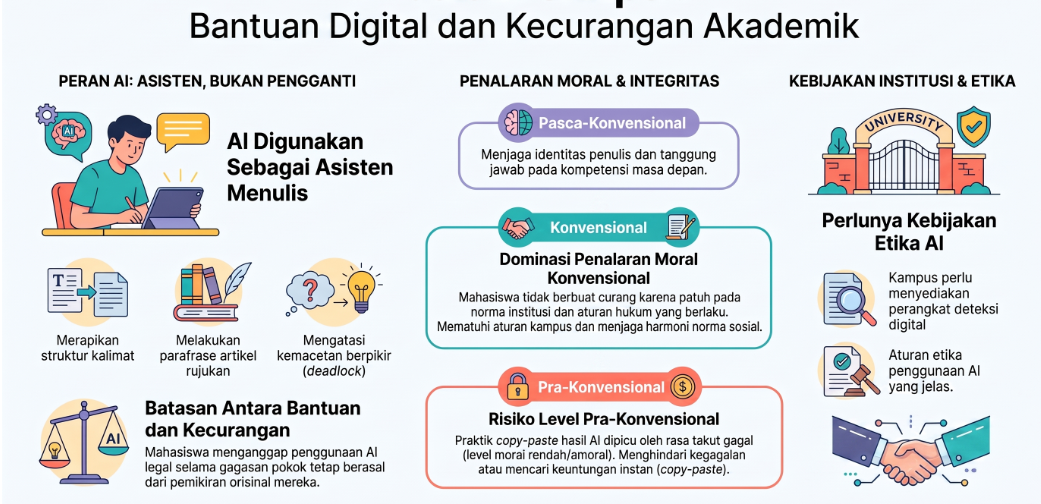
Temuan: Hasil penelitian menunjukkan bahwa hampir semua mahasiswa menggunakan AI sebagai asisten dalam menyusun tugas akhir, bukan menyerahkan seluruh pengerjaan kepada AI. Fungsi utama AI adalah merapikan, memparafrase, atau memperpanjang kalimat yang telah dibuat mahasiswa. Bagi mahasiswa, bantuan tersebut tidak tergolong kecurangan akademik. Penalaran moral yang dominan adalah kepatuhan pada norma institusional yang dapat dikategorikan sebagai level penalaran moral konvensional.
Implikasi: Penelitian ini memberikan implikasi terhadap pengembangan kebijakan perguruan tinggi dalam menetapkan aturan etika penggunaan AI dan penyediaan perangkat deteksi kecurangan akademik berbasis digital guna menciptakan iklim akademik yang berintegritas.
Orisinalitas: Penelitian ini memberikan kontribusi dalam mengkaji secara mendalam hubungan antara penalaran moral mahasiswa dan perilaku kecurangan akademik berbantuan AI, khususnya dalam konteks penyusunan tugas akhir di perguruan tinggi Indonesia.
Abstract
Purpose: This study aims to explore the forms of academic dishonesty assisted by Artificial Intelligence (AI) and to identify the moral reasoning underlying such behavior among final-year students.
Methodology: This study employs an interpretive qualitative approach with a case study design. Data were collected through in-depth interviews with probing techniques involving final-year students at a private university in Mojokerto who were completing their final theses. Data analysis followed the Miles, Huberman, and Saldaña model through data condensation, data display, and conclusion drawing.
Findings: The results indicate that almost all students use AI as an assistant in completing their final theses, rather than surrendering the entire work to AI. The main functions of AI are to tidy up, paraphrase, or elaborate sentences that students have already written. For students, such assistance is not considered academic dishonesty. The dominant moral reasoning is adherence to institutional norms, which can be categorized as a conventional level of moral reasoning.
Implications: This study provides implications for the development of university policies in establishing ethical guidelines for AI use and providing digital-based academic dishonesty detection tools to create an academic climate with integrity.
Originality:This study contributes to an in-depth examination of the relationship between students' moral reasoning and AI-assisted academic dishonesty behavior, particularly in the context of thesis writing in Indonesian higher education.
References
Cotton, D. R. E., Cotton, P. A., & Shipway, J. R. (2024). Chatting and cheating : Ensuring academic integrity in the era of ChatGPT. Innovations in Education and Teaching International, 61(2), 228–239. https://doi.org/10.1080/14703297.2023.2190148
Harman, G., Mason, K., & Sinnot-Armstrong, W. (2010). Moral Reasoning. In J. M. Doris & T. M. P. R. Group (Eds.), The Moral Psychology Handbook. New York: Oxford University Press.
Heriyati, D., & Ekasari, W. F. (2020). A Study on Academic Dishonesty and Moral Reasoning. International Journal of Education, 12(2), 56–62. https://doi.org/10.17509/ije.v12i2.18653
Kajiwara, Y., & Kawabata, K. (2024). AI literacy for ethical use of chatbot: Will students accept AI ethics? Computers and Education: Artificial Intelligence, 6(March), 100251. https://doi.org/10.1016/j.caeai.2024.100251
Kohlberg, L. (1968). The child as a moral philosopher. The Psychology Today, 7, 23–30.
Kohlberg, L. (1972). A Cognitive-Developmental Approach to Moral Education. Humanist, 32(6), 13–16.
Kohlberg, L. (1980). Stages of Moral Development as a Basis of Moral Education. In B. Munsey (Ed.), Moral Development, Moral Education, and Kohlberg (pp. 15–98). Birmingham, Alabama: Religious Education Press.
Lee, V. R., Pope, D., Miles, S., & Rosalía, C. Z. (2024). Cheating in the age of generative AI: A high school survey study of cheating behaviors before and after the release of ChatGPT. Computers and Education: Artificial Intelligence, 7(June). https://doi.org/10.1016/j.caeai.2024.100253
Malinka, K., Perešíni, M., Firc, A., Hujňák, O., & Januš, F. (2023). On the Educational Impact of ChatGPT: Is Artificial Intelligence Ready to Obtain a University Degree? Proceedings of the 2023 Conference on Innovation and Technology in Computer Science Education V. 1, 47–53. https://doi.org/10.1145/3587102.3588827
Miles, M. B., Huberman, A. M., & Saldaña, J. (2014). Qualitative Data Analysis: A Methods Sourcebook. Sage Publications.
Muhadjir, N. (2002). Metodologi Penelitian Kualitatif. Yogyakarta: Rake Sarasin.
Narvaez, D. (2008). Human Flourashing and Moral Development. In L. P. Nucci & D. Narvaez (Eds.), Handbook of Moral and Character Education (pp. 310–327). New York: Routledge.
Paxton, J. M., & Greene, J. D. (2010). Moral reasoning: Hints and allegations. Topics in Cognitive Science, 2(3), 511–527. https://doi.org/10.1111/j.1756-8765.2010.01096.x
Power, F. C. (2008). Moral Reasoning. In F. C. Power (Ed.), Moral Education; A Handbook, Volumes 1&2. Westport-CT: Praeger.
Stapleton, M. (2013). An Investigation of Moral Development: the Effect of Religiosity on Kohlbergian Moral Reasoning. Student Psychology Journal, 4, 1–14.
Sugiono. (2012). Metode Penelitian Kuantitatif, Kualitatif dan R&D. Bandung: Alfabeta.
Williams, R. T. (2024). The ethical implications of using generative chatbots in higher education. Frontiers in Education, 8(January). https://doi.org/10.3389/feduc.2023.1331607
Yaqin, A. (2020). Pendidikan Akhlak-Moral Berbasis Teori Kognitif. Depok: Rajawali Press.
Yaqin, A., & Suadi. (2022). Kecurangan Akademik dalam Moda Pembelajaran Digital di Perguruan Tinggi. Hikmah, 19(2), 77–89. https://doi.org/https://doi.org/10.53802/hikmah.v19i2.164
Zhao, L., Mao, H., Compton, B. J., Peng, J., Fu, G., Fang, F., … Lee, K. (2022). Academic dishonesty and its relations to peer cheating and culture : A meta-analysis of the perceived peer cheating effect. Educational Research Review, 36(June 2021), 100455. https://doi.org/10.1016/j.edurev.2022.100455
Published
How to Cite
Issue
Section
License
Copyright (c) 2026 Ainul Yaqin

This work is licensed under a Creative Commons Attribution-ShareAlike 4.0 International License.