Efisiensi Empat Lembaga Amil Zakat (LAZ) Terbesar di Indonesia
Studi Komparatif Menggunakan Data Envelopment Analysis (DEA)
Authors
-
 Abdullah Ahadish Shamad Muis
Institut Al Fithrah Surabaya
Abdullah Ahadish Shamad Muis
Institut Al Fithrah Surabaya
-
Mohammad Fausi
Institut Al Fithrah Surabaya
DOI:
https://doi.org/10.55757/tasharruf.v6i1.1091Keywords:
Data Envelopment Analysis (DEA), Efficiency, ZIS Fund Management, Zakat Institutions (LAZ)Abstract
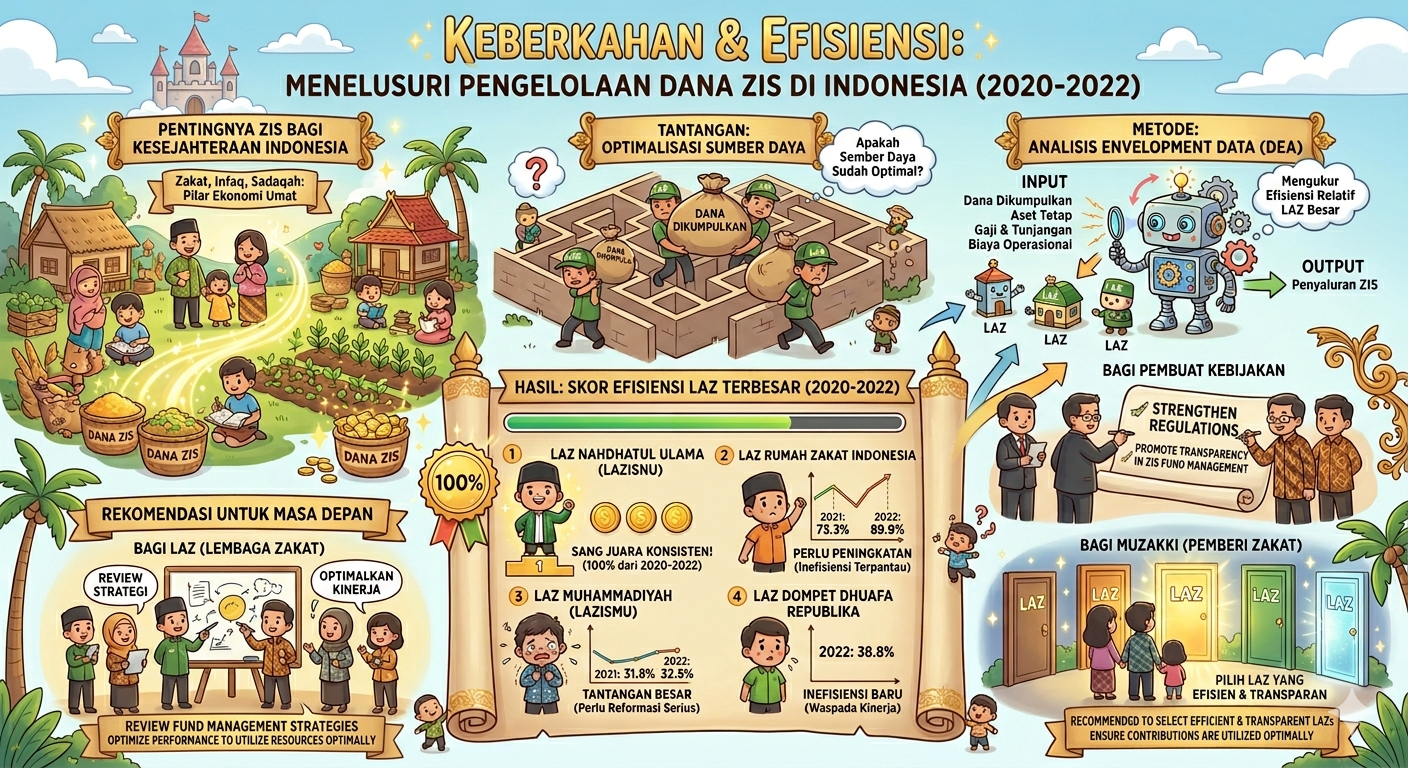
Zakat, Infaq, and Sadaqah (ZIS) fund management in Indonesia plays an important role in supporting the social and economic welfare of the community. However, the effectiveness and efficiency of ZIS fund management in Zakat Institutions (LAZ) remain challenging, particularly in ensuring that managed resources are optimized for the benefit of beneficiaries. This study aims to analyze the efficiency of ZIS fund management in the four largest LAZs in Indonesia using the Data Envelopment Analysis (DEA) approach. DEA was chosen as the analytical method due to its ability to measure relative efficiency among Decision-Making Units (DMUs) with similar objectives. Using secondary data from the Annual Reports of Indonesia's four largest LAZs—LAZ Rumah Zakat Indonesia, LAZ Muhammadiyah (LAZISMU), LAZ Nahdhatul Ulama (LAZISNU), and LAZ Dompet Dhuafa Republika—for the years 2020-2022, specifically on ZIS funds collected, fixed assets, salaries and allowances, ZIS distribution, and operational costs, this study found variations in the efficiency levels of fund management among the four LAZs examined. In 2021 and 2022, LAZ Rumah Zakat Indonesia recorded inefficiency with scores of 73.3% and 89.9%, respectively. LAZ Muhammadiyah (LAZISMU) experienced even worse things, in the same years it experienced inefficiency with scores of 31.8% and 32.5%. Similarly, LAZ Dompet Dhuafa Republika recorded inefficiency with a score of 38.8% in 2022. Only LAZ Nahdhatul Ulama (LAZISNU) consistently achieved a 100% efficiency score from 2020 to 2022. The findings of this study are expected to provide recommendations for related LAZs to review their fund management strategies in order to optimize performance, offer insights for policymakers to strengthen regulations and promote transparency in ZIS fund management, and serve as a recommendation for muzakki to select LAZs that are efficient and transparent, thereby ensuring that their contributions are utilized optimally.
References
BAZNAS, D. K. dan P. (2024). Outlook Zakat Indonesia 2024. BAZNAS Center of Strategic Studies. https://www.puskasbaznas.com/publications/books/1857-buku-outlook-zakat-indonesia-2024
Hasan, N. A., & Muhammad, R. (2023). Analisis Efisiensi Organisasi Pengelola Zakat di Indonesia dengan Metode Data Envelopment Analysis. Proceeding of National Conference on Accounting & Finance, 359–364. https://doi.org/10.20885/ncaf.vol5.art41
Kamus Besar Bahasa Indonesia (KBBI), O. (n.d.). Arti kata efisiensi. Retrieved December 19, 2024, from https://kbbi.web.id/efisiensi
Kementerian Agama. (2024, February 19). Bingung Mau Berzakat? Ini 170 Lembaga Amil Zakat Kantongi Izin dari Kemenag. Kementerian Agama Republik Indonesia. https://kemenag.go.id/nasional/bingung-mau-berzakat-ini-170-lembaga-amil-zakat-kantongi-izin-dari-kemenag-p1AAY
Muis, A. A. S. (2022). Menyoal Keadilan Sosio-Ekonomi dalam Tinjauan Ekonomi Islam: Integrasi Analisis Konseptual dan Praktikal. Innovative: Journal Of Social Science Research, 2(2), 384–394. https://doi.org/10.31004/innovative.v2i2.8403
Muis, A. A. S., Firdausi, M. A., Akbar, C., Gamal, S., & Saleh, H. (2024). The Zakat, Economic Growth, and Poverty Alleviation: An Artificial Neural Networks Analysis. International Journal of Zakat, 9(Special), 56–70. https://doi.org/10.37706/ijaz.v9iSpecial.467
Sidang, N. K. (2024). Analisis Efisiensi Kinerja Keuangan Lembaga Amil Zakat (LAZ) Rumah Zakat Indonesia dengan Metode Data Envelopment Analysis (DEA). Jurnal BAABU AL-ILMI: Ekonomi Dan Perbankan Syariah, 6(1), 48–62. https://doi.org/10.29300/ba.v6i1.2755
Published
How to Cite
Issue
Section
License
Copyright (c) 2026 Abdullah Ahadish Shamad Muis, Mohammad Fausi

This work is licensed under a Creative Commons Attribution-NonCommercial 4.0 International License.