Mekanisme Pembiayaan Berbasis Digital pada Fintech Syariah Peer To Peer Lending
Authors
-
 Hanim Misbah
Universiti Sains Islam Malaysia
Hanim Misbah
Universiti Sains Islam Malaysia
-
 Saiful Bakhri
Universitas Nahdlatul Ulama Pasuruan
Saiful Bakhri
Universitas Nahdlatul Ulama Pasuruan
-
Risa Umami
Universitas Nahdlatul Ulama Pasuruan
-
Kharina Arifia
Universitas Nahdlatul Ulama Pasuruan
DOI:
https://doi.org/10.55757/tasharruf.v6i1.1149Keywords:
Digital Financing Mechanism, Financial Inclusion, Islamic Fintech, MSME, Peer-to-Peer LendingAbstract
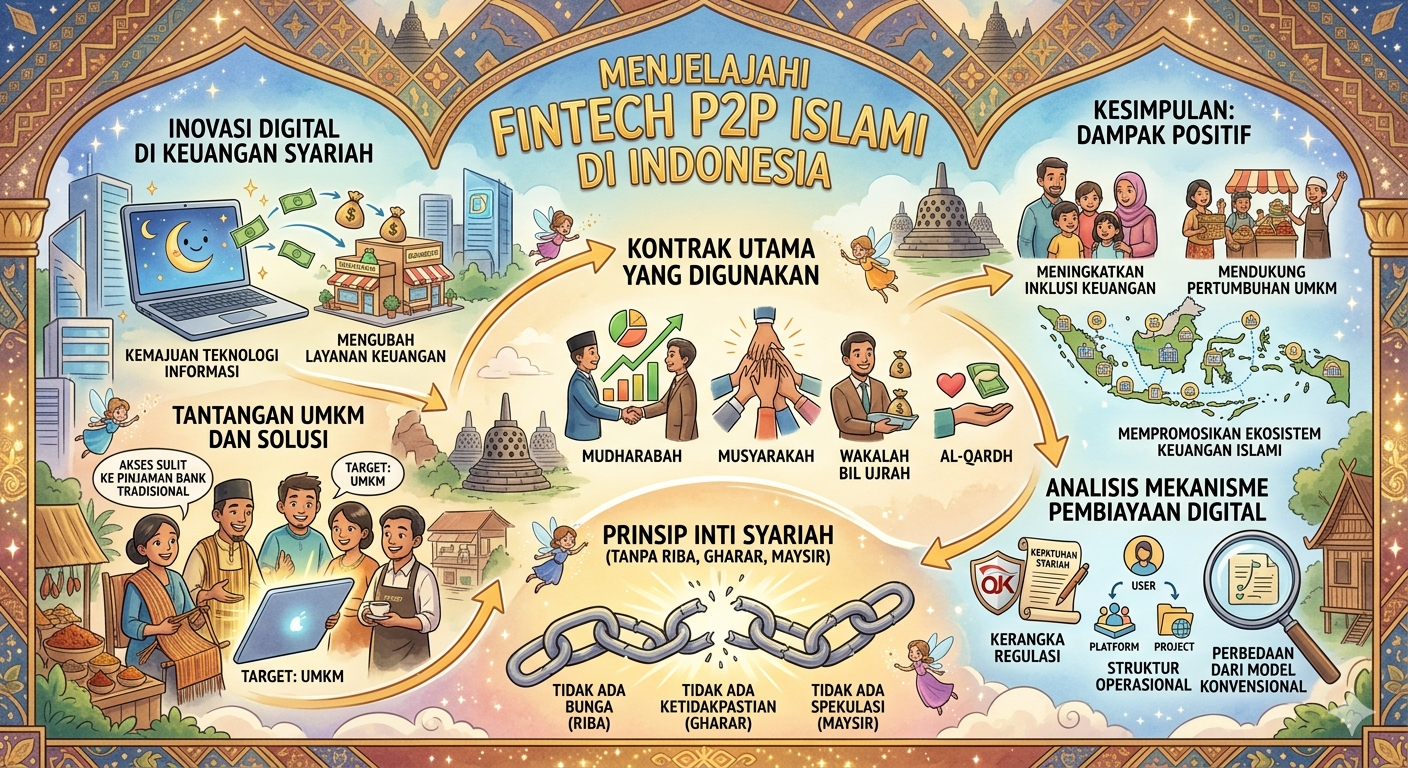
The rapid advancement of information technology has significantly transformed financial services, giving rise to digital innovations such as Islamic Peer-to-Peer (P2P) Lending Fintech. This platform offers a Sharia-compliant financing alternative, primarily targeting Micro, Small, and Medium Enterprises (MSMEs) that often face barriers in accessing traditional bank loans. This study aims to analyze the digital financing mechanism within Islamic P2P lending, examining its regulatory framework, underlying Islamic contracts, operational structure, and key distinctions from conventional models. The findings indicate that Islamic P2P lending operates on core Sharia principles prohibiting riba (usury), gharar (uncertainty), and maysir (speculation) and utilizes contracts such as mudharabah (profit-sharing), musyarakah (joint venture), wakalah bil ujrah (fee-based agency), and al-qardh (benevolent loan). The study concludes that Islamic P2P lending enhances financial inclusion by providing accessible, transparent, and ethically structured digital financing, thereby supporting the growth of MSMEs and promoting the broader development of Indonesia's Islamic financial ecosystem.
References
Abbasi, K. (2021). P2P lending Fintechs and SMEs’ access to finance. Economics Letters, 204. https://doi.org/10.1016/j.econlet.2021.109890
Alwi, A. B. (2018). Pembiayaan Berbasis Teknologi Informasi ( Fintech ) yang Berdasarkan Syariah Pendahuluan Kegiatan pinjam meminjam uang yang dilakukan secara langsung dengan berdasar pada perjanjian , baik yang diperjanjikan . Praktik tersebut – menurut banyak pihak-. 21(2).
Anshari, M. (2021). Financial Technology with AI-Enabled and Ethical Challenges. Society, 58(3), 189–195. https://doi.org/10.1007/s12115-021-00592-w
Baihaqi, J. (2018). Financial Technology Peer-To-Peer Lending Berbasis Syariah Di Indonesia. TAWAZUN : Journal of Sharia Economic Law, 1(2), 116. https://doi.org/10.21043/tawazun.v1i2.4979
Darmansyah. (2021). Factors determining behavioral intentions to use Islamic financial technology: Three competing models. Journal of Islamic Marketing, 12(4), 794–812. https://doi.org/10.1108/JIMA-12-2019-0252
Fitriyadi, G. M. (2019). Analisis Mitigasi Resiko Financial Technology Peer To Peer (P2P) Lending dalam Penyaluran Pembiayaan Terhadap UMKM di Indonesia (Studi Kasus PT. Ammana Fintek Syariah). Jurnal Ekonomi Dan Bisnis, 7(2), 2–13.
Lova, E. F. (2021). Financial Technology Peer To Peer Lending Syariah: Sebuah Perbandingan Dan Analisis. Jeblr, 1(2), 29–41.
Mahmuda, F. (2019). Analisis Perjanjian Pembiayaan Dalam Skema Peer To Peer Lending (P2Pl) SMahmuda, F. 2019. Analisis Perjanjian Pembiayaan Dalam Skema Peer To Peer Lending (P2Pl) Syariah Pada Lembaga Fintech Syariah (Studi Kasus Pt. Dana Syariah Indonesia).
Meilita, H., & Subardi, P. (2021). Mekanisme Pembiayaan Fintech Peer to Peer Lending Syariah Bagi UMKM di. 8, 305–311.
Nasik, S. T. W. & K. (2021). Menelisik Perbedaan Mekanisme Sistem Peer To Peer Lending pada Fintech Konvensional dan Fintech Syariah Di Indonesia. 1(2), 66–90. https://doi.org/10.52620/jeis.v1i1.7
Putri, G. A. (2023). Analysis of financial technology acceptance of peer to peer lending (P2P lending) using extended technology acceptance model (TAM). Journal of Open Innovation Technology Market and Complexity, 9(1). https://doi.org/10.1016/j.joitmc.2023.100027
Sheela, P. (2023). Fintech and Islamic banking: A systematic view and future research agenda. Fintech Applications in Islamic Finance AI Machine Learning and Blockchain Techniques, 1–23. https://doi.org/10.4018/9798369310380.ch001
Trimulato, Saidah Fitri, Z., & Qizam, I. (2022). Linkage Bank Syariah dan Fintech Syariah Penyaluran Pembiayaan Berbasis Digital dan Risiko Pembiayaan. Jurnal Ilmiah Ekonomi Islam, 8(1), 1257–1269.
Published
How to Cite
Issue
Section
License
Copyright (c) 2026 Hanim Misbah, Saiful Bakhri, Risa Umami, Kharina Arifia

This work is licensed under a Creative Commons Attribution-NonCommercial 4.0 International License.