The Nature Of Strategic Management
Authors
-
 Dessy Boegiyati
Universitas Nahdlatul Ulama Pasuruan
Dessy Boegiyati
Universitas Nahdlatul Ulama Pasuruan
-
Yunita Tri Wulandari
Universitas Nahdlatul Ulama Pasuruan
-
Mukhammad Saam Nabil Fairoby
Universitas Islam Negeri Maulana Malik Ibrahim
DOI:
https://doi.org/10.55757/cashless.v3i2.1157Keywords:
Competitive Advantage, Long-term Planning, Organizational Performance, Strategic Management, Strategy Formulation, Strategy ImplementationAbstract
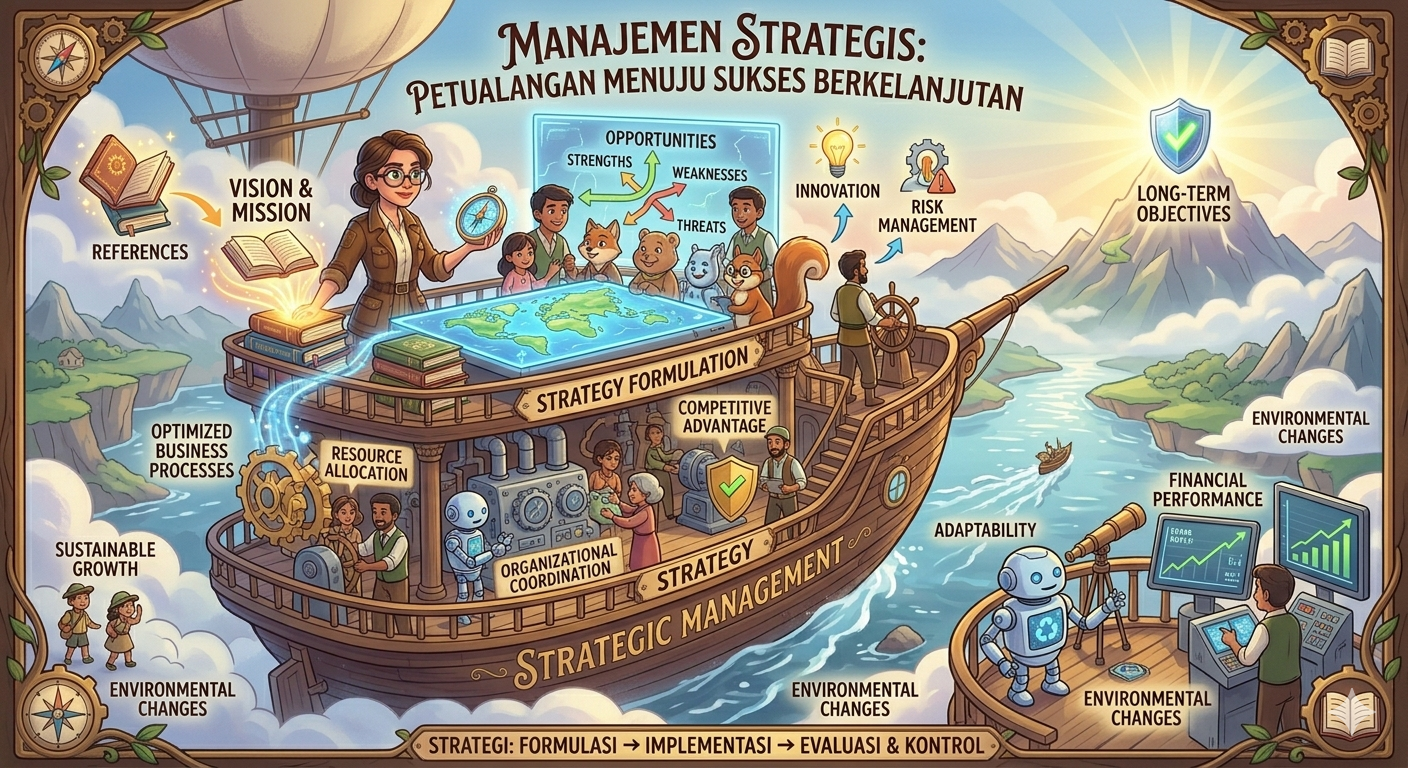
Strategic management is a systematic and structured process that enables organizations to formulate, implement, and evaluate strategies to achieve long-term objectives in a dynamic business environment. This literature review examines the nature of strategic management, including its definition, key characteristics, implementation stages, and importance for organizational success. The study employs a qualitative approach through comprehensive literature analysis from academic sources, journals, and case studies. Findings indicate that strategic management comprises three main stages: strategy formulation, strategy implementation, and strategy evaluation and control. Key characteristics include long-term focus, holistic approach, dynamic adaptability, and competitive advantage orientation. The research demonstrates that strategic management is crucial for organizations to achieve competitive advantage, adapt to environmental changes, optimize resource allocation, enhance organizational coordination, improve financial performance, manage risks, and foster innovation and sustainable growth. Organizations implementing strategic management consistently show better financial performance than those without systematic strategic planning. These insights highlight strategic management as an essential investment for organizational success and sustainability in today's competitive business landscape.
References
Alkaraan, F. (2023). Sustainable strategic investment decision-making practices in UK companies: The influence of governance mechanisms on synergy between industry 4.0 and circular economy. Technological Forecasting and Social Change, 187. https://doi.org/10.1016/j.techfore.2022.122187
Amjad, F. (2021). Effect of green human resource management practices on organizational sustainability: the mediating role of environmental and employee performance. Environmental Science and Pollution Research, 28(22), 28191–28206. https://doi.org/10.1007/s11356-020-11307-9
Febianti Aslamiyah, Rifka Adila Windarti, Septa Farleni, V. F. S. (2024). Pendekatan Resource-Based View ( Rbv ) Dalam Manajemen Bisnis : Strategi Untuk Keunggulan Yang Berkelanjutan. AL-A’mal, 1, 176–183.
Ihsanullah, I. (2021). Desalination and environment: A critical analysis of impacts, mitigation strategies, and greener desalination technologies. Science of the Total Environment, 780. https://doi.org/10.1016/j.scitotenv.2021.146585
Kumar, A. (2021). Mitigate risks in perishable food supply chains: Learning from COVID-19. Technological Forecasting and Social Change, 166. https://doi.org/10.1016/j.techfore.2021.120643
Lutfi, A. (2022). Factors Influencing the Adoption of Big Data Analytics in the Digital Transformation Era: Case Study of Jordanian SMEs. Sustainability Switzerland, 14(3). https://doi.org/10.3390/su14031802
Mahmud, K. (2021). Nitrogen losses and potential mitigation strategies for a sustainable agroecosystem. Sustainability Switzerland, 13(4), 1–23. https://doi.org/10.3390/su13042400
Malik, N. (2022). Impact of artificial intelligence on employees working in industry 4.0 led organizations. International Journal of Manpower, 43(2), 334–354. https://doi.org/10.1108/IJM-03-2021-0173
Nilimaa, J. (2023). Smart materials and technologies for sustainable concrete construction. Developments in the Built Environment, 15. https://doi.org/10.1016/j.dibe.2023.100177
Reddy, S. (2024). Generative AI in healthcare: an implementation science informed translational path on application, integration and governance. Implementation Science, 19(1). https://doi.org/10.1186/s13012-024-01357-9
Richey, R. G. (2022). A Responsiveness View of logistics and supply chain management. Journal of Business Logistics, 43(1), 62–91. https://doi.org/10.1111/jbl.12290
Vientiany, D., Wahyuni Pohan, N. A., & Barus, J. (2024). Pengenalan Balanced Scorecard Sebagai Strategi Organisasi Bisnis. Jurnal Ekonomi Dan Bisnis, 2(6), 712–723.
Wamba, S. F. (2022). Impact of artificial intelligence assimilation on firm performance: The mediating effects of organizational agility and customer agility. International Journal of Information Management, 67. https://doi.org/10.1016/j.ijinfomgt.2022.102544
Published
How to Cite
Issue
Section
License
Copyright (c) 2026 Yunita Tri Wulandari , Mukhammad Saam Nabil Fairoby

This work is licensed under a Creative Commons Attribution-NonCommercial 4.0 International License.