Analisis Break Even Point (BEP) sebagai Dasar Penentuan Kelayakan Usaha pada Cafe Akademos Warungdowo
Authors
-
 Herlina Widya Ananta
Universitas Nahdlatul Ulama Pasuruan, Indonesia
Herlina Widya Ananta
Universitas Nahdlatul Ulama Pasuruan, Indonesia
-
Dessy Boegiyati
Universitas Nahdlatul Ulama Pasuruan, Indonesia
DOI:
https://doi.org/10.55757/cashless.v4i1.1516Abstract
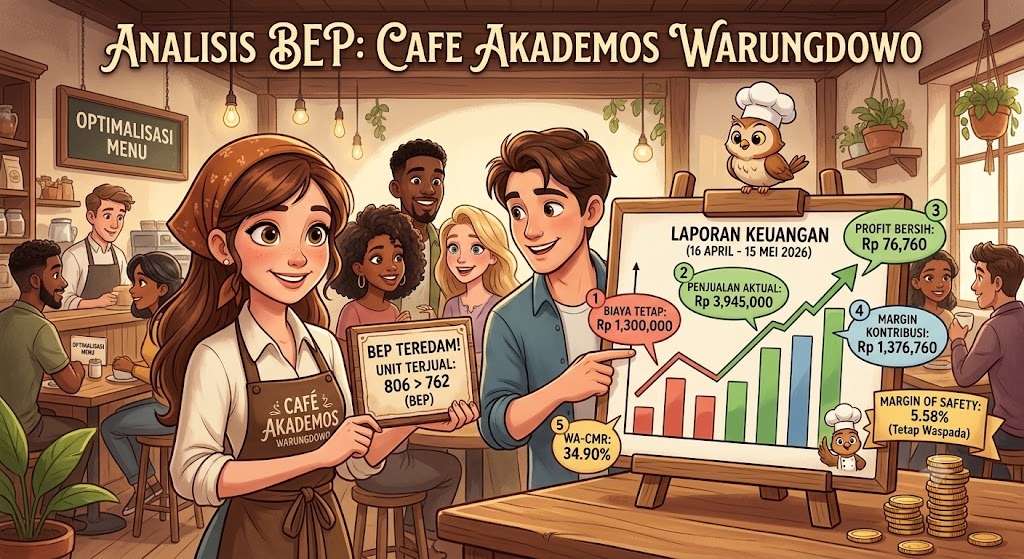
This study aims to analyze the Break Even Point (BEP) as a basis for determining business feasibility at Cafe Akademos Warungdowo using a descriptive quantitative approach and case study method. Data were collected through interviews, observations, and documentation of financial reports during the period of April 16–May 15, 2026. The analysis included calculations of fixed costs, variable costs, contribution margin, Weighted Average Contribution Margin Ratio (WA-CMR), Break Even Point (BEP), Margin of Safety (MoS), and profit-loss reports.
The results showed that the café’s total fixed costs amounted to Rp1,300,000, with total sales of Rp3,945,000 and a contribution margin of Rp1,376,760. The WA-CMR value was 34.90%, while the BEP was achieved at sales of Rp3,725,051 or 762 product units. Actual sales of 806 units exceeded the break-even point, resulting in a net profit of Rp76,760
Although the business was considered financially feasible, the Margin of Safety (MoS) Ratio of 5.58% indicates that the business remains vulnerable to declining sales. Therefore, the café management needs to improve profitability through cost efficiency, price evaluation, and optimization of products with high contribution margins.
References
APKRINDO. (2021). Laporan Tahunan Asosiasi Pengusaha Kafe dan Restoran Indonesia 2021. APKRINDO. https://www.apkrindo.or.id
Bustami, B., & Nurlela. (2021). Akuntansi Biaya: Teori dan Aplikasi (Edisi ke-4). Mitra Wacana Media.
Chiang, A. C., & Wainwright, K. (2020). Fundamental Methods of Mathematical Economics (5th ed.). McGraw-Hill Education.
Creswell, J. W. (2022). Research Design: Qualitative, Quantitative, and Mixed Methods Approaches (6th ed.). SAGE Publications.
Fahmi, I. (2021). Analisis Break Even Point sebagai Dasar Perencanaan Penjualan pada Kedai Kopi Skala Kecil. Jurnal Akuntansi Dan Manajemen Bisnis, 5(1), 23–35.
Garrison, R. H., Noreen, E. W., & Brewer, P. C. (2018). Managerial Accounting (16th ed.). McGraw-Hill Education.
Hansen, D. R., & Mowen, M. M. (2021). Cornerstones of Cost Management (4th ed.). Cengage Learning.
Haryanto, B., & Susanto, A. (2023). Analisis Break Even Point dan Strategi Peningkatan Profitabilitas Usaha Kafe. Jurnal Ekonomi Dan Bisnis, 11(1), 45–62.
Hery. (2021). Analisis Laporan Keuangan: Pendekatan Rasio Keuangan (Edisi ke-3). PT Grasindo.
Horngren, C. T., Datar, S. M., & Rajan, M. V. (2021). Cost Accounting: A Managerial Emphasis (16th ed.). Pearson Education.
Kemenkop, U. (2022). Perkembangan Data Usaha Mikro, Kecil, Menengah (UMKM) dan Usaha Besar (UB) Tahun 2021–2022. https://kemenkopukm.go.id/data-umkm/
Lestari, P. A., & Permatasari, D. (2022). Analisis Break Even Point pada Usaha Kuliner Kelas Menengah di Yogyakarta. Jurnal Ekonomi Dan Bisnis Terapan, 8(2), 112–128.
Mulyadi. (2018). Akuntansi Biaya (Edisi ke-5). UPP STIM YKPN. https://uppstimykpn.ac.id
Mulyadi. (2022). Akuntansi Biaya (Edisi ke-6). UPP STIM YKPN.
Prasetyo, H., & Widayanti, R. (2022). Analisis Titik Impas sebagai Alat Perencanaan Laba Kafe Indie di Malang. Jurnal Manajemen Dan Kewirausahaan Indonesia, 10(1), 55–71.
Puspitasari, D., & Rahayu, S. (2021). Penerapan Analisis Break Even Point dalam Menentukan Kelayakan Usaha Kuliner Skala Kecil di Malang. Jurnal Manajemen Dan Kewirausahaan, 9(1), 45–60.
Rahayu, S., & Sunarto, T. (2023). Peran Analisis BEP dalam Pengambilan Keputusan UMKM Food and Beverage Surabaya. Jurnal Riset Akuntansi Dan Bisnis, 11(2), 89–105.
Rahmawati, N., & Kusuma, H. (2023). Implementasi Analisis BEP sebagai Alat Pengendalian Keuangan UMKM Kuliner. Jurnal Akuntansi Dan Manajemen, 18(1), 30–48.
Sari, R. A., & Wijaya, H. (2020). Permasalahan Pengelolaan Keuangan UMKM di Indonesia: Studi Literatur. Jurnal Akuntansi Dan Keuangan Indonesia, 17(1), 1–18. https://doi.org/10.21002/jaki.2020.01
Sari, R. A., Wijaya, H., & Pratama, D. (2022). Analisis Kelayakan Usaha UMKM Berbasis Break Even Point: Studi Empiris pada Sektor Kuliner Jawa Timur. Jurnal Riset Akuntansi Dan Keuangan, 10(3), 201–218. https://doi.org/10.17509/jrak.v10i3
Sari, Wibowo, A., & Nugroho, F. (2023). Evaluasi Kelayakan Finansial UMKM Minuman Kekinian Berbasis BEP di Sidoarjo. Jurnal Ilmiah Ekonomi Bisnis, 9(3), 200–218.
Siregar, B., Suripto, B., Hapsoro, D., Lo, E. W., & Biyanto, F. (2021). Akuntansi Manajemen (Edisi ke-3). Salemba Empat.
Sugiyono. (2022). Metode Penelitian Kuantitatif, Kualitatif, dan R&D (Edisi ke-3). Alfabeta.
Suliyanto. (2020). Studi Kelayakan Bisnis: Pendekatan Praktis (Edisi ke-2). Andi Offset.
Syaefulloh, A., & Nurdiansyah, H. (2022). Aplikasi Matematika Ekonomi dalam Analisis Break Even Point pada Usaha Kafe. Jurnal Matematika Dan Pembelajaran, 10(1), 34–50.
Published
How to Cite
Issue
Section
License
Copyright (c) 2026 ananta, Dessy Boegiyati

This work is licensed under a Creative Commons Attribution-ShareAlike 4.0 International License.