Analisa Risiko MSDs dengan Metode Nordic Body Map terhadap Pekerja Proyek CV Makarya Engineering
Penulis
-
 Muhammad Irfan Rahmadani
Universitas Nahdlatul Ulama Surabaya, Indonesia
-
Muhammad Syahrul Ramadhan
-
Muhammad Nizar Mahabbi Rosul
-
Ratna Ayu Ratriwardhani
DOI:
https://doi.org/10.55757/ekliptika.v4i2.147Kata Kunci:
gangguan muskuloskeletal, Nordic Body Map, proyek pembangunan gedungAbstrak
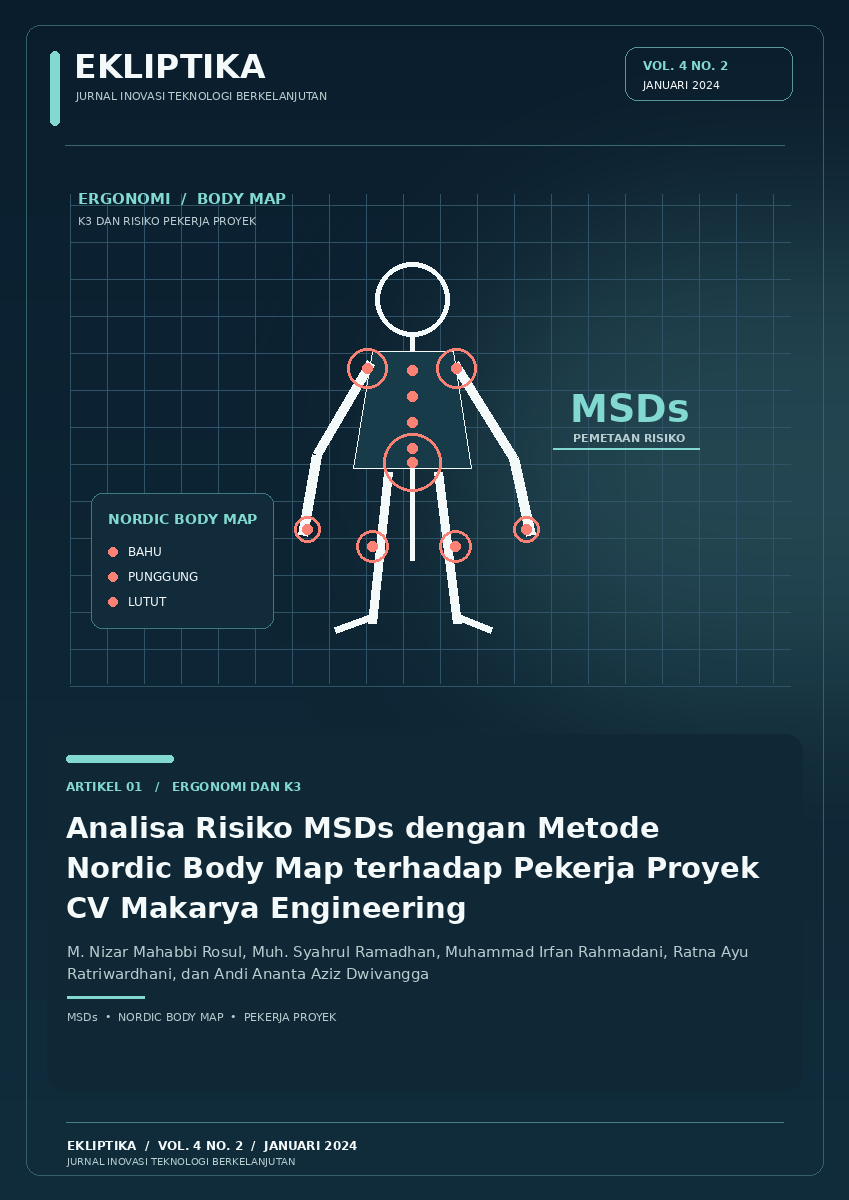
Penelitian ini bertujuan mengidentifikasi keluhan muskuloskeletal pada pekerja proyek
pembangunan gedung SDN Tembok Dukuh II Surabaya yang diawasi oleh CV. Makarya
Engineering. Aktivitas proyek meliputi pengangkatan material, pekerjaan dengan posisi
membungkuk, pemancangan, penggalian, dan pemecahan kepala pancang. Penilaian
dilakukan menggunakan metode Nordic Body Map melalui wawancara terhadap lima
pekerja dengan skala Likert empat tingkat, yaitu tidak sakit (0), agak sakit (1), sakit (2), dan
sakit sekali (3). Hasil disajikan dalam skor dan persentase keluhan pada bagian tubuh.
Keluhan sakit sekali paling banyak terdapat pada punggung, yaitu 60%, sedangkan keluhan
sakit mencapai 60% pada leher bagian bawah dan betis kiri. Keluhan agak sakit mencapai
60% pada pergelangan tangan kanan dan tangan kiri. Berdasarkan klasifikasi dalam artikel
sumber, tiga pekerja memiliki tingkat risiko MSDs sedang dan dua pekerja memiliki tingkat
risiko rendah.
Referensi
[1] Tarwaka, Sholichul, dan L. Sudiajeng, Ergonomi untuk Keselamatan, Kesehatan Kerja dan
Produktivitas. Surakarta: UNIBA Press, 2004.
[2] California Department of Industrial Relations dan National Institute for Occupational Safety
and Health, Ergonomic Guidelines for Manual Material Handling. DHHS (NIOSH)
Publication no. 2007-131, 2007, doi: 10.26616/NIOSHPUB2007131.
[3] K. A. Fitri dan R. A. Ratriwardhani, “Analisa risiko ergonomi dengan metode Nordic Body
Map terhadap pekerja pembuatan karton box di UD. Handia Makmur,” Ekliptika, vol. 2, no.
1, hlm. 1–10, 2021, doi: 10.55757/ekliptika.v2i01.25.
[4] F. Ayu dan R. A. Ratriwardhani, “Relationship of work position with complaints of
musculoskeletal disorders (MSDs) in cracker industrial worker at Kedungdoro Village,
Sidoarjo,” IOP Conference Series: Earth and Environmental Science, vol. 747, no. 1, art.
012105, Mei 2021. IOP Publishing. doi: 10.1088/1755-1315/747/1/012105.
[5] F. Ayu dan R. Ayu, “Sosialisasi teknik mengurangi nyeri tulang punggung bawah (low back
pain) pada pengemudi bus antarkota antarprovinsi (AKAP) di Terminal Bungurasih,”
Community Development Journal, vol. 2, no. 1, 2018.
[6] W. Umer, M. F. Antwi-Afari, H. Li, G. P. Y. Szeto, dan A. Y. L. Wong, “The prevalence of
musculoskeletal symptoms in the construction industry: a systematic review and meta
analysis,” International Archives of Occupational and Environmental Health, vol. 91, no. 2,
hlm. 125–144, 2018, doi: 10.1007/s00420-017-1273-4.
[7] M. F. Antwi-Afari et al., “A science mapping-based review of work-related musculoskeletal
disorders among construction workers,” Journal of Safety Research, vol. 85, hlm. 114–128,
2023, doi: 10.1016/j.jsr.2023.01.011.
[8] X. Wang, X. S. Dong, S. D. Choi, dan J. Dement, “Work-related musculoskeletal disorders
among construction workers in the United States from 1992 to 2014,” Occupational and
Environmental Medicine, vol. 74, no. 5, hlm. 374–380, 2017, doi: 10.1136/oemed-2016
103943.
[9] J. S. Boschman, H. F. van der Molen, J. K. Sluiter, dan M. H. W. Frings-Dresen,
“Musculoskeletal disorders among construction workers: a one-year follow-up study,”
BMC Musculoskeletal Disorders, vol. 13, art. 196, 2012, doi: 10.1186/1471-2474-13-196.
[10] M. Kashif et al., “Work-related musculoskeletal disorders among Pakistani construction
workers: Prevalence, characteristics, and associated risk factors,” Work, vol. 72, no. 1, hlm.
119–126, 2022, doi: 10.3233/WOR-205009.
[11] Y.-C. Lee, X. Hong, dan S. S. Man, “Prevalence and associated factors of work-related
musculoskeletal disorders symptoms among construction workers: A cross-sectional
study in South China,” International Journal of Environmental Research and Public Health,
vol. 20, no. 5, art. 4653, 2023, doi: 10.3390/ijerph20054653.
[12] I. Kuorinka et al., “Standardised Nordic questionnaires for the analysis of musculoskeletal
symptoms,” Applied Ergonomics, vol. 18, no. 3, hlm. 233–237, 1987, doi: 10.1016/0003
6870(87)90010-X.
[13] G. C. David, “Ergonomic methods for assessing exposure to risk factors for work-related
musculoskeletal disorders,” Occupational Medicine, vol. 55, no. 3, hlm. 190–199, 2005, doi:
10.1093/occmed/kqi082.
[14] E.-P. Takala et al., “Systematic evaluation of observational methods assessing
biomechanical exposures at work,” Scandinavian Journal of Work, Environment & Health,
vol. 36, no. 1, hlm. 3–24, 2010, doi: 10.5271/sjweh.2876.
61
Ekliptika : Jurnal Inovasi Teknologi Berkelanjutan
M. Nizar Mahabbi Rosul dkk.
│
Analisa Risiko MSDs dengan NBM
[15] P. G. Dempsey, R. W. McGorry, dan W. S. Maynard, “A survey of tools and methods used by
certified professional ergonomists,” Applied Ergonomics, vol. 36, no. 4, hlm. 489–503,
2005, doi: 10.1016/j.apergo.2005.01.007.
[16] L. McAtamney dan E. N. Corlett, “RULA: A survey method for the investigation of work
related upper limb disorders,” Applied Ergonomics, vol. 24, no. 2, hlm. 91–99, 1993, doi:
10.1016/0003-6870(93)90080-S.
[17] S. Hignett dan L. McAtamney, “Rapid entire body assessment (REBA),” Applied
Ergonomics, vol. 31, no. 2, hlm. 201–205, 2000, doi: 10.1016/S0003-6870(99)00039-3.
[18] H. F. van der Molen, R. Grouwstra, P. P. F. M. Kuijer, J. K. Sluiter, dan M. H. W. Frings-Dresen,
“Efficacy of adjusting working height and mechanizing of transport on physical work
demands and local discomfort in construction work,” Ergonomics, vol. 47, no. 7, hlm. 772
783, 2004, doi: 10.1080/0014013042000193309.
[19] P. A. J. Luijsterburg, P. M. Bongers, dan E. M. M. de Vroome, “A new bricklayers’ method for
use in the construction industry,” Scandinavian Journal of Work, Environment & Health,
vol. 31, no. 5, hlm. 394–400, 2005, doi: 10.5271/sjweh.923.
[20] H. F. van der Molen et al., “Implementation of participatory ergonomics intervention in
construction companies,” Scandinavian Journal of Work, Environment & Health, vol. 31,
no. 3, hlm. 191–204, 2005, doi: 10.5271/sjweh.869
Diterbitkan
Cara Mengutip
Terbitan
Bagian
Lisensi
Hak Cipta (c) 2023 Ekliptika

Artikel ini berlisensiCreative Commons Attribution-ShareAlike 4.0 International License.