Strategi Guru Pendidikan Agama Islam dalam Pembinaan Akhlak Mahmudah di Sekolah Menengah Pertama
Authors
-
 Atika Robiatul Adawiyah
Universitas PGRI Wiranegara, Indonesia
Atika Robiatul Adawiyah
Universitas PGRI Wiranegara, Indonesia
-
Siti Rofiqoh At-Thobibi
Universitas PGRI Wiranegara, Indonesia
-
Rochmatus Saidah
Universitas PGRI Wiranegara, Indonesia
DOI:
https://doi.org/10.55757/tarbawi.v14i1.1274Keywords:
Akhlaq mahmudah, pendidikan karakter, pendidikan agama islam, strategi guruAbstract
Purpose: This study aims to analyze the strategies employed by Islamic Education (PAI) teachers in fostering akhlaq mahmudah (noble character) among seventh-grade students at SMPN 11 Pasuruan City.
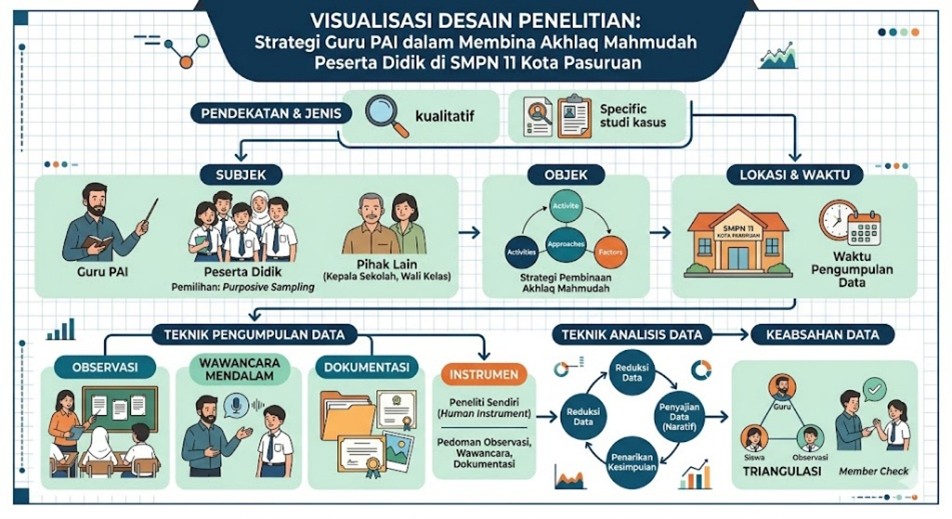
Design/methodology/approach: The research uses a qualitative approach with a case study design. Data were collected through observations, interviews, and documentation involving PAI teachers, students, and school administrators.
Findings: The results indicate that teachers implement various strategies, including role modeling (uswah hasanah), habituation of positive behaviors, integration of moral values into learning activities, and providing advice and motivation. In addition, teachers collaborate with parents and utilize religious activities such as congregational prayers and Qur'an recitation programs to strengthen students' character development. The findings reveal that these strategies significantly contribute to shaping students' discipline, honesty, responsibility, and respect toward others.
Research limitations/implications: Challenges such as diverse student backgrounds and the influence of external environments remain obstacles in the implementation process. Therefore, continuous collaboration among teachers, parents, and the school environment is essential to optimize the development of students' noble character.
Originality/value: This research provides empirical insights into the integration of multiple character-building strategies in a junior high school context, highlighting the combined role of teacher exemplar, habituation, and school-family collaboration in fostering Islamic moral values.
References
Abdullah, M., & Sukari, S. (2025). Beyond Technical Efficiency: Integrating Islamic Reflective Pedagogy into Digital Learning Design. Assyfa Journal of Islamic Studies. https://journal.assyfa.com/index.php/ajis/article/view/616
Afriandi, Amaliah, N., & Awaliah, N. I. (2024). Akhlak dalam Pendidikan Agama Islam. TEKNOS: Jurnal Pendidikan Dan Teknologi, 2(1), 104–111. https://doi.org/10.59638/teknos.v1i1.258
Amrullah, A. K. (2021). Akhlak Mahmudah. At-Ta’lim: Kajian Pendidikan Agama Islam.
Asyari, A. (2022). Metode Deskriptif Kualitatif dalam Pembinaan Akhlak. El Midad. https://doi.org/10.20414/elmidad.v14i1.5314
Asyari, A., & Sania, A. W. (2022). Pembinaan Akhlak Mahmudah di Sekolah Dasar. El Midad. https://doi.org/10.20414/elmidad.v14i1.5314
Buwono, M. P. R. (2024). Literature Review dalam Pendidikan Islam. Jurnal Eduslamic. https://doi.org/10.59548/jed.v3i1.464
Chotimah, C., Qudsy, S. Z., & Yusuf, M. (2025). Superficial implementation of religious moderation in Islamic educational management. Cogent Education, 12(1). https://doi.org/10.1080/2331186X.2024.2442235
Darmayanti, R., Choirudin, C., Hadiroh, S., Sumani, S., Naim, M. A., & Aidha, A. S. (2023). Pizza Vs. PJBL: How mathematics learning media improves high school students creative thinking on trigonometric function limits. Assyfa Journal of Islamic Studies, 2(1). https://doi.org/10.61650/ajis.v2i1.313
Effectiveness of the Use of Information Technology in the Merdeka Mengajar Platform in Islamic Religious Education Learning in Pringsewu Regency, 2 Assyfa Journal of Islamic Studies 97 (2024). https://journal.assyfa.com/index.php/ajis/article/view/550
Hadiati, E., Dwiyanto, A., Setianingrum, D. A., & Jatmiko, A. (2025). Women Academic Leadership in Islamic Higher Education: Embracing the Society 5.0 Era. Munaddhomah, 6(2), 345–357. https://doi.org/10.31538/munaddhomah.v6i2.1860
Irbathy, S. A., & Fahma, N. (2025). Reconstructing Pesantren Pedagogy: Integrating Social-Emotional Learning (SEL) and Sayyidah ’Ā’ishah’s Intellectual Rigor to Enhance Student Agency. Assyfa Journal of Islamic Studies. https://journal.assyfa.com/index.php/ajis/article/view/688
Jannata Anhar, Rani Darmayanti, & Usmiyatun Usmiyatun. (2023). Pengaruh Kompetensi Guru Agama Islam Terhadap Implementasi Manajemen Sumber Daya Manusia Di Madrasah Tsanawiyah. Assyfa Journal of Islamic Studies, 1(1).
Kistoro, H. C. A., Istiyono, E., Latipah, E., & Burhan, N. M. (2023). Islamic Character Education: Mapping and Networking Data Using Bibliometric Analysis. Jurnal Pendidikan Agama Islam, 20(2), 195–214. https://doi.org/10.14421/jpai.v20i2.8027
Kusumaningsih, D., DARMAYANTI, R., LATIPUN, L., Rizki, N., Laila, A. R. N., Inganah, S., DARMAYANTI, R., Rahmah, K., Inganah, S., DARMAYANTI, R., Sugianto, R., Ningsih, E. F., Sah, R. W. A., DARMAYANTI, R., Maryanto, B. P. A., Vedianty, A. S. A., DARMAYANTI, R., Lestari, A. S. B., Rayungsari, M., … Prakongpan, P. (2023). Analysis of Mathematics Problem Solving Ability of Junior High School Students Based on APOS Theory Viewed from the Type of Kolb Learning Style. Assyfa Journal of Islamic Studies, 1(1), 1–12. https://www.scopus.com/inward/record.uri?eid=2-s2.0-105031244740&doi=10.3390%2Fsocsci15020068&partnerID=40&md5=c5c236926a8d590f340683d66801ef06
Laila, A. R. N., Cholily, Y. M., Syaifuddin, M., Darmayanti, R., Sugianto, R., & Muhammad, I. (2023). Desain Modul Matematika Bilingual: Urgensi Pengembangan Media Matematika Bilingual dengan konten Islami. Assyfa Journal of Islamic Studies, 1(2). https://doi.org/10.61650/ajis.v1i2.133
Maulani, D. F., & Permana, H. (2025). Studi Analisis Akhlak Mahmudah dan Akhlak Mazmumah dalam Perspektif Pendidikan Islam. Pendas: Jurnal Ilmiah Pendidikan Dasar. https://doi.org/10.23969/jp.v11i02.44833
Muniir, M. M., & Yusuf, M. S. (2025). Akhlak Mahmudah dalam Perspektif Tasawuf Akhlaki. Jurnal Teologi Islam. https://doi.org/10.63822/8brny685
Nabila, S., & Darmayanti, R. (2024). Islamic Leadership and Teacher Emotional Intelligence in Modern Schooling. Assyfa Journal of Multidisciplinary Education, 1(1). https://scholar.google.com/citations?view_op=view_citation%5C&hl=en%5C&user=3YBrj-MAAAAJ%5C&cstart=200%5C&pagesize=100%5C&citation_for_view=3YBrj-MAAAAJ:4h3h8eWKHbMC
Nasution, N. L. (2023). Lingkup Studi Akidah Akhlak. Jurnal Yaqzan.
Pajarianto, H. (2025). Sustainable development goals through Islamic education: a literature review. Journal of Education and Learning, 19(4), 2042–2053. https://doi.org/10.11591/edulearn.v19i4.21308
Pandia, W. S. S., Lee, S., & Khan, S. (2024). The fundamentals of Islamic religious education in inclusive schools meet special needs children’s PAI issues. Assyfa Journal of Islamic Studies. https://journal.assyfa.com/index.php/ajis/article/view/322
Qosim, N., & Siri, A. (2025). Cultivating Intrinsic Motivation through Uswatun Hasanah Leadership and Satlogi Santri Core Values in Islamic Pedagogy. Assyfa Journal of Islamic Studies. https://journal.assyfa.com/index.php/ajis/article/view/129
Rahma, A. D. (2023). Hubungan Akhlak Mahmudah terhadap Prestasi Belajar Siswa. Alacrity Journal of Education.
Soleh, W. (2024). Metode Kualitatif dalam Kajian Pendidikan Islam. IJIELC. https://doi.org/10.22437/ijielc.v2i1.35734
Soleh, W., & Vahlepi, S. (2024). Identifikasi Akhlak Mahmudah dalam Pendidikan Agama Islam. Indonesian Journal of Islamic Education and Local Culture. https://doi.org/10.22437/ijielc.v2i1.35734
Sumanti, S. T. (2024). The Evolution of Islamic Educational Institutions in North Sumatra Indonesia. Nazhruna: Jurnal Pendidikan Islam, 7(1), 1–19. https://doi.org/10.31538/nzh.v7i1.4419
Syamsiah, N., & Aisyah, S. (2025). Gender Justice in Islamic Higher Education: Challenges and Opportunities in the Digital Age. International Journal of Learning, Teaching and Educational Research, 24(8), 1092–1113. https://doi.org/10.26803/ijlter.24.8.49
Syauqi, M. L., Ghozali, M. Y., Khairah, R., Nurzen, K., Muksin, A., Romdhon, M. R., Prasetiawan, A. Y., Rezi, M., Sayska, D. S., & Muftadin, D. (2025). Embedding Islamic values in higher education: Trends, practices, and future research agenda. Research Journal in Advanced Humanities, 6(4). https://doi.org/10.58256/sfz8ag27
Tri Lestari, J., Darmayanti, R., Arifin, Z., Bina Anak Shaleh Pasuruan, S., & Bimbingan Belajar Assyfa Pasuruan, C. (2024). Integration of Artificial Intelligence in Islamic Education Curriculum. Journal of Pergunu and Contemporary Islamic Studies, 1(1).
Udin, B., & Misbah, H. (2025). Sustainable Leadership: Mobilizing Islamic Social Finance for Digital Transformation in the 4.0 Education Era. Assyfa Journal of Islamic Studies. https://journal.assyfa.com/index.php/ajis/article/view/886
Vedianty, A. S. A., Darmayanti, R., Lestari, A. S. B., Rayungsari, M., & ... (2023). What is the need for" UBUR-UBUR GABUT" media and its urgency in high school mathematics learning. Assyfa International Scientific Journal, 1(1). https://scholar.google.com/citations?view_op=view_citation%5C&hl=en%5C&user=3YBrj-MAAAAJ%5C&pagesize=100%5C&citation_for_view=3YBrj-MAAAAJ:BJB_-tUCMIIC
Waseso, H. P., Albar, M. H., Zain, M. F., & Husnayain, F. (2025). Ma’had Aly and the Future of Islamic Higher Education: Bridging Tradition and Modernity in Indonesia’s Islamic Religious College System. Kharisma, 4(2), 145–156. https://doi.org/10.59373/kharisma.v4i2.119
Yuliana, L., Hamdi, S., & Perdana, R. (2026a). Quality Assurance in Islamic Higher Education: Global Trends, Challenges, and Future Directions. Munaddhomah, 7(1), 202–215. https://doi.org/10.31538/munaddhomah.v7i1.2547
Yuliana, L., Hamdi, S., & Perdana, R. (2026b). Quality Assurance in Islamic Higher Education: Global Trends, Challenges, and Future Directions. Munaddhomah, 7(1), 202–215. https://doi.org/10.31538/munaddhomah.v7i1.2547
Yusuf, M., Jaenullah, J., & Anwar, M. S. (2026). Pedagogical Strategies for Character Building in Islamic Education: Addressing Moral Degradation in Secondary Schools. Assyfa Journal of Islamic …. https://journal.assyfa.com/index.php/ajis/article/view/975
Zahroh, U., Rachmawati, N. I., & ... (2023). Significance of Collaborative Learning Guidelines in 21st Century Education on Functional Limits Material in Madrasah Tsanawiyah. Assyfa Journal of Islamic …. https://journal.assyfa.com/index.php/ajis/article/view/239
Zamzam, R., Usmiyatun, U., Suharsiwi, S., Asmawati, D., Aziz, I., Wijaya, A., & ... (2023). Problems of Investment Literacy and Utilization of Security Crowdfunding in Digital Age Through the Islamic Capital Market. In Assyfa Journal of (Vol. 103). https://scholar.google.com/citations?view_op=view_citation&hl=en&user=3YBrj-MAAAAJ&cstart=200&pagesize=100&citation_for_view=3YBrj-MAAAAJ:9ZUIJWZAAVgC
Published
How to Cite
Issue
Section
License
Copyright (c) 2026 Atika Robiatul Adawiyah, Siti Rofiqoh At-Thobibi, Rochmatus Saidah

This work is licensed under a Creative Commons Attribution-ShareAlike 4.0 International License.