
Objectives and Scope

Objectives and Scope

Tarbawi: Jurnal Studi Pendidikan Islami

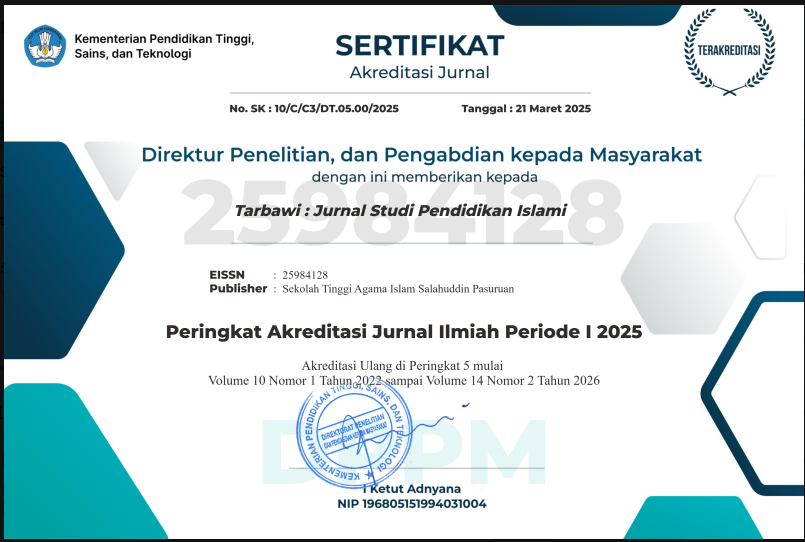
Tarbawi: Jurnal Studi Pendidikan Islami (p-ISSN: 2502-4353; e-ISSN: 2598-4128) is an open-access, peer-reviewed scholarly journal dedicated to the advancement of knowledge, research, and educational practice in Islamic education. Its primary scholarly identity is Islamic education, with interdisciplinary contributions in educational studies, curriculum, and educational technology considered when they establish a substantive relationship to Islamic educational theory, institutions, or practice.

Objectives

The journal aims to promote rigorous, original, and ethically conducted scholarship that advances Islamic education and responds to contemporary educational challenges. Specifically, the journal seeks to:

  • Advance theories, philosophies, histories, and practices of Islamic education.
  • Disseminate empirical and conceptual research relevant to Islamic educational institutions and learning environments.
  • Strengthen research on curriculum design, educational assessment, instructional innovation, and educational technology within Islamic educational contexts.
  • Promote evidence-informed educational leadership, institutional management, teacher development, and educational quality improvement.
  • Encourage interdisciplinary scholarship addressing character formation, inclusive education, educational psychology, and community-based Islamic education.
  • Facilitate scholarly dialogue among researchers, educators, practitioners, and policymakers across institutions and countries.

Focus and Scope

The journal's scope is organized into three interconnected scholarly domains reflecting its disciplinary orientation. These domains are not unrestricted categories: manuscripts must demonstrate an explicit contribution to Islamic education.

Islamic Religion and Islamic Education

This primary domain encompasses research on Islamic educational thought, religious instruction, and Islamic learning institutions, including:

  • Philosophy, history, and contemporary thought in Islamic education.
  • Islamic Religious Education (Pendidikan Agama Islam) and related teaching practices.
  • Qur'anic and Hadith education, including their pedagogy and instructional development.
  • Islamic character education, ethics, akhlak, and values-based learning.
  • Islamic educational institutions, including madrasahs, pesantren, Islamic schools, and higher education.
  • Leadership, governance, policy, and management in Islamic education.

Interdisciplinary and Other Educational Studies

The journal welcomes interdisciplinary research addressing educational issues where the Islamic educational relevance is explicitly established, including:

  • Educational psychology, motivation, student development, and learning environments.
  • Teacher professional development, educational competencies, and pedagogical practices.
  • Formal, nonformal, informal, and community-based Islamic education.
  • Inclusive and multicultural education, religious moderation, and educational responses to social change.
  • School improvement, educational quality assurance, and community engagement.
  • Interdisciplinary perspectives from relevant social sciences and humanities that strengthen Islamic educational scholarship.

Curriculum and Educational Technology

This domain concerns curriculum studies and educational technologies that have clearly articulated implications for Islamic educational contexts, including:

  • Curriculum development, implementation, innovation, and evaluation in Islamic education.
  • Instructional design, teaching models, learning resources, and assessment of learning outcomes.
  • Technology-enhanced, online, blended, and hybrid learning for Islamic educational settings.
  • Digital literacy, educational media, and learning management systems.
  • Responsible applications of artificial intelligence and emerging technologies in Islamic education.
  • Evidence-based evaluation of educational interventions, learning technologies, and curriculum reform.

Types of Scholarly Contributions

The journal considers original empirical research and well-developed conceptual or literature-based scholarly research that is consistent with its published author guidelines. Relevant approaches may include qualitative, quantitative, mixed-methods, case studies, historical or philosophical analysis, and systematic or critically structured literature reviews. All manuscripts must demonstrate a clear research question, adequate analytical or methodological rigor, engagement with relevant scholarship, and a meaningful contribution to knowledge. Manuscripts must be original, must not have been previously published, and must not be simultaneously submitted elsewhere.

Scope Boundaries

Research on education in general, technology, social studies, or religious topics is not automatically within the journal's scope. A manuscript must show a clear connection between its central problem, evidence, analysis, and implications and the study or practice of Islamic education. Manuscripts that lack this connection may be declined at initial editorial screening.

Target Readership

The journal is intended for researchers, university lecturers, postgraduate students, teachers, curriculum developers, educational technologists, leaders of Islamic educational institutions, education policymakers, and practitioners concerned with Islamic education and its interdisciplinary development.

Editorial Assessment and Scholarly Integrity

Submitted manuscripts are screened for their suitability to the journal's objectives and scope, originality, scholarly merit, and compliance with publication requirements. Manuscripts that pass initial screening are processed according to the journal's published peer-review policy. Editorial decisions are based on academic merit and ethical considerations and should not be influenced by an author's institutional affiliation, nationality, ethnicity, political beliefs, race, or religion. The journal supports transparent and responsible publication practices.

Transparency Framework: This statement is informed by COPE, DOAJ, OASPA, and WAME, Principles of Transparency and Best Practice in Scholarly Publishing (2022). The framework concerns transparent scholarly publishing and does not itself determine the journal's subject classifications.
View the transparency principles
