
Ownershipand Management Information

Ownership and Management Information

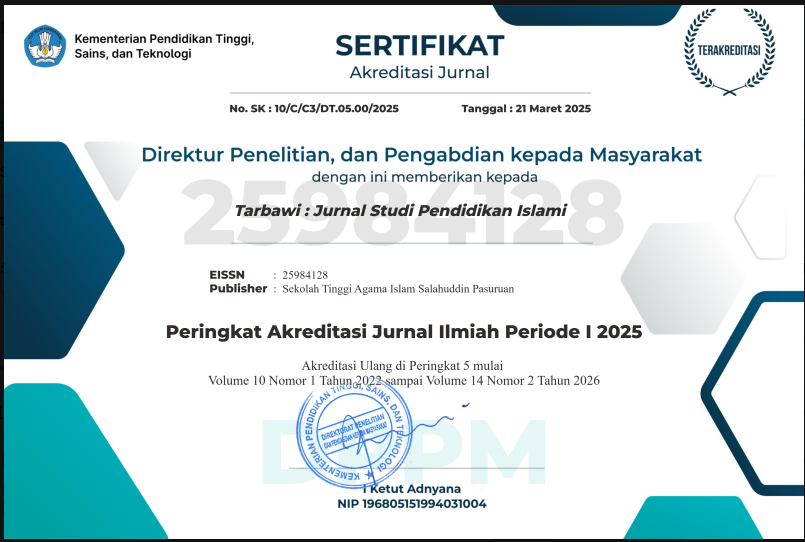
Tarbawi: Jurnal Studi Pendidikan Islami

Tarbawi: Jurnal Studi Pendidikan Islami is a scholarly, peer-reviewed, open-access journal published by Universitas Nahdlatul Ulama Pasuruan, Indonesia. This statement provides public information about the journal's publisher, editorial management, governance responsibilities, and contact channels in support of transparent scholarly publishing.

Journal and Publisher Identity

Journal Title Tarbawi: Jurnal Studi Pendidikan Islami
Publisher Universitas Nahdlatul Ulama Pasuruan, Indonesia
Print ISSN 2502-4353
Electronic ISSN 2598-4128
Journal Website https://ejournal.unupasuruan.ac.id/index.php/tarbawi
Publisher Address Area Perkantoran PCNU Kabupaten Pasuruan, Gedung Rektorat, Jl. Raya Warungdowo, Pohjentrek, Pasuruan 67171, East Java, Indonesia

Ownership and Institutional Responsibility

Universitas Nahdlatul Ulama Pasuruan is identified as the journal's publishing institution on its current official website. The publisher is responsible for providing an institutional framework and supporting the sustainable operation of the journal, including its scholarly publishing infrastructure and the public availability of journal information. Institutional ownership and publishing responsibility do not supersede the scholarly assessment of individual manuscripts.

Editorial Management

The journal's editorial operations are managed by its publicly listed editorial team. Editorial responsibilities include initial manuscript screening, coordinating peer review, communicating with authors and reviewers, evaluating revisions, managing publication decisions, and responding to publication-ethics concerns. The names, affiliations, and roles of current editors are provided on the journal's official Editorial Team page. Information about peer reviewers is available through the Reviewers Board page.

Roles and Responsibilities

  • Publisher: Provides the institutional publishing framework, administrative support, and infrastructure necessary for journal operations.
  • Editor-in-Chief and Editorial Team: Oversee editorial policies, manuscript evaluation, the integrity of peer review, and editorial decisions.
  • Peer Reviewers: Evaluate manuscripts on their scholarly merits, relevance, rigor, and ethical considerations, while maintaining confidentiality.
  • Authors: Remain responsible for the originality, accuracy, ethical conduct, and proper attribution of their submitted work.

Editorial Independence and Conflicts of Interest

Editorial decisions should be based on scholarly quality, the relevance of submissions to the journal's aims and scope, the adequacy of methods and evidence, and compliance with publication ethics. Decisions should not be determined by institutional, personal, financial, or political interests. Potential conflicts of interest involving editors, reviewers, authors, or the publisher should be disclosed and managed according to the journal's applicable policies. The publisher should support editorial independence and transparent handling of ethical complaints.

Public Accountability and Contact

Readers, authors, reviewers, and other stakeholders may consult the journal's official contact page for up-to-date editorial correspondence details and institutional contact information. Requests concerning editorial management, publishing policies, or corrections should be directed to the journal through its stated communication channels.

Accuracy and Updates

The journal should review and update this page whenever the publishing institution, managing unit, editorial team, contact information, or governance arrangements change. Any institutional transition should be reflected consistently in the journal website, published articles, and relevant indexing or serial-registration records, subject to the requirements of the respective services.

Reference framework: COPE, DOAJ, OASPA, and WAME, Principles of Transparency and Best Practice in Scholarly Publishing. Read the principles.
