Psikologi Olahraga Dan Kesejahteraan Mahasiswa: Analisis Kualitatif Dampak Pendekatan Humanistik Terhadap Pengurangan Kecemasan Dalam Penguasaan Keterampilan Renang Dasar
Authors
-
 Feri Weldani
Universitas PGRI Sumenep, Indonesia
DOI:
https://doi.org/10.55757/cejou.v6i2.1714Keywords:
Humanistik, Kecemasan, Pembelajaran Renang, Psikologi Olahraga, PJKRAbstract
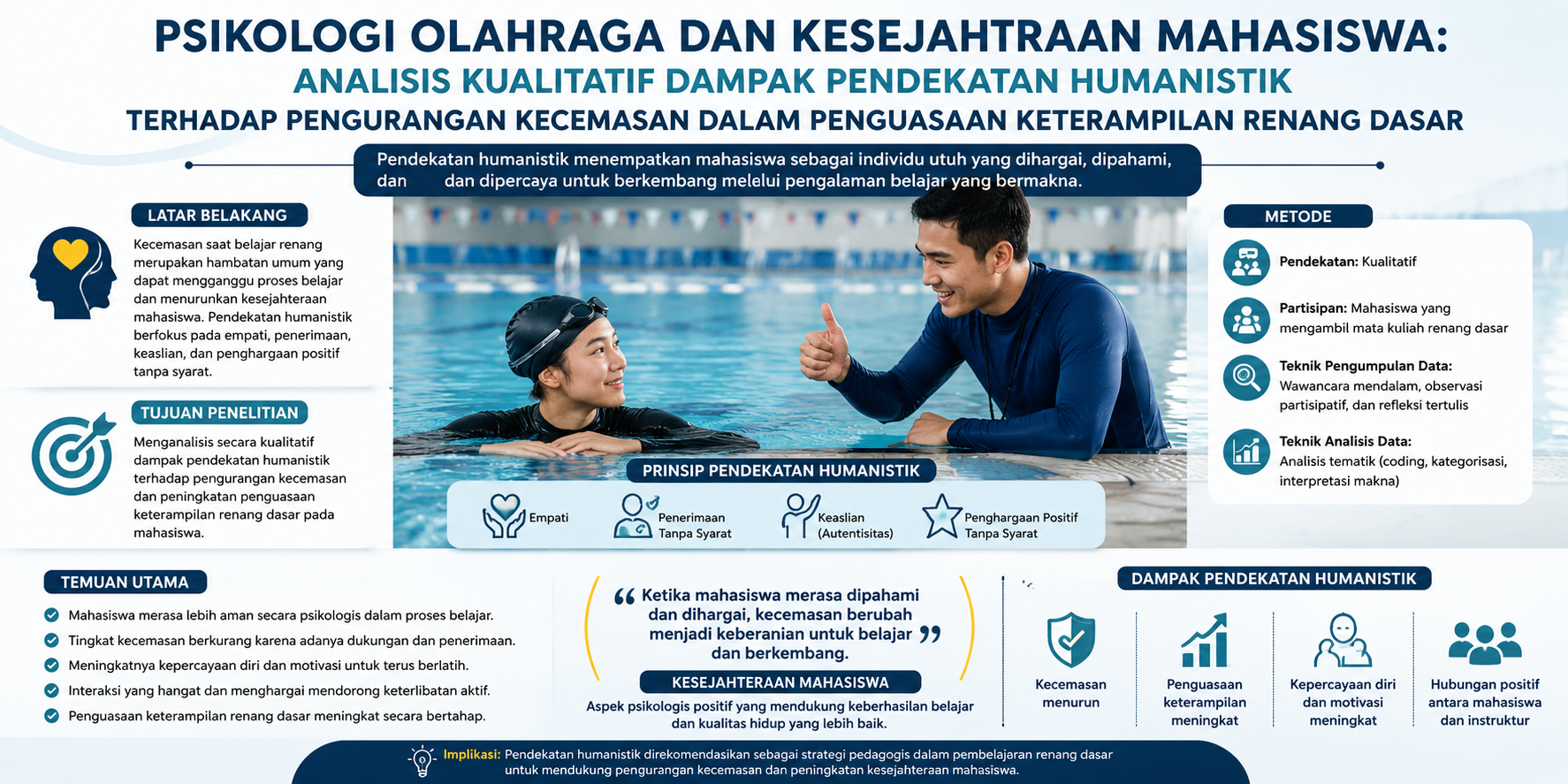
Di era disrupsi saat ini, penguasaan keterampilan motorik dasar seperti renang menjadi krusial bagi mahasiswa pendidikan jasmani untuk menunjang kompetensi profesional. Strategi pembelajaran humanistik yang mengedepankan pendekatan emosional dan suportif dipandang sebagai metode yang efektif dan menarik untuk menciptakan lingkungan belajar yang kondusif. Penelitian ini dilatarbelakangi oleh fenomena tingginya tingkat kecemasan mahasiswa dalam penguasaan teknik renang dasar, di mana selama ini banyak penelitian hanya berfokus pada aspek teknis motorik semata, sehingga pengabaian terhadap aspek psikologis sering kali menghambat optimalisasi capaian psikomotorik. Tujuan penelitian ini adalah untuk menganalisis secara mendalam dampak penerapan pendekatan humanistik terhadap penurunan tingkat kecemasan mahasiswa dalam pembelajaran renang. Metode penelitian yang digunakan adalah kualitatif dengan desain studi kasus, melibatkan pengumpulan data melalui observasi partisipatif dan wawancara mendalam terhadap mahasiswa PJKR. Hasil penelitian menunjukkan bahwa pendekatan humanistik memberikan dampak positif yang signifikan dalam menciptakan rasa aman, yang berfungsi sebagai scaffolding psikologis untuk menurunkan kecemasan. Tidak ditemukan adanya variabel teknis yang berpengaruh dominan dalam menurunkan kecemasan, melainkan faktor iklim emosional yang diciptakan oleh dosen. Implikasi penelitian ini menegaskan bahwa integrasi psikologi olahraga melalui pendekatan humanistik sangat vital dalam pengembangan keterampilan psikomotorik mahasiswa, sehingga perlu diterapkan sebagai strategi pembelajaran berkelanjutan untuk mencapai efektivitas kurikulum pendidikan jasmani yang lebih holistik.
Downloads
References
Astuti, A., Mulianingsih, F., & ... (2022). Teori pendidikan humanistik, implikasinya dalam humanistik persaudaraan. HARVESTER …. http://e-journal.sttharvestsemarang.ac.id/index.php/harvester/article/view/89
Dewi, K. A. K., & Tutuandari, N. K. R. (2025). Innovative Swimming Activities: Enhancing Self-Confidence, Safety, and Motor Development in Young Children. Champions: Education Journal of …. http://ejournal.imbima.org/index.php/champions/article/view/526
Dinata, F. R. (2020). Pembelajaran Humanistik Dalam Mendorong Pengembangan Afeksi. Al-I’tibar: Jurnal Pendidikan Islam. http://journal.unuha.ac.id/index.php/JPIA/article/view/1188
Hariyasasti, Y., Kristanti, E. Y., Darmuki, A., & ... (2025). The Influence of Humanistic Learning Theory and Holistic Education Theory on the Quality of Student Learning Outcomes at Jembulwunut Elementary School in the …. International Journal of …. https://www.ijosmas.org/index.php/ijosmas/article/view/481
Hudaya, S., & Supriyanto, A. (2020). PENDIDIKAN HUMANISTIK HOLISTIK SEBAGAI ARAH KONSEP PENDIDIKAN MERDEKA BELAJAR DI INDONESIA. … Pada Masa Dan Pasca Pandemi …. http://conference.um.ac.id/index.php/apfip/article/view/428
Marwah, S. S., & Abdussalam, A. (2020). Tinjauan Psikologis Humanistik dalam Pedagogik Spiritual. In Al-Musannif. pdfs.semanticscholar.org. https://pdfs.semanticscholar.org/536b/f2cf60735103a4960b4f6250140f6e224a2d.pdf
Maslukiyah, N., & Rumondor, P. (2020). Implementasi konsep belajar humanistik pada siswa dengan tahap operasional formal di SMK Miftahul Khair. Psikologika: Jurnal Pemikiran Dan …. https://journal.uii.ac.id/Psikologika/article/view/14593
Maula, A. R. (2021). Konsep pembelajaran humanistik dan relevansinya dalam pendidikan agama Islam. In Atthulab: Islamic Religion Teaching and …. pdfs.semanticscholar.org. https://pdfs.semanticscholar.org/a1b4/cbaa809d96fdb2197b44b5b390086ccb97ba.pdf
Pranajaya, S. A., Firdaus, A., & Nurdin, N. (2020). Eksistensial humanistik dalam perspektif bimbingan konseling islam. In Al-Ittizaan: Jurnal Bimbingan …. academia.edu. https://www.academia.edu/download/73536083/5468.pdf
Rahayu, A., Shoimah, L. N., & Iryani, E. (2026). Pendekatan Humanistik dalam Pendidikan: Implikasi terhadap Peran Guru sebagai Fasilitator Belajar: Penelitian. Jurnal Pengabdian Masyarakat Dan …. http://jerkin.org/index.php/jerkin/article/view/4436
Samian, S. (2025). Psikologi Humanistik. JOURNAL OF GLOBAL DA’WAH AND …. https://ejournal.stidkinu.ac.id/index.php/JADE/article/view/24
Saputri, S. (2022). Pentingnya menerapkan teori belajar humanistik dalam pembelajaran untuk meningkatkan hasil belajar peserta didik pada jenjang sekolah dasar. EduBase: Journal of Basic Education. https://jurnal.uibbc.ac.id/index.php/edubase/article/view/677
Syarifuddin, S. (2022). Teori humanistik dan aplikasinya dalam pembelajaran di sekolah. Tajdid: Jurnal Pemikiran Keislaman Dan …. https://ejournal.iaimbima.ac.id/index.php/tajdid/article/view/837
Tanzil, S. P. (2026). PENGEMBANGAN PERANGKAT LUNAK UNTUK SISTEM PREDIKSI PERFORMA PERENANG BERDASARKAN KARAKTERISTIK FISIK MENGGUNAKAN …. rama.mdp.ac.id. http://rama.mdp.ac.id:84/id/eprint/992
Weldani, F. (2026). Evaluasi Keterampilan Dasar Olahraga Berbasis AI: Sebuah SLR Mengenai Keterbaruan Metodologi Pembelajaran Renang dan Futsal dalam Bingkai Keberlanjutan SDGs. In Journal of Physical Education and Sports Pedagogy (Vol. 1, Issue 1, pp. 49–68). https://scholar.google.com/citations?view_op=view_citation&hl=en&user=Flo5L6EAAAAJ&pagesize=100&citation_for_view=Flo5L6EAAAAJ:_FxGoFyzp5QC
Weldani, F., Basri, M. H., Mas’odi, M., & Prasetyo, D. A. (2025). Evolusi Renang Dan Olahraga Air. In UNU Pasuruan Press (Vol. 2, pp. 1–150). https://scholar.google.com/citations?view_op=view_citation&hl=en&user=9BgPsc8AAAAJ&pagesize=100&citation_for_view=9BgPsc8AAAAJ:35N4QoGY0k4C
Weldani, F., & Muhammad, H. N. (2015). Penerapan Terapi Nlp (Neuro Linguistic Programming) Untuk Menurunkan Kecemasan Dalam Melakukan Lompat Kangkang Pada Siswa Kelas X. In Jurnal Pendidikan Olahraga dan Kesehatan: Vol. Volume 03 (Issue 2, pp. 303–307). http://ejournal.unesa.ac.id/index.php/jurnal-pendidikan-jasmani/issue/archive303
Weldani, F., Prasetyo, D. A., Masodi, M., & Basri, M. H. (2025). Evolusi Renang &Olahraga Air: Pendekatan Sains, Teknologi, dan Psikologi. In UNU PASURUAN PRESS (Vol. 2, pp. 1–200). https://scholar.google.com/citations?view_op=view_citation&hl=en&user=Flo5L6EAAAAJ&pagesize=100&citation_for_view=Flo5L6EAAAAJ:roLk4NBRz8UC
Weldani, F., Prasetyo, D. A., Masodi, M., & Basri, M. H. (2026). Akuatik Inklusif: Transformasi Teknologi AR dan AI Dalam Pembelajaran Renang Berbasis Kearifan Lokal Madura. In UNU PASURUAN PRESS (Vol. 3, pp. 1–200). https://scholar.google.com/citations?view_op=view_citation&hl=en&user=Flo5L6EAAAAJ&pagesize=100&citation_for_view=Flo5L6EAAAAJ:LkGwnXOMwfcC
Xiao, Y., & Chen, T. (2025). Emotional and behavioral problems of preschool children and their correlation with family factors. Zhongguo Ertong Baojian Zazhi, 33(4), 396–401. https://doi.org/10.11852/zgetbjzz2024-0396
Xiao, Z., Ma, H., Song, Q., Zhang, G., Liu, Z., & Liu, Z. (2024). A novel cross-domain tool breakage monitoring method based on locality preserving joint transfer with intra-class compactness. Journal of Manufacturing Processes, 116, 149–164. https://doi.org/10.1016/j.jmapro.2024.02.049
Xiaochao, W., Qiping, S., & Guihua, N. (2024). Research on e-commerce platform credit supervision resilience based on stochastic catastrophe theory. Journal of Industrial Engineering and Engineering Management, 38(1), 266–280. https://doi.org/10.13587/j.cnki.jieem.2024.01.020
YUNIAR, V., KURNIAWATI, S., & ... (2026). EFEKTIVITAS PEMBELAJARAN BERENANG PADA ANAK USIA 5 TAHUN. Jurnal Harmoni Abdi …. https://journal.harpro.id/juham/article/view/56
Published
How to Cite
Issue
Section
License
Copyright (c) 2025 Feri Weldani

This work is licensed under a Creative Commons Attribution-ShareAlike 4.0 International License.
License Terms
Open Access · Copyright · Responsible Scholarly Sharing
The Center Journal of Education (CEJou) supports the dissemination of scholarly knowledge and educational research. The journal's licensing terms are intended to clarify how published works may be accessed, shared, and reused.
1. Open Access License
Articles published by CEJou are identified on the journal website as licensed under the Creative Commons Attribution-ShareAlike 4.0 International License (CC BY-SA 4.0) , subject to the license information applicable to each article.
Under this license, users may share and adapt licensed material for any purpose, including commercially, provided that they give appropriate attribution, provide a link to the license, indicate whether changes were made, and distribute adaptations under the same license.
VIEW LICENSE DETAILS ↗2. Copyright
Copyright ownership and publication rights are governed by the journal's stated copyright policy and any applicable agreement between the authors and CEJou. Authors should review the relevant terms before submitting their manuscripts.
3. Author Responsibilities
Authors are responsible for ensuring that:
- The submitted work is original and appropriately acknowledges previous scholarship.
- Permission has been obtained for third-party materials when required.
- All co-authors agree to the submission and applicable publication terms.
- Any reused material is accompanied by appropriate attribution and licensing information.
4. Reuse and Attribution
Anyone reusing material licensed under CC BY-SA 4.0 must provide appropriate credit, identify the source, link to the license, indicate whether modifications were made, and comply with the license's ShareAlike requirements when distributing adaptations. The license does not remove rights that may apply separately to third-party content.
5. Third-Party Materials
Images, tables, figures, and other content belonging to third parties may be subject to separate copyright or licensing terms. Users should check the credit lines and permissions associated with such materials before reusing them.
6. License Information
Readers and authors should consult the license statement displayed on the relevant article page or published document. Where an article specifies a different license or a specific rights notice, that information should be reviewed before reuse.









