Desain Media Pohon Baca Huruf Hijaiyah Berbahan Kardus untuk Anak Usia Dini
Authors
-
 Erna Budiarti
Universitas Pancasakti Bekasi, Indonesia
-
Balqis Shintarahayu
DOI:
https://doi.org/10.55757/cejou.v6i1.892Keywords:
desain media, pohon baca, huruf hijaiyah, anak usia diniAbstract
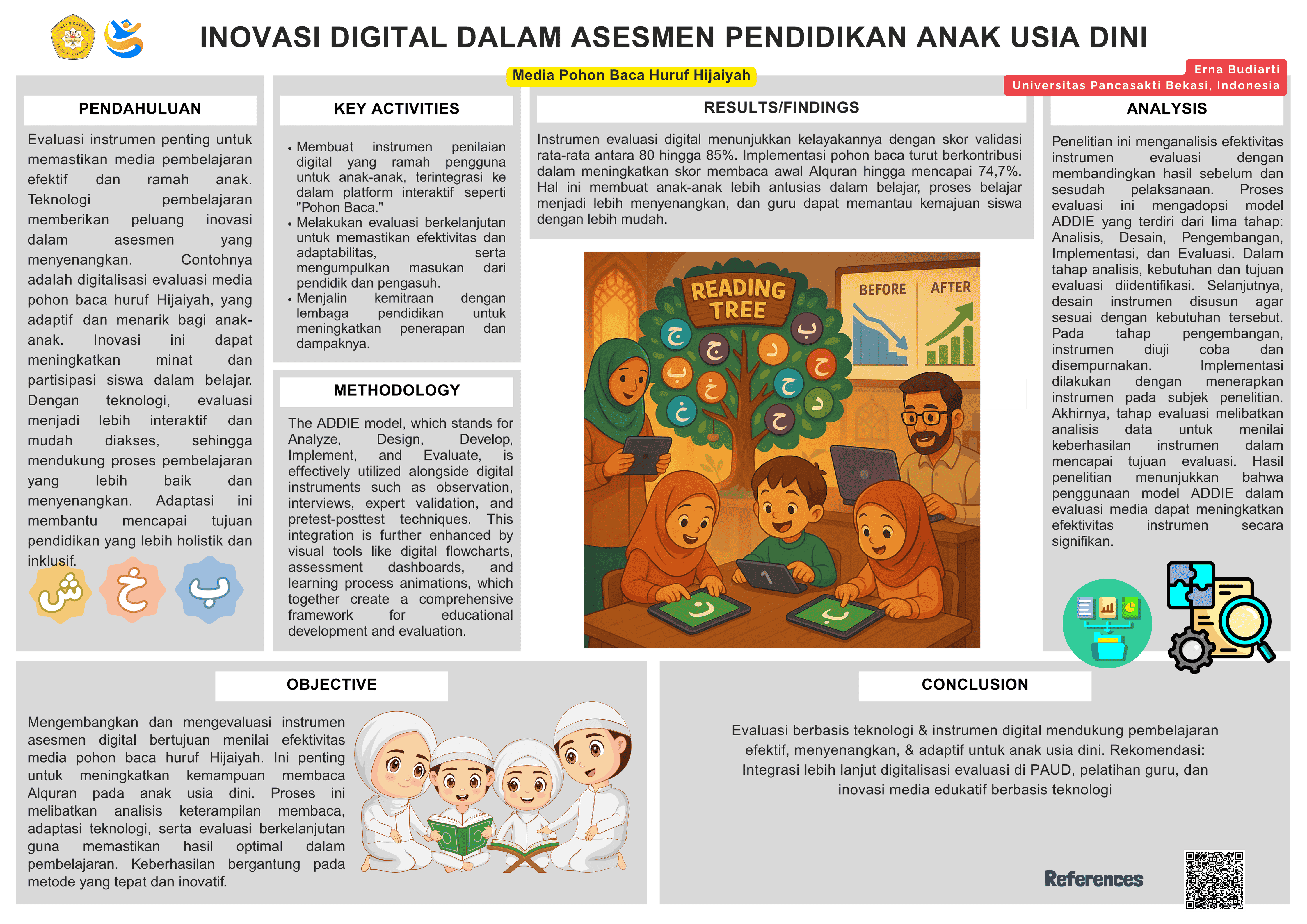
Penelitian ini dilatarbelakangi oleh kebutuhan akan media pembelajaran yang efektif, menarik, dan aman untuk memperkenalkan huruf Hijaiyah kepada anak usia dini di lembaga PAUD, khususnya di wilayah Jakarta Utara, yang selama ini masih banyak menggunakan alat permainan berbahan berat, mahal, dan kurang menarik. Tujuan utama penelitian ini adalah merancang dan mengembangkan desain media pohon baca huruf Hijaiyah berbahan kardus, yang tidak hanya ringan, aman, dan mudah dirawat, namun juga memiliki tampilan visual menarik dengan warna-warna cerah untuk meningkatkan minat belajar anak. Penelitian menggunakan metode penelitian dan pengembangan (R&D) dengan model ADDIE yang terdiri dari tahapan analisis, desain, pengembangan, implementasi, dan evaluasi, berfokus pada aspek desain media. Hasil pengembangan menunjukkan bahwa media pohon baca huruf Hijaiyah yang didesain dari kardus berlapis dan berwarna cerah berhasil mendapatkan penilaian layak dari ahli PAUD dan media, dengan skor rata-rata 80-85% pada uji validasi desain, serta rata-rata 74,7% pada uji implementasi di tiga lembaga PAUD. Kesimpulan dari penelitian ini menegaskan bahwa desain media pohon baca huruf Hijaiyah berbahan kardus telah memenuhi aspek keamanan, keringanan, keindahan visual, dan kemudahan penggunaan, sehingga efektif digunakan sebagai media pembelajaran yang ramah anak dan variatif di lingkungan PAUD.
Downloads
References
fAbdella, G. M., Abdelrady, A. H., Akram, H., Abdelreheem, H. H. S., Abdel-Tawab, N., Saher, S., Nawawi, N. El, Abdieva, S., Abdolmaleki, N., Saeedi, Z., Abdrafikova, A. R., Konopatskaya, E. A., Adhikary, R. P., Adhyatma, M., Syaikhullah, G., Nurfitriani, R. A., Muhamad, N., Kusuma, S., Adi, D., … Zummo, L. (2022). Ship type classification by convolutional neural networks with auditory-like mechanisms. English Language Teaching, 14(1), 535–552. https://doi.org/10.1016/j.aej.2023.06.054
Abidin, M. Z., Mispani, M., Yusuf, M. S., Setiawan, A., Wati, R. I., Darmayanti, R., Afifah, A., Darmayanti, R., Sugianto, R., Choirudin, C., Ahmed, M. T. M. A. M. W., Darmayanti, R., Usmiyatun, U., Aini, N., Choirudin, C., Karim, S., Darmayanti, R., Purnamasari, P., Choirudin, C., … Baradaran, A. (2023). Students’ Attitudes Towards Learning Mathematics:" Too Soft Attitudes-Very Difficult-Boring-In A Good Way". Delta-Phi: Jurnal Pendidikan Matematika, 1(1), 27–33. https://doi.org/10.1007/978-3-030-70716-3_7
Afifah, A., Putri, A. D., Almawadeh, N. S., Al-Amad, T., Arshad, R., Gulshad, L., Haq, I.-U.-, Farooq, M. A., Al-Farga, A., Siddique, R., Manzoor, M. F., Karrar, E., Arslan Selçuk, S., Mutlu Avinç, G., Budiarti, E., Butchbach, M. E. R., Scott, R. C., Darmayanti, R., Darqui, F. S., … Araniti, F. (2021). Dampak Lirik Lagu Bertema Seksual “Ngidam Pentol” terhadap Kemampuan Penalaran Matematika Siswa Sekolah Menengah Atas. Kaizen Media Publishing, 1(1), 163–174. https://doi.org/10.1016/j.fsi.2024.109613
Ahmed, M., Darmayanti, R., & Purnamasari, P. (2024). The Influence of the Use of Interactive Digital Media in Sewing Pattern Activities on Students’ Cognitive Aspects and Mathematical Abilities. Delta-Phi: Jurnal Pendidikan Matematika, 2(3), 167–172.
Anggraini, N. A., Ningsih, E. F., Choirudin, C., Darmayanti, R., & Triyanto, D. (2022). Application of the AIR learning model using song media to improve students’ mathematical representational ability. AMCA Journal of Science and Technology, 2(1), 28–33.
Anhar, J., Darmayanti, R., & Usmiyatun, U. (2023). Pengaruh Kompetensi Guru Agama Islam Terhadap Implementasi Manajemen Sumber Daya Manusia Di Madrasah Tsanawiyah. Assyfa Journal of Islamic Studies, 1(1), 13–23.
Arifudin. (2023). Metode Pembelajaran Ilmu Tajwid Dengan Menggunakan Kitab Tuhfatul Athfal Karangan Syekh Al Jamzury di Pondok Pensantren Islam Darusy Syahadah, Simo Boyolali Jawa Tengah. Rayah Al-Islam, 7(2), 661–672. https://doi.org/10.37274/rais.v7i2.753
Arn, L., & Huang, E. M. (2024). “Robots Can Do Disgusting Things, but Also Good Things”: Fostering Children’s Understanding of AI through Storytelling. ACM Transactions on Computing Education, 24(3). https://doi.org/10.1145/3677613
Atmawidjaja, D. R. H. S., & (ed) Rafa Basyirah (ed) Eko Digdoyo, (ed) Erna Budiarti. (2023). Negara Pancasila : implementasi nilai-nilai Pancasila dalam bernegara dan bermasyarakat. Semesta Irfani Mandiri.
Bleses, D., Højen, A., Justice, L. M., Dale, P. S., Dybdal, L., Piasta, S. B., Markussen-Brown, J., Clausen, M., & Haghish, E. F. (2018). The Effectiveness of a Large-Scale Language and Preliteracy Intervention: The SPELL Randomized Controlled Trial in Denmark. Child Development, 89(4), e342 – e363. https://doi.org/10.1111/cdev.12859
Budiarti, E., Solehudin, (ed), Priyanti, & Budiarti. (2024). Asesmen pendidikan karakter anak [sumber elektronis]. Perkumpulan Rumah Cemerlang Indonesia.
Carey, E., Gillan, D., Healy, C., Dooley, N., Campbell, D., McGrane, J., O’Neill, A., Coughlan, H., Clarke, M., Kelleher, I., & Cannon, M. (2021). Early adult mental health, functional and neuropsychological outcomes of young people who have reported psychotic experiences: A 10-year longitudinal study. Psychological Medicine, 51(11), 1861–1869. https://doi.org/10.1017/S0033291720000616
Dahliani, L., & Rahman, M. A. (2024). Is it feasible to design learning media" Tomato Plant Growth" hydroponically based on the discovery learning model? AMCA Journal of Community Development, 4(1), 19–26.
Darmayanti, R. (2022). LIMIT FUNGSI.
Darmayanti, R., Baiduri, B., & Sugianto, R. (2022). Learning application derivative algebraic functions: Ethnomathematical studies and digital creator books. Jurnal Cendekia: Jurnal Pendidikan Matematika, 6(2), 2212–2227.
Darmayanti, R., In’am, A., & Effendi, M. M. (2025). Trends and Gaps in Game-Based Learning for Mathematics: A VOSviewer-Assisted Systematic Review with a Focus on Ethnomathematics and 21st Century Skills. Internasional Conference on Games Based Learning, 1(1), 1–13.
de Waal, E., & Pienaar, A. E. (2021). Influences of persistent overweight on perceptual-motor proficiency of primary school children: the North-West CHILD longitudinal study: Persistent overweight and perceptual-motor proficiency in children. BMC Pediatrics, 21(1). https://doi.org/10.1186/s12887-021-02708-x
Devi, R., & Chand, S. P. (2024). In-Service Teachers’ Perceptions and Challenges in Online Assessments Amid COVID-19. International Journal of Assessment and Evaluation, 31(2), 85–103. https://doi.org/10.18848/2327-7920/CGP/v31i02/85-103
Fauza, M. R., Inganah, S., Darmayanti, R., Prasetyo, B. A. M., & Lony, A. (2022). Problem solving ability: strategy analysis of working backwards based on polya steps for Middle School Students YALC Pasuruan. Jurnal Edukasi Matematika Dan Sains, 10(2), 353–363.
Mardiningsih, M. P. (2021). KATA PENGANTAR.
odi, M. M., Darmayanti, R., Basri, M. H., Prasetyo, D. A., Weldani, F., & ... (2025). Landscape Kompetensi Calon Guru Pjok Di STKIP PGRI Sumenep Melalui Pelaksanaan Kegiatan Outbound Di Bumi Perkemahan Bedengan Batu. Center of Education Journal (CEJou), 6(1), 9–20.
Prahastiwi, E. D., Budiarti, E., Eriyanti, R. W., & Asih, R. A. (2023). The Impact of Driving Teachers on Pancasila Students and School Culture. Assyfa Journal of Multidisciplinary Education, 2, 116–130.
Retnawati, H., Kistoro, H. C. A., & Putranta, H. (2021). School readiness assessment: Study of early childhood educator experience. Elementary Education Online, 20(1), 468–478. https://doi.org/10.17051/ilkonline.2021.01.041
Rizki, N., Laila, A. R. N., Inganah, S., & Darmayanti, R. (2022). Analysis of Mathematic Connection Ability in Mathematics Problem Solving Reviewed from Student’s Self-Confedence. Seminar Nasional Teknologi Pembelajaran, 2(1), 111–126.
Sekaryanti, R., Cholily, Y. M., Darmayanti, R., Rahma, K., Prasetyo, B., & ... (2022). Analysis of Written Mathematics Communication Skills in Solving Solo Taxonomy Assisted Problems. Jurnal Edukasi Matematika Dan Sains, 10(2), 395–403.
Sekaryanti, R., Darmayanti, R., Choirudin, C., Usmiyatun, U., Kestoro, E., & ... (2022). Analysis of mathematics problem-solving ability of junior high school students in Emotional Intelligence. Jurnal Gantang, 7(2), 149–161.
Sugianto, R., Darmayanti, R., & Muhammad, I. (2023). Teacher Competence in The Preparation of Test and Non-Test Instruments. Journal of Teaching and Learning Mathematics, 1(1), 25–32.
Suhartini, B., & Wara Kushartanti, B. M. (2022). Development of Physical Activity Models Based on Motor Perception for Kindergarten Children. International Journal of Human Movement and Sports Sciences, 10(1), 6–13. https://doi.org/10.13189/saj.2022.100102
Syaifuddin, M., Darmayanti, R., Rizki, N., Vedianty, A. S. A., Nurhayati, D., Darmayanti, R., Lestari, A. S. B., Sah, R. W. A., Darmayanti, R., Maryanto, B. P. A., Usmiyatun, U., Darmayanti, R., Safitri, N. D., Afifah, A., Vidyastuti, A. N., Darmayanti, R., Sugianto, R., Fatra, M., Darmayanti, R., … Aqazade, M. (2023). Promising interactive functions in digital storybooks for young children. Delta-Phi: Jurnal Pendidikan Matematika, 1(1), 27–33. https://doi.org/10.4103/jisppd.jisppd_237_22
Triono, T., Darmayanti, R., Saputra, N. D., Afifah, A., & Makwana, G. (2023). Open Journal System: Assistance and training in submitting scientific journals to be well-indexed in Google Scholar. Jurnal Inovasi Dan Pengembangan Hasil Pengabdian Masyarakat, 1(2), 106–114.
Uwineza, I., Uworwabayeho, A., & Yokohama, K. (2023). Perceptions of using interactive mathematics software among Rwandan primary school teachers. Cogent Education, 10(1). https://doi.org/10.1080/2331186X.2023.2170113
Wicaksana, M. F., Marmoah, S., & Darmayanti, R. (2025). Problematika Evaluasi Pembelajaran di Era Digital. Applied Observation and Pedagogical Studies Poster, 4(1), 5.
Wicaksana, M. F., Sari, N. K., & Darmayanti, R. (2024). 76 Alat dan Aplikasi Evaluasi Pembelajaran Online. Applied Observation and Pedagogical Studies Poster, 3(2), 6.
Wulandari, T., Nurmalitasari, D., Susanto, K., & Darmayanti, R. (2022). Etnomatematika Pada Batik Daun Sirih dan Burung Kepodang Khas Pasuruan. Seminar Nasional Teknologi Pembelajaran, 2(1), 95–103.
Yang, H. (2024). APPLICATION ANALYSIS OF ENGLISH PERSONALIZED LEARNING BASED ON LARGE-SCALE OPEN NETWORK COURSES. Scalable Computing, 25(1), 355–368. https://doi.org/10.12694/scpe.v25i1.2300
Zahroh, U., Rachmawati, N. I., Darmayanti, R., & Tantrianingrum, T. (2023). Guidelines” for collaborative learning in 21st century education at Madrasah Tsanawiyah. Assyfa Journal of Islamic Studies, 1(2), 155–161.
Published
How to Cite
Issue
Section
License
License Terms
Open Access · Copyright · Responsible Scholarly Sharing
The Center Journal of Education (CEJou) supports the dissemination of scholarly knowledge and educational research. The journal's licensing terms are intended to clarify how published works may be accessed, shared, and reused.
1. Open Access License
Articles published by CEJou are identified on the journal website as licensed under the Creative Commons Attribution-ShareAlike 4.0 International License (CC BY-SA 4.0) , subject to the license information applicable to each article.
Under this license, users may share and adapt licensed material for any purpose, including commercially, provided that they give appropriate attribution, provide a link to the license, indicate whether changes were made, and distribute adaptations under the same license.
VIEW LICENSE DETAILS ↗2. Copyright
Copyright ownership and publication rights are governed by the journal's stated copyright policy and any applicable agreement between the authors and CEJou. Authors should review the relevant terms before submitting their manuscripts.
3. Author Responsibilities
Authors are responsible for ensuring that:
- The submitted work is original and appropriately acknowledges previous scholarship.
- Permission has been obtained for third-party materials when required.
- All co-authors agree to the submission and applicable publication terms.
- Any reused material is accompanied by appropriate attribution and licensing information.
4. Reuse and Attribution
Anyone reusing material licensed under CC BY-SA 4.0 must provide appropriate credit, identify the source, link to the license, indicate whether modifications were made, and comply with the license's ShareAlike requirements when distributing adaptations. The license does not remove rights that may apply separately to third-party content.
5. Third-Party Materials
Images, tables, figures, and other content belonging to third parties may be subject to separate copyright or licensing terms. Users should check the credit lines and permissions associated with such materials before reusing them.
6. License Information
Readers and authors should consult the license statement displayed on the relevant article page or published document. Where an article specifies a different license or a specific rights notice, that information should be reviewed before reuse.









