Studi Pendidikan Kewirausahaan Inklusif pada UMKM Disabilitas di Rangkasbitung: Peran Manajemen dan Intervensi Pendidikan
Authors
-
 Dian Sudiantini
Universitas Bhayangkara Jakarta Raya, Indonesia
-
Eteh Resa Asyifa
Universitas Swadaya Gunung Jati, Indonesia
DOI:
https://doi.org/10.55757/cejou.v6i1.898Keywords:
UMKM Disabilitas, Potensi Ekonomi, Rangkasbitung, Kendala, PeluangAbstract
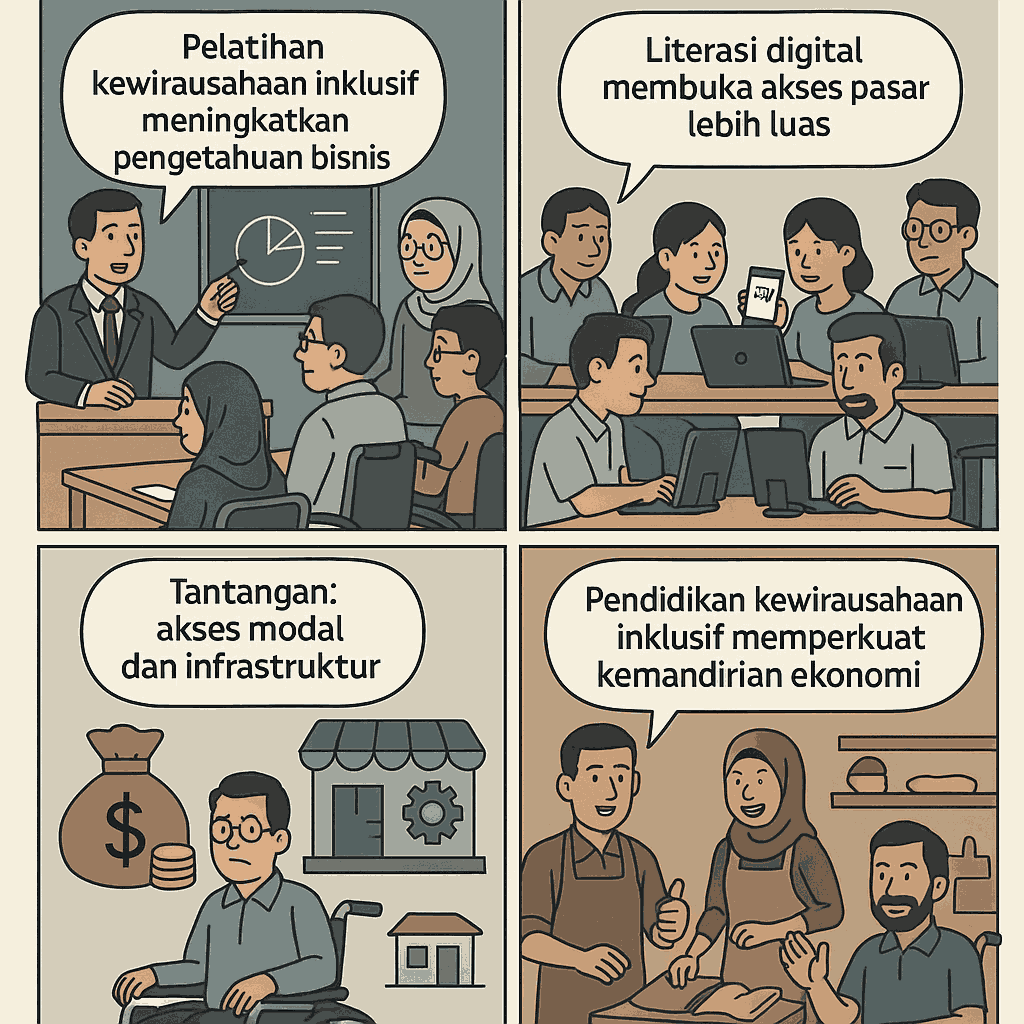
Penelitian ini bertujuan untuk menganalisis peran intervensi pendidikan dalam pemberdayaan Usaha Mikro, Kecil, dan Menengah (UMKM) yang dikelola oleh penyandang disabilitas di Rangkasbitung, Banten. Studi ini melibatkan 120 UMKM disabilitas sebagai responden, dengan data dikumpulkan melalui kuesioner dan wawancara mendalam. Intervensi pendidikan yang diimplementasikan meliputi pelatihan kewirausahaan inklusif, literasi digital, dan pendampingan manajemen usaha, yang dirancang secara partisipatif dan disesuaikan dengan kebutuhan penyandang disabilitas. Hasil penelitian menunjukkan bahwa pelatihan tersebut secara signifikan meningkatkan pengetahuan bisnis, keterampilan manajerial, dan kepercayaan diri pelaku UMKM disabilitas. Selain itu, literasi digital yang diberikan mendorong pemanfaatan e-commerce dan media sosial untuk memperluas akses pasar dan jaringan usaha. Kendala utama yang diidentifikasi adalah keterbatasan akses modal dan infrastruktur, namun intervensi pendidikan terbukti mampu memperkuat resiliensi dan kemandirian ekonomi peserta. Temuan ini menegaskan pentingnya integrasi pendidikan kewirausahaan inklusif dalam strategi pemberdayaan UMKM disabilitas, serta perlunya dukungan berkelanjutan dari pemerintah dan masyarakat untuk menciptakan ekosistem bisnis yang lebih inklusif dan berkelanjutan.
Downloads
References
Ahmed, A. A. (2024). Youth Participation in Peacebuilding in Somalia: Challenges and Opportunities. Multidisciplinary Journal of Horseed International University (MJHIU), 2(1). https://doi.org/10.59336/e9b1z095
Armayani, D. L. P. D. Sudiantini. D. S. Khaerunisa. D. P., & Andini, D. F. (2023). ANALISA MENGENAI PEMBERIAN KOMPENSASI TERHADAP KINERJA KARYAWAN DI PERUSAHAAN. SIBATIK JURNAL 2 (SIBATIK JURNAL), 1673–1681.
Chicas Sierra, S., & Arias Vera, J. (2021). INCLUSIVE BUSINESSES IN HIGHER EDUCATION: TEACHING ADMINISTRATIVE SCIENCE STUDENTS. PANORAMA, 15.
Cowell, M., Lyon-Hill, S., & Tate, S. (2018). It takes all kinds: understanding diverse entrepreneurial ecosystems. Journal of Enterprising Communities, 12(2). https://doi.org/10.1108/JEC-08-2017-0064
da Costa, M. T. G., & Carvalho, L. C. (2012). Education for entrepreneurship as social inclusion facilitator: A case in higher education . A Case in Higher Education: A Educação Para o Empreendedorismo Como Facilitador Da Inclusão Social: Um Caso No Ensino Superior, 19.
de Figueiredo-Nery, M. A. N., & Figueiredo, P. N. (2008). FORMING ENTREPRENEURIAL MINDSETS? PRELIMINARY EVIDENCE OF TEACHING PRACTICES FROM PRIMARY SCHOOLS IN A DEVELOPING AREA IN SOUTH AMERICA. Journal of Technology Management & Innovation, 3(2).
Dwi Prada, Y., Raihan Kesuma Sakti, Rizki Latif Oktavian, Erni Masruroh, Ifana, Muhammad Fadloli Al Hakim, & Geovani Akbar. (2023). Inclusion Based Sports Learning Media at SD Tumbuh 1 Yogyakarta. Jurnal Pendidikan Jasmani (JPJ), 4(1). https://doi.org/10.55081/jpj.v4i1.797
Enciso, J. D. (2010). El emprendimiento y el bien común: Pensamiento & Gestion, 13(1).
Fenton, M., & Barry, A. (2014). Breathing space – graduate entrepreneurs’ perspectives of entrepreneurship education in higher education. Education and Training, 56. https://doi.org/10.1108/ET-05-2014-0051
Hakimi, M., Fazil, A. W., Ahmady, E., Qarizada, A., & Quraishi, T. (2024). Cyber Opportunities: Fostering Women’s Empowerment through E-Commerce in Afghanistan. Room of Civil Society Development, 3(1). https://doi.org/10.59110/rcsd.275
Hazarika, B., & Goswami, K. (2018). Micro-entrepreneurship Development in the Handloom Industry: An Empirical Analysis Among the Tribal Women in Assam. International Journal of Rural Management, 14(1). https://doi.org/10.1177/0973005218754437
Iwegbu, C. J., & Uwaifo, E. C. (2021). The Principle of Effective and Efficient Restructuring and the Future of the Nigerian Nation: The Role of Social Science Education. UJAH: Unizik Journal of Arts and Humanities, 21(3). https://doi.org/10.4314/ujah.v21i3.3
Kamaruddin, H., Hassan, R., Othman, N., Mimi Diyana Wan Zaki, W., & Md Sum, S. (2021). Meeting the Needs of Fourth Industrial Revolution (4IR) in Entrepreneurial Education in Malaysia: The Government’s Role. In Circular Economy - Recent Advances, New Perspectives and Applications. https://doi.org/10.5772/intechopen.94919
Korzhov, H., & Pasko, Y. (2021). Entrepreneurship education as a driver of societal progress. Ukrainian Journal of Educational Studies and Information Technology, 9(1). https://doi.org/10.32919/uesit.2021.01.05
Mogaji, E. (2024). Women entrepreneurs in transport family business: a perspective article. Journal of Family Business Management, 14(2). https://doi.org/10.1108/JFBM-08-2023-0121
Munjal, P. G. (2023). How does the hospitality industry integrate heritage? Worldwide Hospitality and Tourism Themes, 15(3). https://doi.org/10.1108/WHATT-01-2023-0014
Ngundu, M., & Ngalawa, H. (2023). A sectoral analysis of output elasticity of employment in South Africa. South African Journal of Economic and Management Sciences, 26(1). https://doi.org/10.4102/sajems.v26i1.4825
Nieuwenhuizen, C., & Jegede, O. (2021). Influence of entrepreneurship learning modes on entrepreneurial intentions of science based students. Proceedings of the European Conference on Innovation and Entrepreneurship, ECIE. https://doi.org/10.34190/EIE.21.050
Nurminingsih. (2023). PENGEMBANGAN METODE COBLAS (Consulting Based Learning for ASEAN SMEs) UNTUK PENDIDIKAN KEWIRAUSAHAAN LANSIA DI USAHA KECIL MENENGAH (UKM). TRANSEKONOMIKA: AKUNTANSI, BISNIS DAN KEUANGAN, 3(4). https://doi.org/10.55047/transekonomika.v3i4.477
Percival, J. (2021). Families creating employment opportunities for individuals with developmental disabilities: Understanding the contribution of familial entrepreneurship. In Families Creating Employment Opportunities for Individuals with Developmental Disabilities: Understanding the Contribution of Familial Entrepreneurship. https://doi.org/10.4324/9781003054740
Poruka, Z. (2019). SOCIAL ENTREPRENEURSHIP AS AN INNOVATIVE TOOL FOR SOLVING SOCIAL PROBLEMS IN LATVIA. INDIVIDUAL. SOCIETY. STATE. Proceedings of the International Student and Teacher Scientific and Practical Conference. https://doi.org/10.17770/iss2019.5268
Prof. Lurai Rongmei, & Prof. A.L Ghosh. (2023). Entrepreneurial Inclination: Reviewing Literature for Entrepreneurship among Tribal Women. International Journal of Engineering and Management Research, 13(6). https://doi.org/10.31033/ijemr.13.6.6
Radovič-Markovič, M., & Živanovič, B. (2019). Fostering green entrepreneurship and women’s empowerment through education and banks’ investments in tourism: Evidence from Serbia. Sustainability (Switzerland), 11(23). https://doi.org/10.3390/su11236826
Rohida, L., & Sudiantini, D. (2025). Transformasi Manajemen Sumber Daya Manusia Pendidikan Tinggi Untuk Meningkatkan Kompetensi Mahasiswa Di Era Artificial Intelligence. SINERGI: Jurnal Riset Ilmiah, 2(4), 2045–2055.
Sahela, K. Z., Susanti, R., & Adjie, A. R. (2021). The Influence of Government Dimension on Financial Education and Empowerment of Micro-, Smalland Medium-Sized Enterprises in Indonesia. Journal of Asian Finance, Economics and Business, 8(3). https://doi.org/10.13106/jafeb.2021.vol8.no3.0637
Sánchez, P. J. R., León, A. J. C., & Rubio, F. J. (2021). E-LEARNING: TOOL FOR TRAINING IN SOCIAL ENTREPRENEURSHIP AND TRADITIONAL KNOWLEDGE OF YOUNG VICTIMS OF THE CONFLICT. REVISTA COLOMBIANA DE CIENCIAS SOCIALES, 12(2).
Sánchez-Hernández, M. I., & Maldonado-Briegas, J. J. (2023). The EntreComp Framework in Practice: A Case Study Linking Employability, Entrepreneurship, and Regional Development. Sustainability (Switzerland), 15(15). https://doi.org/10.3390/su151512022
Santini-Hernández, G. (2022). Pedagogy and Andragogy, a Shared Approach to Education in Entrepreneurship for Students in Higher Education. In Theorising Undergraduate Entrepreneurship Education: Reflections on the Development of the Entrepreneurial Mindset. https://doi.org/10.1007/978-3-030-87865-8_13
Saukkonen, J., & Kakouris, A. (2022). Context-Aware Entrepreneurship Education: Exploring the Educators Perspective. Proceedings of the European Conference on Innovation and Entrepreneurship, ECIE, 17(1). https://doi.org/10.34190/ecie.17.1.406
Smuts, E., Campello Beckwith, S., Nkonyeni, N., Scheepers, E., & Bonnici, F. (2019). Silulo Ulutho Technologies: African social enterprise driving inclusive business practice. Emerald Emerging Markets Case Studies, 9(1). https://doi.org/10.1108/EEMCS-05-2018-0078
Sudiantini, D. (2020a). Empirical Testing of Climate Work as Moderating at Regional Public Service. International Conference on Management, Accounting, and Economy (ICMAE 2020 ….
Sudiantini, D. (2020b). Leaders and Culture-Bagaimana Strategi Meningkatkan Kinerja Layanan Publik. Elex Media Komputindo.
Sudiantini, D. (2023a). Impact of management information system quality and strategic risk management on performance management mediated by good corporate governance at chief of village/Dian-Sudiantini. Insight Journal (IJ), 10, 15–24.
Sudiantini, D. (2023b). Impact of management information system quality and strategic risk management on performance management mediated by good corporate governance at chief of village/Dian-Sudiantini. Insight Journal (IJ), 10, 15–24.
Winarni, C., Radyati, M. R. N., & Utha, M. A. (2023). Analysis of the Impact of the Implementation of Special Needs School Entrepreneurship Education on Institutional Sustainability. Journal of Social Research, 2(3). https://doi.org/10.55324/josr.v2i3.735
Yarmi, G., Marja, M., Siregar, Y. E. Y., & Iasha, V. (2023). Ability of Deaf Students in Internalizing Ecopreneurship Values. International Journal of Social Science Research and Review, 6(2). https://doi.org/10.47814/ijssrr.v6i2.831
Zvarych, I., & Brodovska, O. (2023). Determinants of the formation of an inclusive economy in Middle East countries and its socio-economic consequences. Economic Analysis, 33(2). https://doi.org/10.35774/econa2023.02.291
Published
How to Cite
Issue
Section
License
Copyright (c) 2025 Dian Sudiantini, Eteh Resa Asyifa

This work is licensed under a Creative Commons Attribution-ShareAlike 4.0 International License.
License Terms
Open Access · Copyright · Responsible Scholarly Sharing
The Center Journal of Education (CEJou) supports the dissemination of scholarly knowledge and educational research. The journal's licensing terms are intended to clarify how published works may be accessed, shared, and reused.
1. Open Access License
Articles published by CEJou are identified on the journal website as licensed under the Creative Commons Attribution-ShareAlike 4.0 International License (CC BY-SA 4.0) , subject to the license information applicable to each article.
Under this license, users may share and adapt licensed material for any purpose, including commercially, provided that they give appropriate attribution, provide a link to the license, indicate whether changes were made, and distribute adaptations under the same license.
VIEW LICENSE DETAILS ↗2. Copyright
Copyright ownership and publication rights are governed by the journal's stated copyright policy and any applicable agreement between the authors and CEJou. Authors should review the relevant terms before submitting their manuscripts.
3. Author Responsibilities
Authors are responsible for ensuring that:
- The submitted work is original and appropriately acknowledges previous scholarship.
- Permission has been obtained for third-party materials when required.
- All co-authors agree to the submission and applicable publication terms.
- Any reused material is accompanied by appropriate attribution and licensing information.
4. Reuse and Attribution
Anyone reusing material licensed under CC BY-SA 4.0 must provide appropriate credit, identify the source, link to the license, indicate whether modifications were made, and comply with the license's ShareAlike requirements when distributing adaptations. The license does not remove rights that may apply separately to third-party content.
5. Third-Party Materials
Images, tables, figures, and other content belonging to third parties may be subject to separate copyright or licensing terms. Users should check the credit lines and permissions associated with such materials before reusing them.
6. License Information
Readers and authors should consult the license statement displayed on the relevant article page or published document. Where an article specifies a different license or a specific rights notice, that information should be reviewed before reuse.









